
Sound Therapy and the Meditative Power of the Handpan
What you’ll learn: what sound therapy is and where the handpan fits, what the instrument reliably does versus what is often over-claimed about it, how to run a simple session from arrival to integration, which scale and build to look for if you are buying one for healing work, and the ethics that come with using sound on other people.
In almost every culture, sound has been used as a bridge between the visible and the invisible. From Sufi zikr ceremonies to shamanic drums and temple bells, people have turned to vibration to regulate emotion, mark transitions, and reach states that words do not reach.
The handpan — also called a pantam — has quietly become one of the most used instruments in sound therapy, sound baths, and meditation. It is a young instrument in an old lineage: a steel dome played with the hands, tuned to a single scale, with a sustain long enough that notes overlap into something closer to weather than melody.
This guide is written for people who use it in that context — yoga teachers, sound practitioners, therapists, and players who use it for their own practice. It covers what the instrument actually does, how to work with it, and how to choose one. It also tries to be honest about the difference between what the handpan reliably delivers and what gets claimed on its behalf.
What Sound Therapy Is
Sound therapy, sometimes called sound healing, is the intentional use of vibration and frequency to support relaxation and emotional well-being. Rather than working through words or touch alone, practitioners work with three properties of sound:
Frequency — how fast something vibrates, which we hear as pitch. Resonance — how that vibration travels through a room and through a body. Harmonics and overtones — the quieter frequencies that sit above a fundamental note and give an instrument its character.
The traditional toolkit is built on sustaining instruments: gongs, Himalayan singing bowls, tuning forks, flutes, and frame drums. Our guide to building a sound bath set covers how practitioners usually assemble those. The handpan joins that group from an unusual angle — it is the one instrument in the set that plays actual melody while still sustaining like a bowl.
Why the Handpan Suits This Work
It is almost impossible to play badly
A handpan is built around a single scale, usually minor or modal. Only those notes exist on the instrument. That constraint is the whole reason a complete beginner can sit down and produce something that sounds intentional within minutes: there are no wrong notes available.
For a practitioner, this matters more than it sounds. It means your attention can stay on the room and the person in front of you rather than on your hands. Our guide to how a handpan is tuned explains how those scales are hammered into the steel in the first place.
The overtones do the work
Strike a note and you hear the fundamental pitch, then a cloud of higher harmonics that bloom and fade at different rates. Because the sustain is long, the notes you play a few seconds apart are still sounding together. The result is a continuously shifting chord rather than a sequence of separate events — which is exactly the texture that makes people stop tracking time.
It sits between traditions rather than inside one
The handpan is barely two decades old, but it borrows from older places: the hypnotic cycles of Middle Eastern and North African frame drums, the sustained tone of gongs and bowls, the call-and-response shape of many folk instruments. That makes it easy to combine with almost anything without sounding like a novelty.
What the Sound Actually Does — and What We Can Honestly Say
You will find confident claims online that the handpan “shifts the brain into theta” or “tunes the body to a healing frequency.” We are not going to repeat those, because the honest picture is both more limited and more interesting.
What is simply true about the instrument. The sustain is long, the overtone content is dense, the dynamic range is wide at the quiet end, and the scale is fixed. Those four facts explain most of what happens in a room. Sustained, overlapping, quiet, harmonically rich sound is difficult to listen to analytically — there is no rhythm to count and no melody to follow — and attention tends to settle when there is nothing to track.
What the research supports, carefully. There is real evidence that music-based interventions affect mood, perceived stress and anxiety. We set out what controlled studies have actually measured, with sources, in the science of group drumming. That evidence is about music and participation in general, not about the handpan specifically, and it is worth being precise about the difference.
What is not established. That any particular instrument reliably drives a listener’s brain into a named brainwave state, or that a specific tuning frequency has a specific therapeutic effect. These claims circulate widely and are not supported at the level they are usually asserted.
What practitioners consistently report. Slower and deeper breathing. Visible release of tension in the shoulders and jaw. Loss of the sense of elapsed time. Emotional material surfacing without being pushed. We hear this from customers constantly, and we take it seriously as observation — it is just not the same category of claim as a measured physiological effect.
Sound work sits alongside medical and psychological care, not in place of it. Saying so plainly is part of doing it well.
Practical Ways to Use the Handpan in Sessions
One-to-one work
Invite the client to lie down or sit comfortably. Position yourself with the instrument near their feet or beside them so the vibration reaches the body, not only the ears. Start with spacious, simple patterns rather than anything busy. Match their breathing rhythm at first, then slow yours gradually — most people follow without being asked.
The handpan combines well with guided body scans, breathwork, and — if you are qualified for it — light touch work.
Group sound baths and yoga
Use the handpan to open and close a session. In between, layer it with bowls, gongs, or frame drums. Alternate between free improvisation and a simple repeating motif: the improvisation creates space, the motif creates safety, and a group needs both.
It fits particularly well in yin and restorative yoga, in savasana, and in slow mindful movement.
Your own practice
Five to ten minutes of free playing at the start or end of a day is a practice in itself. Choose an intention — grounding, release, gratitude — and let your hands look for sounds that match it. Pay attention to the vibration in your hands and chest rather than to the melody. Over time it becomes a kind of wordless journaling, and it is the reason many practitioners keep an instrument they never perform on.
Here is what that texture sounds like on one of our own instruments:
A Simple Session Structure
Use this as a starting frame, not a script.
Arrival, 1–2 minutes. Sit quietly with the instrument on your lap. Invite people to close their eyes and find the breath.
Grounding, 3–5 minutes. Choose one central note — usually the low “ding” in the middle — and repeat it slowly and steadily, at roughly the pace of a calm heartbeat. Add neighbouring notes occasionally, but always return to the centre.
Exploration, 10–20 minutes. Follow the room. Go slower and softer if the group feels heavy; add brighter notes from the upper field if it needs lifting.
Return, 3–5 minutes. Simplify back to the grounding pattern. Drop the volume, widen the space between notes, and end on a single tone allowed to fade completely.
Integration, 2–5 minutes. Sit in silence before anyone speaks. Then invite people to notice their body and breath before they get up.
How to Choose a Handpan for Healing Work
Scale and emotional colour
Ask what emotional space you want to open. Minor scales such as D Kurd are introspective and hold weight — they suit deep inner work, and they are what most practitioners reach for. Celtic and major-leaning scales are lighter and more hopeful. Modal scales with a Middle Eastern colour open a more trance-like, spacious feel.
There is no best scale for healing. There is the scale whose emotional colour matches the work you do, and if you are unsure, D minor is where almost everyone starts for good reason.
Tuning and build
For therapeutic work the sound quality matters more than the visual finish. Every note should be accurately tuned and stable, each tone should ring cleanly without buzzing or metallic edge, and — most important for this use — the instrument should still sound full when you play it very quietly. A handpan that only opens up when struck hard is the wrong tool for a room full of people lying down.
Surface finish also affects tone and maintenance: stainless, nitrided and coated steels behave differently, and our handpan care guide covers what each needs. If you are choosing your first instrument, the best handpans for beginners compares the models directly, and our complete handpan guide is worth reading if you are still deciding which family you want.
Weight, portability and protection
If you carry the instrument between studios, weight and case quality stop being details. A well-protected handpan travels for years; an unprotected one develops dents that change the tuning. Our guide to percussion cases and stands covers the three protection levels.
The cheaper alternative worth knowing about
If the budget is not there yet, a steel tongue drum gives you a tuned, sustaining, hard-to-play-wrong instrument for a fraction of the price. It is not a handpan and does not have the same overtone depth, but for a first sound bath it does the job — we cover its meditation use in the steel tongue drum meditation guide.
Ethics, Intention and Respect
Using sound on other people is not only a technical matter.
Treat the instrument as a partner rather than a prop. Some modes and approaches are rooted in specific cultures and spiritual traditions — engage with them from genuine curiosity rather than decoration. Be transparent about your training, your scope of practice, and its limits: sound work complements medical and psychological treatment and does not substitute for it. And be careful with certainty. Overselling what an instrument does is the fastest way to lose the trust that makes the work possible in the first place.
Played with that humility, the handpan stops being a beautiful object and becomes something more useful: a mirror for inner states, a bridge between traditions, and a quiet way of leading people back to listening.
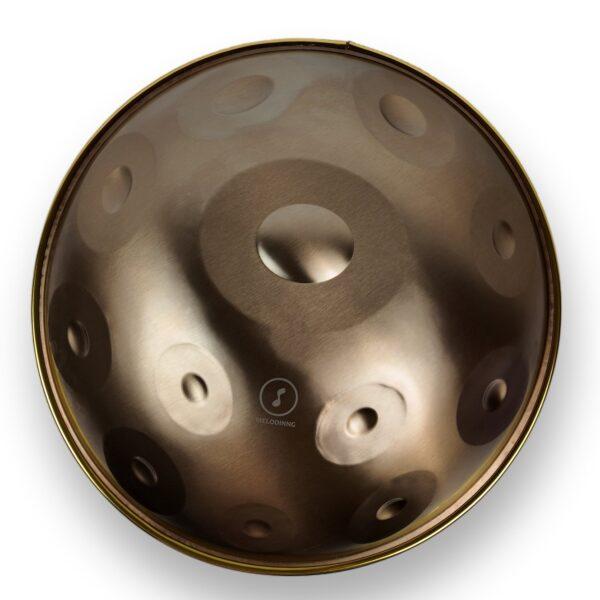
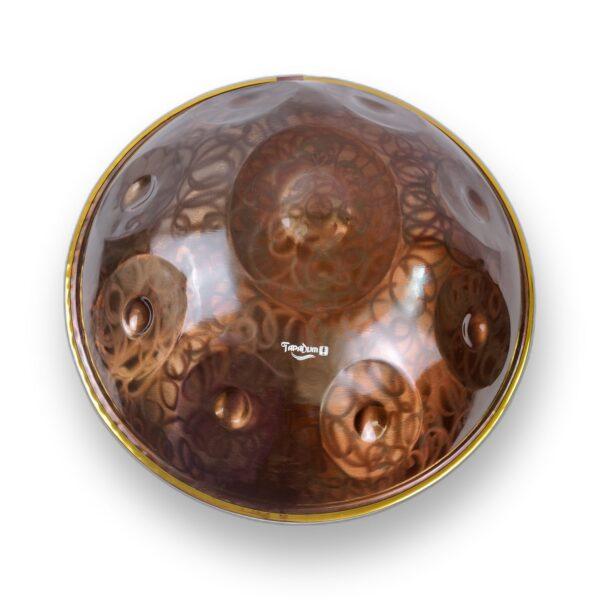
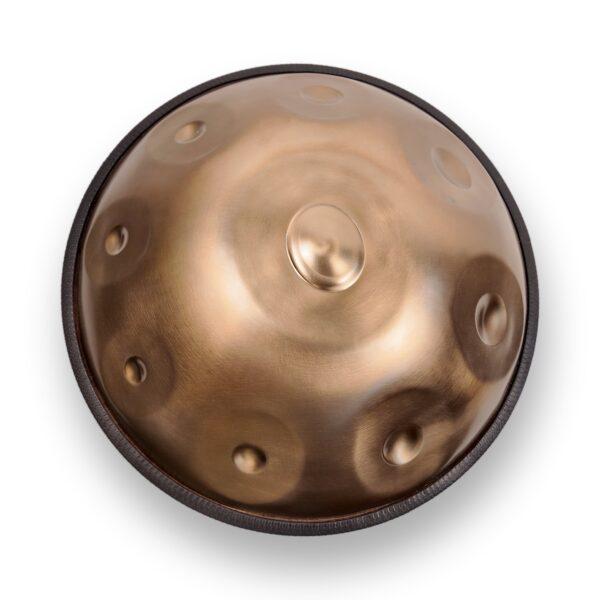
A wider look at the instruments we build and curate for this work:
Frequently Asked Questions
What is a handpan?
A handpan is a steel melodic percussion instrument shaped like a dome and played with the hands. A central low note — the “ding” — is surrounded by a ring of tuned tone fields, and the whole instrument is tuned to one scale. You will also see it called a pantam.
Is the handpan good for sound healing?
It is one of the most used instruments in the practice, for practical reasons: long sustain, dense overtones, a fixed scale that makes wrong notes impossible, and a wide quiet dynamic range. Those qualities produce the continuous, unhurried texture sound baths are built on. That is a description of what the instrument does, not a medical claim.
Do I need musical training to use one in therapy?
No. Because the instrument is tuned to a single scale, simple intuitive patterns are usually more effective in this context than complex playing. What does need training is the therapeutic side — holding a room, working with what comes up, and knowing the limits of your own scope. The music is the easy half.
Which handpan scale is best for meditation?
There is no single best scale. Minor and modal scales are the most common choice because their emotional colour suits introspective work, and D Kurd — a D minor scale — is far and away the most popular starting point. Choose the colour that fits the work you actually do rather than the one described as most “healing”.
Can I use a handpan in yoga classes?
Yes, and it is one of the most common uses. It suits yin, restorative and slow flow classes, and savasana in particular. It works alone or layered with singing bowls, gongs and flutes. Keep the playing simple — a yoga class needs a floor under it, not a performance on top of it.
How do I look after a handpan used in sessions?
Keep it in a dry, temperate place, wipe fingerprints and moisture off with a soft cloth after playing, and apply a light protective oil if the maker recommends one for that surface. Store and travel with it in a proper case. Dents change the tuning, and moisture is the main enemy of nitrided and carbon steel surfaces in particular.

[…] For a more careful separation between musical experience and health claims, read our guide to handpan meditation and sound therapy. […]
[…] any special frequency, as research on group drumming and stress shows, and as players who use the handpan for meditation […]