Buzuq
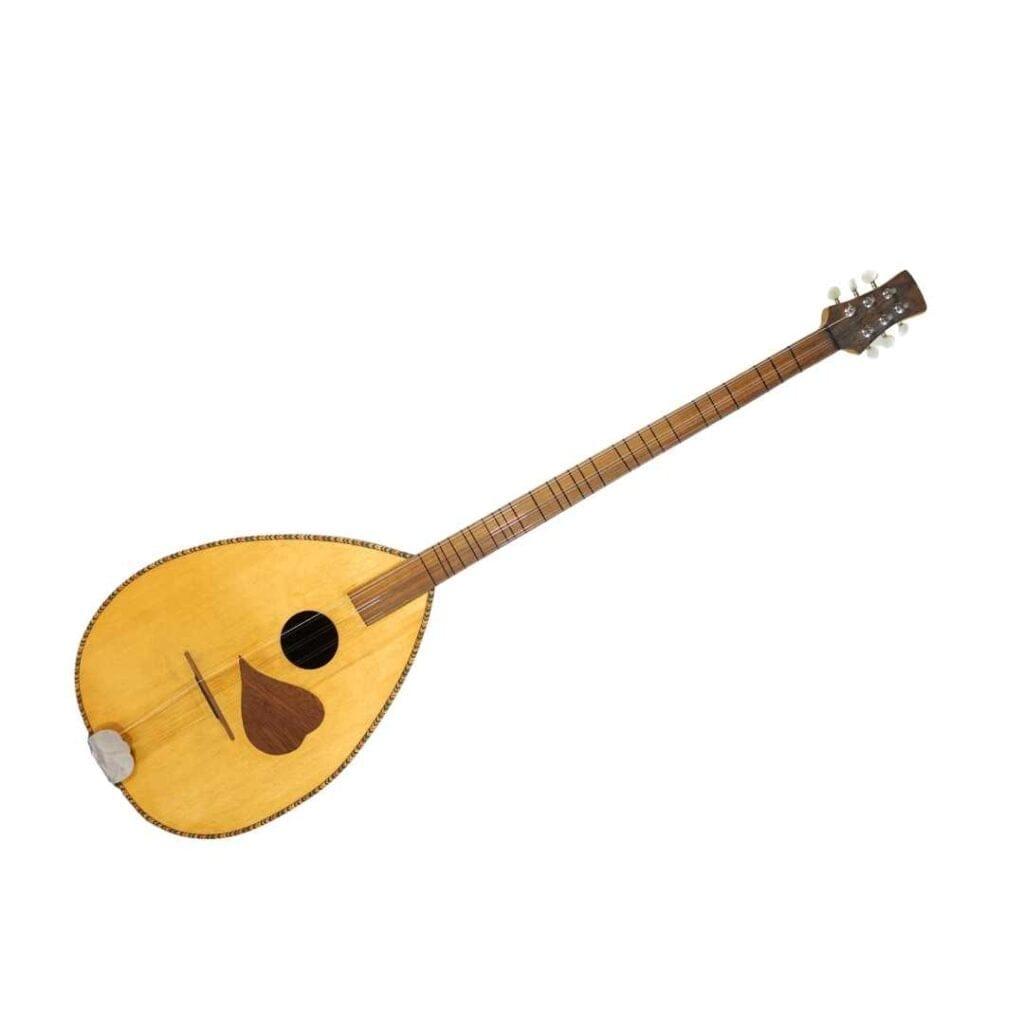
The buzuq is a long-necked fretted lute at the heart of Kurdish and Arabic musical traditions, prominent across the Levant — a larger, deeper-voiced relative of the Anatolian saz. Its long neck, metallic strings, and movable frets give it a bright, sustaining voice built for the microtonal language of maqam, at home in both traditional repertoire and contemporary performance.
Construction follows the saz-family pattern. The carved body is built from mulberry or walnut, paired with a long neck carrying movable tied frets — repositionable along the neck for the precise quarter-tone intervals that maqam practice demands. The instrument is strung with three courses of metal strings, and the pairing of a deep body with bright metallic strings produces the characteristic ringing sustain and drone-like resonance that define its voice.
The buzuq is played with a plectrum, driving rapid melodic runs and the shimmering articulation typical of Levantine and Kurdish repertoire. Standard tuning is D–A–D, and the movable frets let the player shift between maqam modes and colour individual notes with microtonal inflection. A full-size instrument measures roughly 100 × 35 × 25 cm and weighs about 4.3 kg.
The buzuq carries the melodic line in Levantine song and Kurdish instrumental music, equally suited to solo improvisation (taqsim) and ensemble accompaniment. Within the wider string instruments family it sits close to the fretless oud as a fretted maqam voice, and shares both its name and D–A–D tuning with the Greek bouzouki — a related but distinct Mediterranean lute.
At Tapadum, the buzuq is built in-house at the Tapadum Strings & Percussion Workshop in Izmir. Each instrument passes individual quality control — fret positioning, neck stability, string response, and tonal balance — with our string instruments specialist Sertan Sarioglu before shipping from our Brisighella, Italy showroom.
Frequently Asked Questions
What is a buzuq?
How is the buzuq tuned?
What is the difference between a buzuq and a Greek bouzouki?
What should I look for when choosing a buzuq?
Is the buzuq fretted, and how is it played?