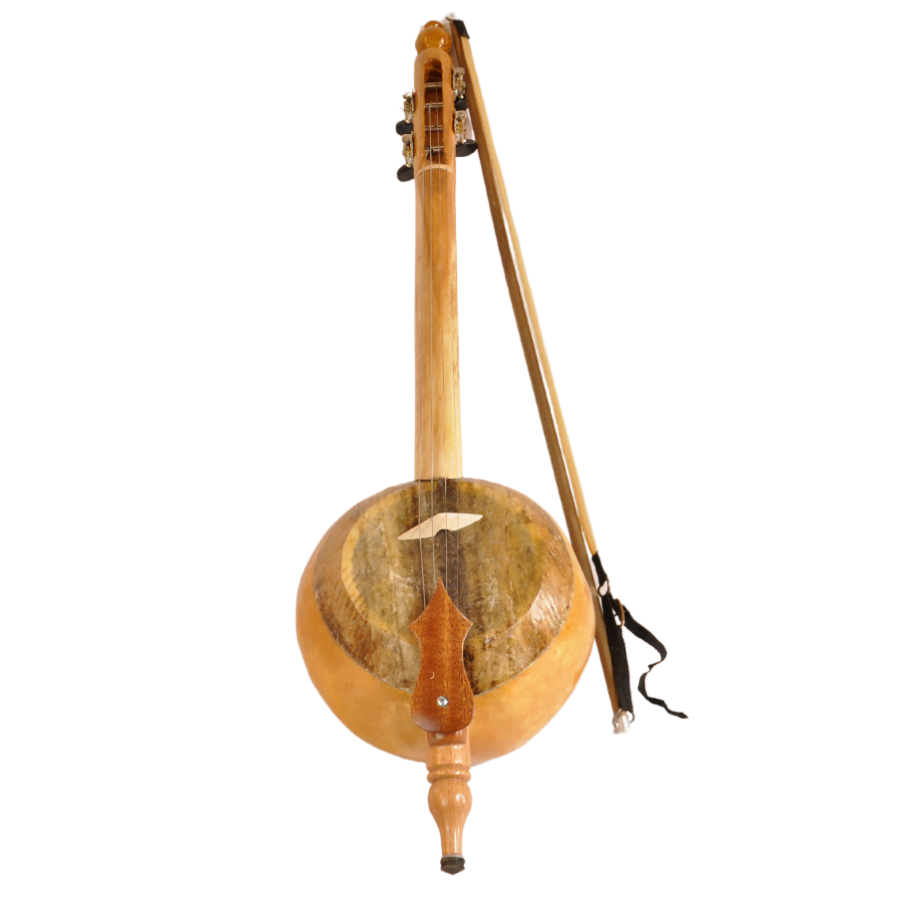
Kabak Kemane
The kabak kemane is the gourd-bodied spike fiddle of Anatolian folk music — kabak means gourd in Turkish. A dried, hollowed gourd forms the body, its open face is covered with a thin animal-skin membrane that acts as the soundboard, and a long fretless neck carries three metal strings. The player rests the instrument upright on the knee and sounds it with a horsehair bow, turning the instrument toward the bow to change strings.
Older instruments were strung with gut; today’s makers fit steel strings. Because the neck has no frets, every pitch comes from finger placement alone — which is how the slides, bends and microtonal steps of Turkish folk melody are played. The kabak kemane is closely tied to the folk music of the Aegean and Teke regions, and its light gourd body makes it as much at home at a village gathering as on the concert stage.
Our Traditional Turkish Kabak Kemane has a gourd body of about 30 cm across, a skin membrane (traditionally cattle pericardium) and three metal strings, and it ships with a horsehair bow and a gig bag. It suits intermediate and advanced players most naturally; a committed beginner with a good ear can start on it too.
Each instrument is made by hand, so availability changes. If the kabak kemane is not in stock when you visit, write to us and we will tell you when the next one is expected. Read our guide to the kabak kemane, compare it with the classical kemence of Ottoman art music, or browse all our bowed instruments. Worldwide shipping & 15-day return.
Frequently Asked Questions
What is a kabak kemane?
How many strings does a kabak kemane have, and what are they made of?
Is the kabak kemane hard to learn?