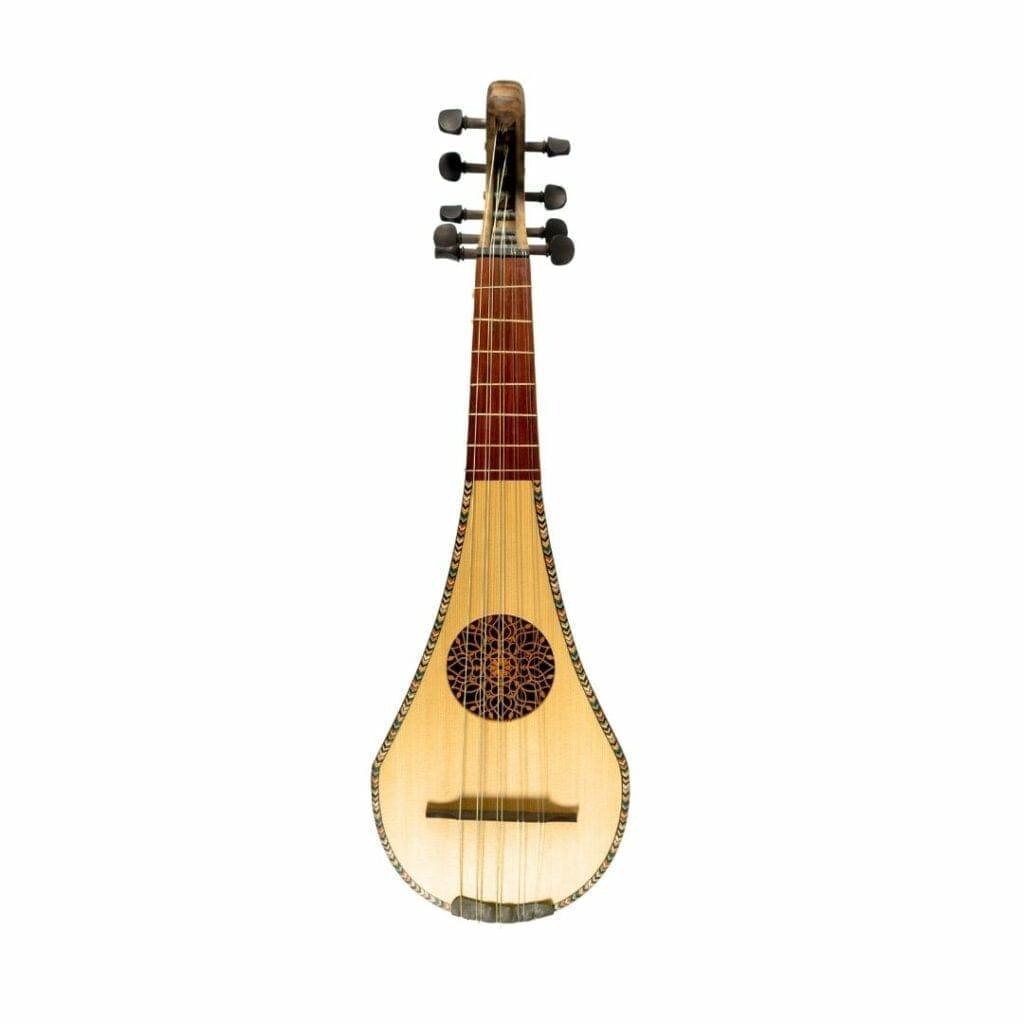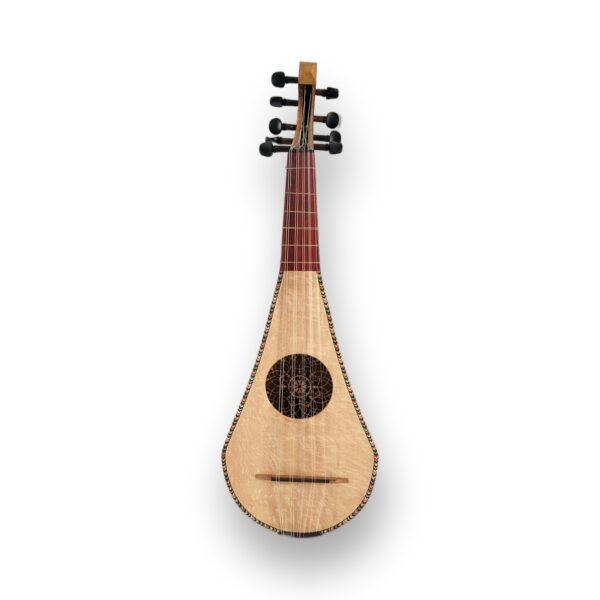
Gittern
The gittern is a small, carved-body plucked lute from medieval Europe — one of the ancestors of the Renaissance guitar and a close cousin of the wider lute family. Widely played between the thirteenth and sixteenth centuries, it carried the secular music of the medieval and Renaissance courts: dance tunes, troubadour songs, and the lively instrumental repertoire of minstrels and travelling players. Its bright, resonant gut-string voice and compact size made it a favourite of both street performers and courtly ensembles.
Construction follows the early-lute tradition. The rounded, pear-shaped back is carved from a single block of hardwood rather than built up from staves, joined to a flat wooden soundboard and a short neck. The instrument is strung with gut and plucked with a quill or plectrum for clear single-line melody and chordal accompaniment, its modest body giving a quick, articulate response well suited to fast medieval dance figures.
The gittern is typically strung with four to six strings — traditional gut or modern lute strings — set up for the diatonic and modal melodies of early-music repertoire. Tuning varied by region and period with no single standard, the player setting the instrument to suit the dance and song forms of the day. The right hand drives melody and rhythmic strumming with a quill, while the left navigates the short neck for the ornamented lines characteristic of medieval and Renaissance playing.
Today the gittern belongs to early-music ensembles, historical reenactment, Renaissance fairs, and the repertoire of players exploring medieval and Renaissance song. As a member of the lute family — the same tradition that reached Europe through the Arabic oud — it can even be strung with oud strings, and it sits naturally alongside the other plucked lutes within the wider string instruments family.
At Tapadum, our Medieval Gittern is hand-carved to order — an elm body paired with a spruce soundboard and an afromosia fretboard, strung with four to six gut or oud strings (string length 45 cm, total length 67 cm, body 22 × 12 cm, 2.5 kg). Built for early-music players, collectors, and historical reenactment, each instrument passes individual quality control — carving integrity, string action, and tonal balance — with our string instruments specialist Sertan Sarioglu before shipping from our Brisighella, Italy showroom.
Frequently Asked Questions
What is a gittern?
How many strings does a gittern have?
How is a gittern played?
What is the Tapadum gittern made of?