Persian Kamancheh
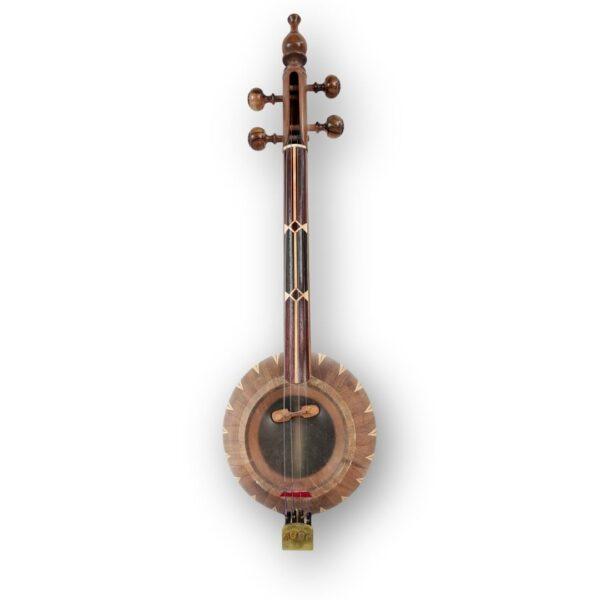
The Persian kamancheh is the bowed spike fiddle of Persian classical music. A small spherical bowl carved from hardwood is closed with a stretched natural skin membrane, a metal spike passes through the bowl to rest on the player’s knee, and four strings run over a wooden bridge standing on the skin. The player holds the bow hair beneath the hand and turns the instrument itself to reach each string. Because the skin answers every change in bow pressure, the kamancheh has a breathing, voice-like tone.
In Persian classical music the kamancheh carries the modal melodies of the radif and the dastgah system with long bow strokes and fine ornamentation. It is also played in Lori folk music, in Azerbaijani mugham, and in contemporary fusion.
Our collection currently includes three kamanchehs:
- Lori Kamancheh — handmade in the Lori regional style of western Iran, with a carved hardwood bowl, a natural skin membrane and a slightly larger resonator than the urban Tehran kamancheh.
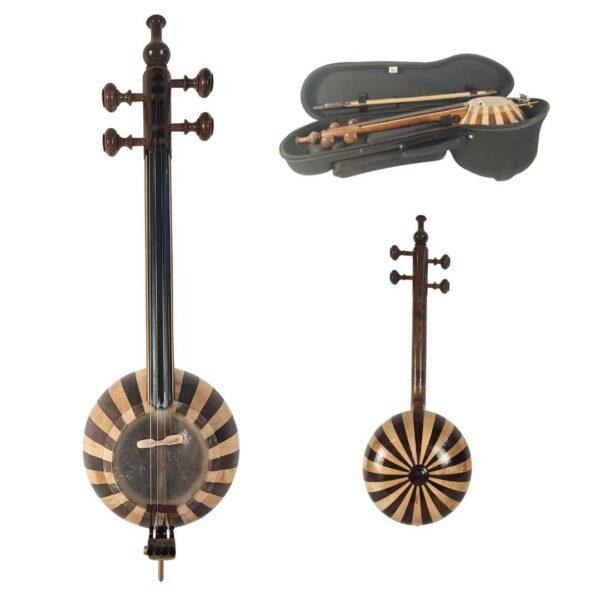
- Professional Persian Kamancheh by Bajalavand — a mulberry bowl with maple inlay, a lamb-skin head and a brass tailpiece with fine tuners; about 70 cm long with a 34 cm string scale, supplied with a hard case.
- High Quality Persian Kamancheh by Hatami — handmade by Iranian luthier Hesam Hatami, supplied in a fitted hard case.
Every kamancheh in our collection comes with a horsehair bow. The fretless neck and upright bowing ask for a developed ear and bow control, so players with some violin or cello background progress fastest, though a committed beginner can start here. Explore all our bowed instruments, or the Persian setar, its plucked relative in the classical ensemble. Worldwide shipping & 15-day return, with every instrument checked at our Brisighella, Italy showroom before it ships.
Frequently Asked Questions
What is a Persian kamancheh?
What is a Persian kamancheh made of?
How big is a Persian kamancheh?
Which kamancheh model should I choose?
Does the kamancheh come with a bow?
Is the kamancheh hard to learn?