Bouzouki (Greek)
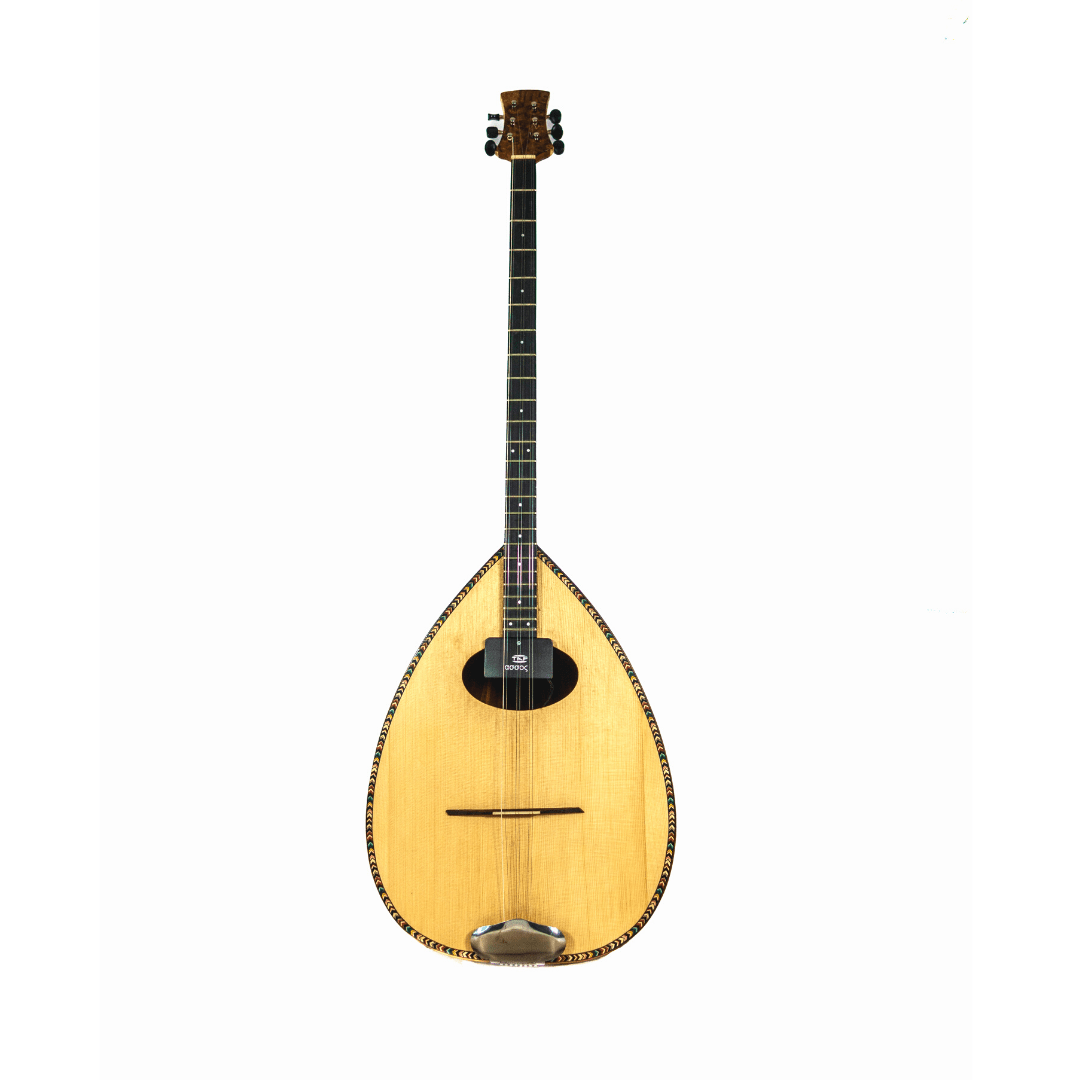
The Greek bouzouki is a long-necked plectrum lute central to rebetiko, laiko, and contemporary Greek music — a Mediterranean lute family member with a deep, sustained voice and a signature tremolo articulation that defines its melodic identity. Modern bouzoukis use three- or four-course string layouts, played with a tortoise-shell or plastic plectrum across rapid melodic passages and chord arpeggios.
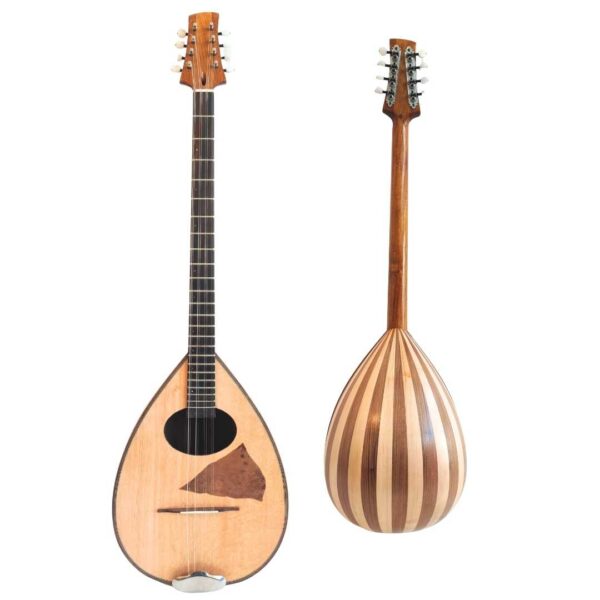
Construction uses a deep, staved pear-shaped bowl built from walnut, mulberry, or maple, paired with a spruce soundboard for projection. The long fretted neck — typically with twenty-six fixed frets — supports precise diatonic intonation across the bouzouki’s two- to two-and-a-half-octave range. Soundholes are often decorated with traditional Greek motifs, and the instrument body is finished with hand-applied lacquer for warm, balanced resonance.
Three-course bouzoukis carry six strings (three doubled courses) tuned D-A-D — the classic rebetiko voicing used by early masters like Markos Vamvakaris. Four-course bouzoukis carry eight strings (four doubled courses) tuned C-F-A-D — the modern voicing adopted by contemporary Greek classical and crossover players. The right hand drives tremolo articulation, while the left navigates the long neck for fast melodic runs.
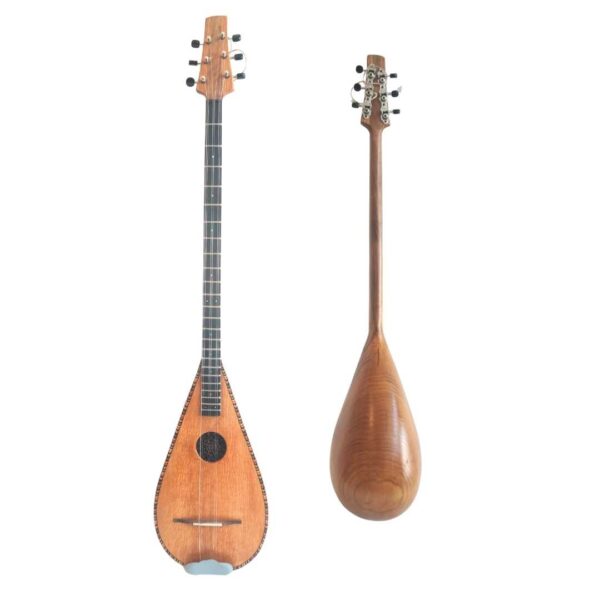
The rebetiko family — three sizes — This category also covers the bouzouki’s two smaller relatives, and what separates them is scale and register rather than technique. The tzouras is smaller than a bouzouki and higher in pitch, keeping the same long slender neck and staved bowl. The baglamadaki (or baglamas) is the smallest member of all, traditionally carved with a one-piece soundbox and neck — the pocket-sized voice of early rebetiko. All three take a plectrum and share the family’s tremolo articulation.
The bouzouki sits at the center of rebetiko (urban Greek folk), laiko (popular song), and contemporary Greek classical and fusion repertoire. Its bright sustain and tremolo voice make it equally suited to solo improvisation, song accompaniment, and ensemble work — including crossover projects with neighbouring Mediterranean lutes such as the Turkish lavta within the wider string instruments family.
At Tapadum, our string instruments specialist Sertan Sarioglu tests every curated bouzouki for tuning stability, neck geometry, and tonal projection across both three- and four-course models before listing. Each instrument ships from our Brisighella, Italy showroom.
Frequently Asked Questions
What is the difference between a bouzouki, a tzouras and a baglamadaki?
Should I choose a three-course or a four-course bouzouki?
What woods are used in a Greek bouzouki?
What is the tremolo technique on the bouzouki?
Is the bouzouki suitable for a beginner?
How much does a Greek bouzouki cost?
Where can I buy a Greek bouzouki?