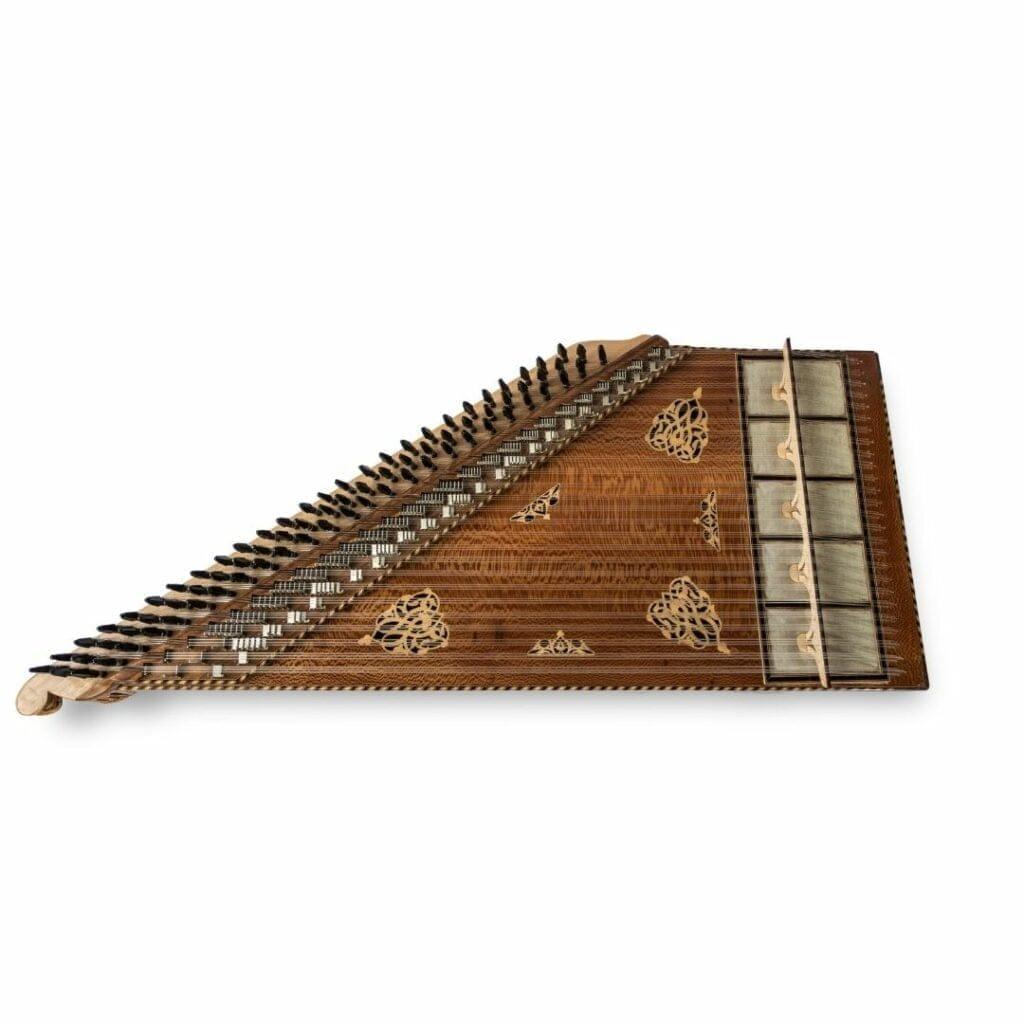
Qanun
The qanun is a plucked trapezoidal box zither at the heart of Turkish (Türk sanat müziği) and Arabic (tarab) classical music — an instrument whose fan-shaped span of strings and signature mandal lever system give it both a shimmering, harp-like resonance and the microtonal precision that makam performance demands. Where the struck santur is sounded with mallets, the qanun is plucked — a melodic and accompaniment voice equally at home in solo improvisation and large ensemble work.
Construction follows the classical trapezoidal pattern. A wide wooden frame carries a thin soundboard — traditionally combining timber with small parchment (fish-skin) windows beneath the bridge feet that shape the instrument’s bright attack. The strings run in tight parallel courses, most often three strings to a course across roughly twenty-six courses, stretched from the angled side over a long bridge that rests on the resonating soundboard. The player sits with the instrument flat on the lap or on a stand, the trapezoid angling away to the right.
The defining feature is the mandal system — rows of small metal levers mounted along the bridge end of each course. Flipping a mandal raises or lowers that course by a precise microtonal step, letting a player move between makam modes such as Rast, Hicaz, Nihavend, and Saba mid-performance without retuning a single string. The qanun is played with two plectra (mızrap) fitted to metal rings on the index fingers, drawing rapid melodic runs, tremolo, and the cascading arpeggio figures that define its voice. Standard tuning follows Turkish classical convention and accommodates Arabic systems through the mandals.
The qanun sits at the centre of fasıl and tarab ensemble work, vocal accompaniment, and solo taksim improvisation across Turkish and Arabic classical repertoire. Its harmonic resonance and instant modal flexibility make it a natural partner to plucked lutes such as the oud and to its struck cousin the santur within the wider string instruments family. For a deeper introduction, read our guide to the qanun’s voice in Middle Eastern music.
At Tapadum, our qanun is a concert-grade Turkish instrument handcrafted to order by master luthier Ozgur Gurbuz, a qanun specialist who carries forward a family craft as the son of Necati Gurbuz — the veteran Izmir luthier who has built ouds, classical kemence, and qanun since the early 1980s. The instrument pairs a plane-wood soundboard set in a maple frame with cranberry-wood tuning pegs, a maple bridge inlaid with mahogany marquetry, and mahogany side embroidery (105 × 55 × 20 cm, 5.1 kg). Built for serious performers and dedicated students of Turkish and Arabic classical music, each qanun passes individual quality control — string tension, mandal action, and tonal balance across the courses — with our string instruments specialist Sertan Sarioglu before shipping from our Brisighella, Italy showroom.
Frequently Asked Questions
What is a qanun?
How does a qanun play quarter tones?
What is the difference between a qanun and a santur?
Who builds the qanun sold at Tapadum?