
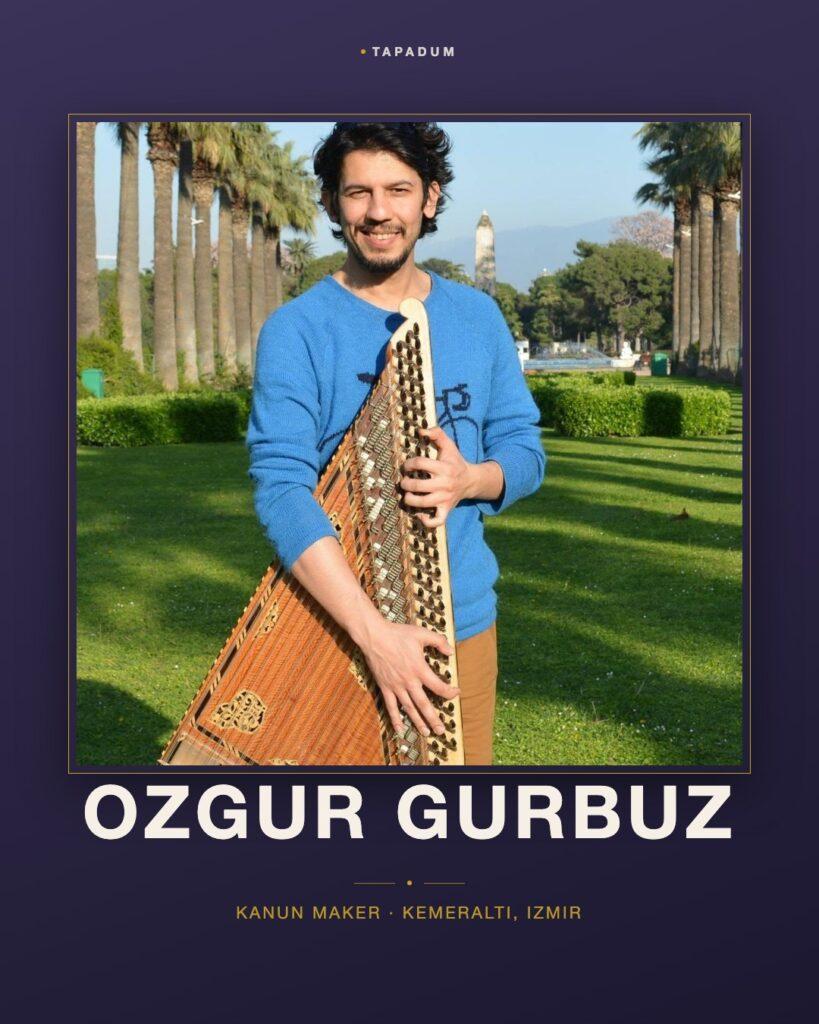
Luthiers · Kemeralti, Izmir
Ozgur Gurbuz
Kanun Maker & Multi-Instrumentalist
Second-generation Izmir luthier — son of master oud maker Necati Gurbuz, Ege Conservatory instrument-making graduate (2004), designing kanuns from his Kemeralti workshop. Multi-instrumentalist (kanun, igil, hömey vocals), composer of polyphonic maqam works, and music therapist.
Ozgur Gurbuz designs kanuns from a workshop on Kestelli Caddesi in Izmir’s historic Kemeralti bazaar — only a few streets from his father Necati Gurbuz‘s bench. He grew up inside the trade, watching ouds, kemence, and qanun take shape in his father’s hands, then formalised it: graduating from Ege University State Turkish Music Conservatory’s instrument-making programme in 2004, he became the second-generation maker in a family lineage that already ran four decades deep.
The qanun — the 78-string trapezoidal psaltery at the heart of Turkish classical music — sits at the centre of his work, but Ozgur is unusual among contemporary qanun makers in being himself a serious player and composer. Music education began in 1999 at Ege Conservatory; conservatory years gave way to six years in Istanbul, where he played the city’s street and stage circuits. He toured with Sinbad Turkish Band, La Mekan, Tatva Ensemble, and Ebren Duo, and gave concerts alongside Armenian duduk master Suren Asatryan.
His curiosity for healing traditions and improvised music drew him eastward. In 2010 he travelled to Xinjiang, China, where he worked as a studio musician on Uyghur music recordings. Returning to Anatolia, he developed a personal ten-finger technique for the qanun and built a body of nearly fifty polyphonic maqam compositions — a Western harmonic vocabulary applied to traditional Turkish microtones. His album Yıldız Tozları (Stardust) with Ebren Trio gathers some of this work; he currently performs with Ebren Trio and the Şinadika ensemble.
Beyond the qanun, Ozgur is a multi-instrumentalist with a particular focus on Central Asian traditions: he plays the igil — a two-stringed bowed lute from the Altay region — and practices hömey, the Central Asian polyphonic throat-singing technique that produces multiple pitches simultaneously from a single voice. The thread that runs through these instruments is harmonic: the qanun’s pitched plectra, the igil’s drone-and-melody pairing, and hömey’s overtone layering all explore how multiple voices can coexist in a single sound.
Music therapy is the natural extension. Drawing on his own research into how sound and music affect human physiology and psychology, Ozgur runs individual and group therapy sessions that combine vocal harmonic work, improvisation, and learning-resistance techniques — including NLP and hypnotic methods adapted from his teaching practice. He teaches qanun, composition, music theory, solfège, and songwriting to students from beginner to conservatory level, adapting the curriculum to each student’s resistance points rather than fitting them to a standard syllabus.
For Tapadum, the result is a second-generation lineage: Necati’s classical luthiery on oud, kemence, and qanun, carried forward by a son who builds the qanun he himself plays on stage. Each Ozgur Gurbuz kanun leaves Izmir already shaped by the hands of someone who knows exactly what the instrument will be asked to do.
