Santur - Hammered Dulcimer
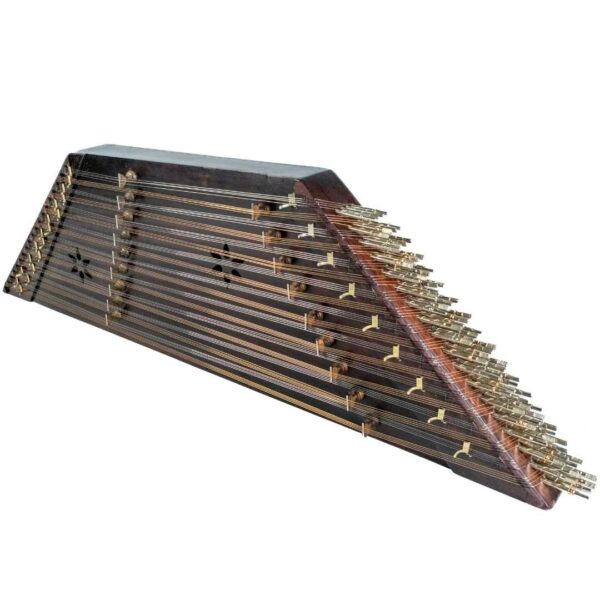
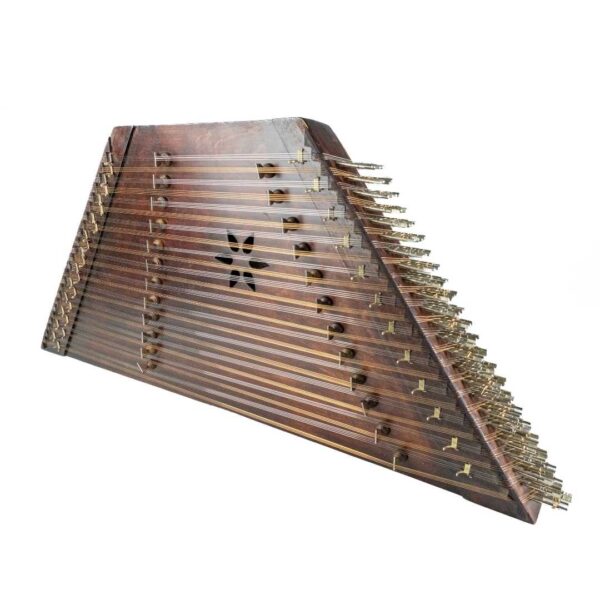
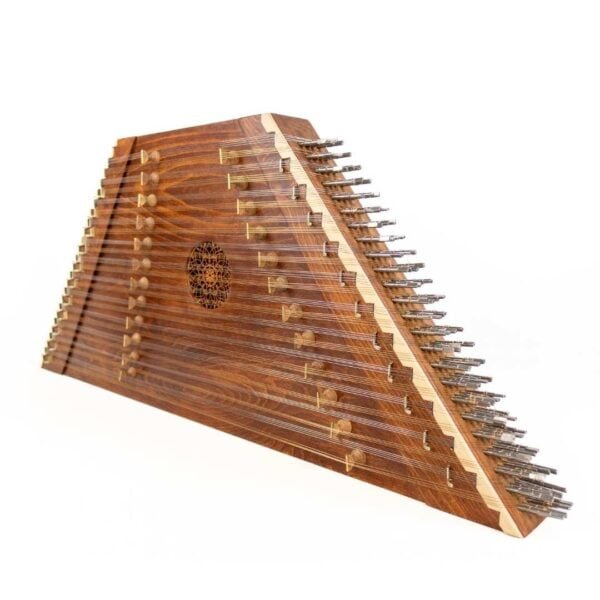
The santur is a struck-string trapezoidal dulcimer with deep roots in Persian classical music — and a sister instrument across Greek, Turkish, Indian, European, and East Asian traditions where it appears under names such as cimbalom (Romania), tympanon (France), salterio (Italy), hackbrett (Germany), and yangqin (China). Each variant carries distinct cultural nuance, but all share the foundational technique of strings struck by a pair of light wooden mallets.
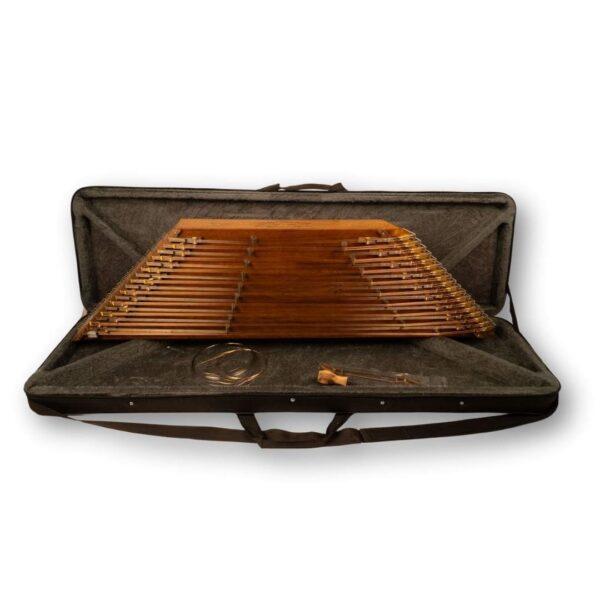
Persian santur construction uses a trapezoidal walnut or maple soundbox with a thin spruce soundboard. Strings — typically seventy-two in total, grouped in courses of four — run across two parallel sets of bridges, allowing each note to be played in two pitches by striking either side of the bridge. The mallets, called mezrab, are light wooden hammers held between the fingers, driving the rapid articulation and dynamic shading that define dastgah practice.
Traditional santur is a diatonic instrument — locked to a specific tuning system, with key changes requiring laborious retuning of individual strings. Tapadum carries two innovation variants that overcome this limitation. The Special Santur with Sharping Levers integrates Celtic harp–style mechanical levers, allowing each note to be shifted by a half-tone instantly — opening rapid key changes within a single piece. The Special Santur with Mandal goes further: each string carries a sliding adjustment mechanism that allows full-tone changes and microtonal positioning, with the mandal stopping at any desired pitch — supporting the full quarter-tone vocabulary of Persian dastgah practice without retuning.
The santur sits at the heart of Persian classical dastgah and avaz repertoire, alongside related traditions across Greek (santouri), Turkish, and Indian (santoor) classical music. Solo taksim improvisation, vocal accompaniment, and ensemble work all draw on the santur’s harmonic resonance and articulation range — making it a versatile partner to plucked lutes such as the qanun within the broader string instruments family.
At Tapadum, our Persian santur curation draws on multiple Tehran-tradition makers — including Behrad & Zolani, Persa, and Alavi — alongside in-house builds from the Tapadum Strings & Percussion Workshop in Izmir. Each instrument passes individual quality control — tuning stability, bridge geometry, mezrab response — with our string instruments specialist Sertan Sarioglu before shipping from our Brisighella, Italy showroom.
Frequently Asked Questions
What is a santur?
How is the santur tuned?
What music styles use the santur?
What is the difference between Persian, Turkish, and Indian santur?