
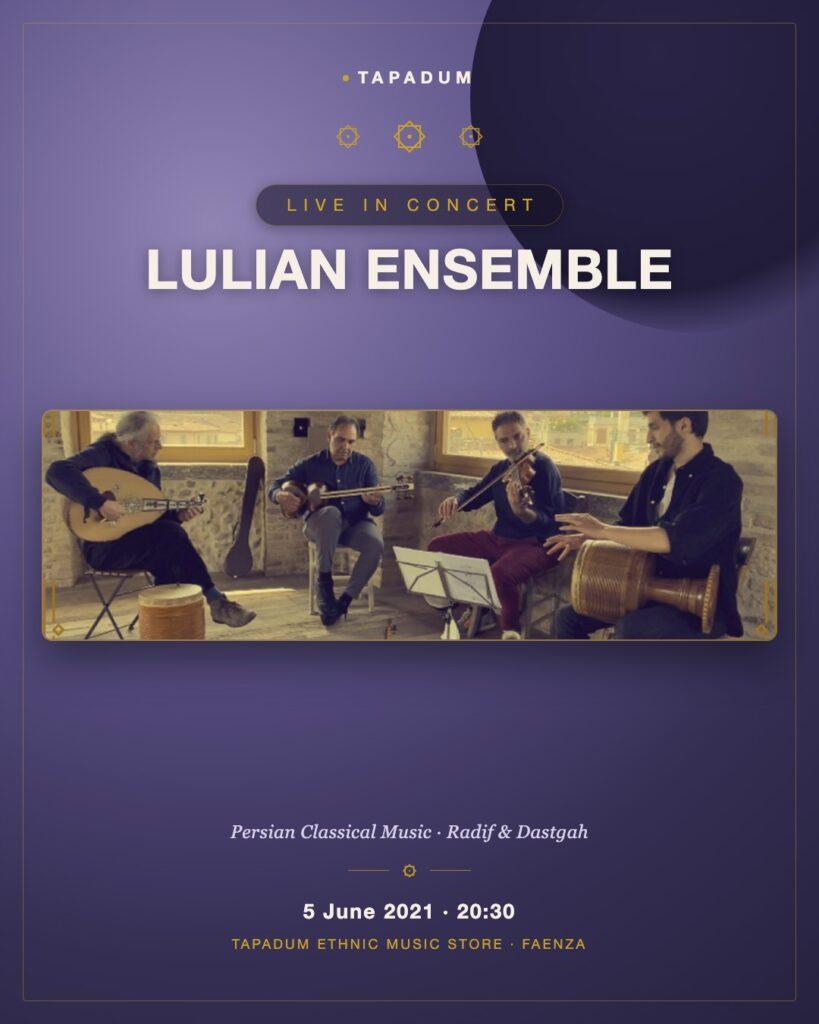
Lulian Ensemble: An Evening of Iranian Classical Music
On 5 June 2021, the four-piece Lulian Ensemble brought Iranian classical music to Tapadum in Faenza — tar, setar, daf, oud, and tombak weaving the Persian radif and dastgah tradition.
June 5 brought something rare to our home concert space: a full evening of Iranian classical music, performed on instruments that most of our audience had never heard played live.
Fourteen people came. The room was quiet in the way that only happens when people are genuinely listening.
Lulian Ensemble: Iranian Classical Music in Romagna
The Lulian Ensemble brought together four musicians united by a shared immersion in the Persian classical tradition — its modal framework, its instruments, its particular relationship between melody, rhythm, and silence.
The lineup:
- Darioush Madani — tar, setar, daf
- Fabio Tricomi — oud, tombak
- Alessandro Urso — violin
- Salar Khalilnasab — tombak, vaso, half calabash
The Instruments
The instrument list deserves attention, because each one carries its own world.
The tar is a long-necked plucked lute at the heart of Persian classical music, with a distinctive double-bowl body and a skin soundboard that gives it a warm, slightly nasal resonance. Its smaller sibling, the setar — literally “three strings,” though modern versions have four — has a quieter, more intimate sound, traditionally associated with private and meditative playing.
The daf, which Tapadum audiences had already encountered in Darioush Madani’s workshop the previous month, appeared here in its proper ensemble context — no longer an object of study but a voice within a larger musical conversation.
Fabio Tricomi played both oud and tombak — moving between the plucked melody of the Arab-Turkish lute and the Persian goblet drum that provides the rhythmic backbone of Iranian classical music. Alessandro Urso‘s violin entered the Persian classical tradition through the same path many string players have followed: the violin was adopted into Iranian music in the nineteenth century and has been fully absorbed into the classical system, played in a way that is entirely distinct from both Western classical and folk approaches.
Salar Khalilnasab completed the rhythmic section with tombak, vaso, and half calabash — the last two being resonant vessels used as percussion instruments, producing a deep, woody tone that sits beneath the tombak’s articulate surface rhythms.
The Persian Classical Tradition
Iranian classical music is built on the radif — a vast repertoire of melodic material organised into modal frameworks called dastgah. Each dastgah carries its own emotional character, its own set of melodic phrases, its own gravitational centres. Performance within this tradition is not improvisation in the Western jazz sense, nor is it reproduction of fixed scores. It is something between the two: a deep knowledge of the material combined with real-time decisions about how to move through it.
The result, when it works, is music of extraordinary subtlety — capable of sustaining long stretches of quiet intensity before releasing into rhythmic passages that feel earned rather than imposed.
Darioush Madani: A Familiar Face
For those who had attended the daf workshop the month before, seeing Darioush Madani lead the ensemble gave the evening an additional layer. The instrument they had studied in practical terms now appeared in its full musical context — the daf not as a lesson but as a living voice within a complete musical language.
That continuity between workshop and concert is something we try to build at Tapadum. The instruments we sell and teach are the same instruments that appear on our stage. The knowledge is connected.
Tapadum hosts concerts and workshops from across the Mediterranean and beyond. Explore our Persian instrument collection or follow our upcoming events.
Özgür Yalçın is the founder of Tapadum and the founding member of Karagüneş. He has performed ethnic and world music across Europe for over twenty-five years and builds custom instruments from Tapadum’s workshop in Brisighella, Italy.