Persian Tanboor
The Persian Tanboor (also spelled tanbur or tanbour) is a sacred long-necked lute at the heart of Kurdish and Western Iranian devotional music. Revered as a sacred object in the Ahl-e Haqq (Yarsan) tradition of Kermanshah and Lorestan, it accompanies sacred hymns (zekr) and ceremonial repertoire — its sound long tied to meditation and spiritual connection. Counted among the instruments of the Sassanid court before Kurdish devotional communities adopted it as their chosen sacred instrument, the Tanboor is distinct from the Ottoman Turkish tanbur: a folk-sacred lute sounded with the bare fingers rather than a plectrum.
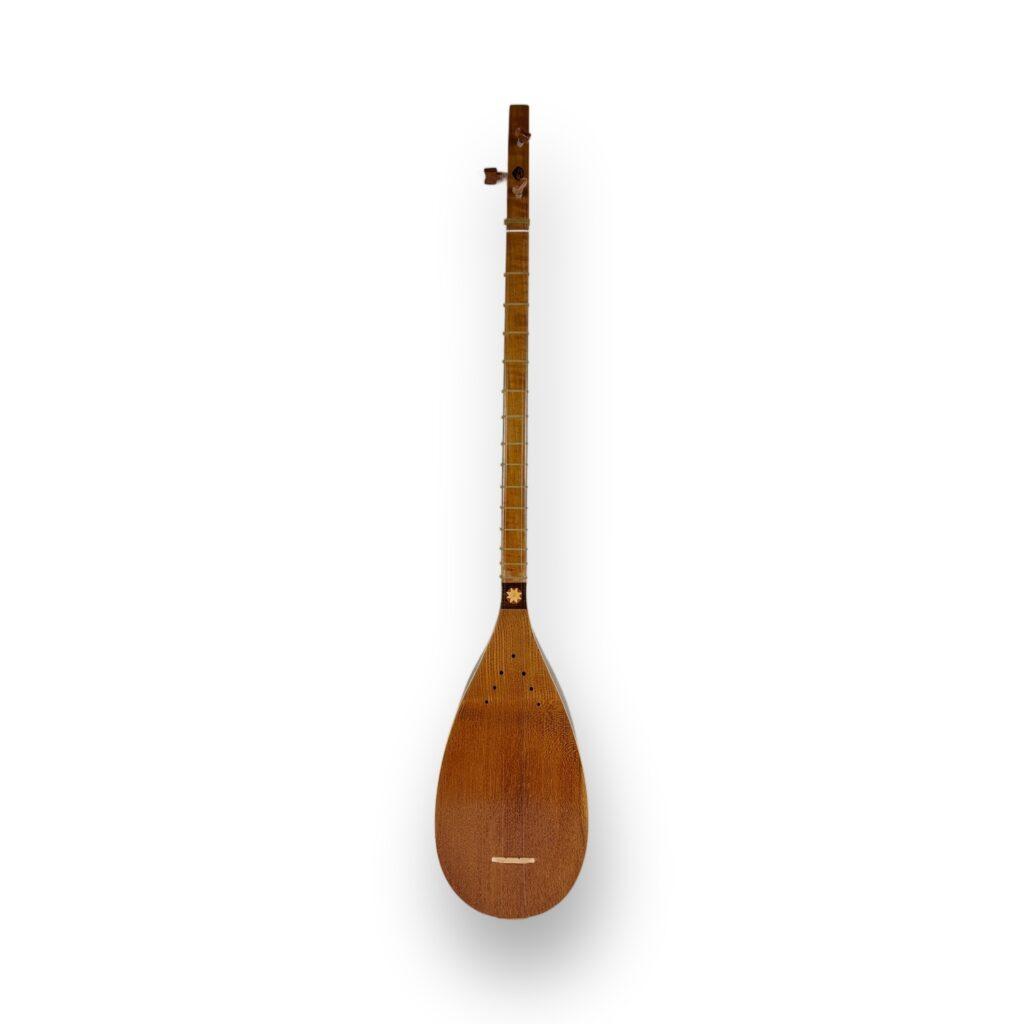
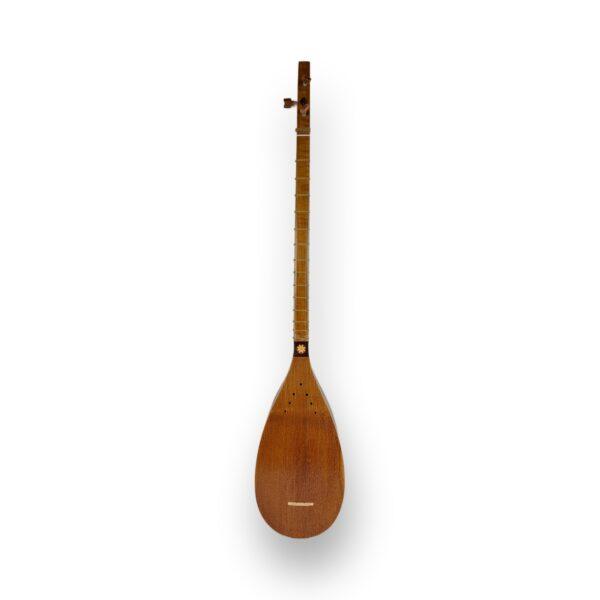
Construction follows centuries of regional practice. The pear-shaped body is built from aged mulberry wood — often from seven to ten glued ribs — with a mulberry soundboard pierced by small patterned sound-holes. A slender walnut neck carries fourteen tied gut frets arranged in a semi-tempered chromatic scale, supporting the microtonal modes of the sacred repertoire. A full-size Tanboor measures about 92 cm in total length, with a 71 cm scale and a bowl of roughly 36 × 19 × 16 cm.
Traditionally the Tanboor carried two strings. The twentieth-century master Ostad Elahi (1895–1974) added a third — the upper course often doubled — and developed the fluid five-finger right-hand technique known as shor, drawing a shimmering, continuous texture from the instrument. The lowest string sounds as a drone beneath the melody. Tuned in intervals such as fourths and fifths, the Tanboor speaks in a dry, ascetic sonority suited to its devotional role, and Ostad Elahi assembled a repertoire of over a hundred pieces still central to players today.
Within the wider string instruments family the Tanboor sits close to the Persian setar, which belongs to the same tanbur family of long-necked lutes, and the fretted Iranian tar. Our Persian Tanboor collection comes from Iranian makers — the Persian Tanboor by Zolghadr from the Tehran workshop of Mohammad Zolghadr and the Persian Tanboor by Mofakheri — each instrument selected for tonewood quality, fret accuracy, and structural stability.
Every Tanboor is checked for tuning stability, fret positioning, and string response by our string instruments specialist Sertan Sarioglu before shipping from our Brisighella, Italy showroom. Worldwide shipping & 15-day return.
Frequently Asked Questions
What is the Persian Tanboor used for?
How is the Persian Tanboor different from the Turkish tanbur?
What is the Persian Tanboor made of?
How many strings does a Persian Tanboor have?
How big is a Persian Tanboor?