
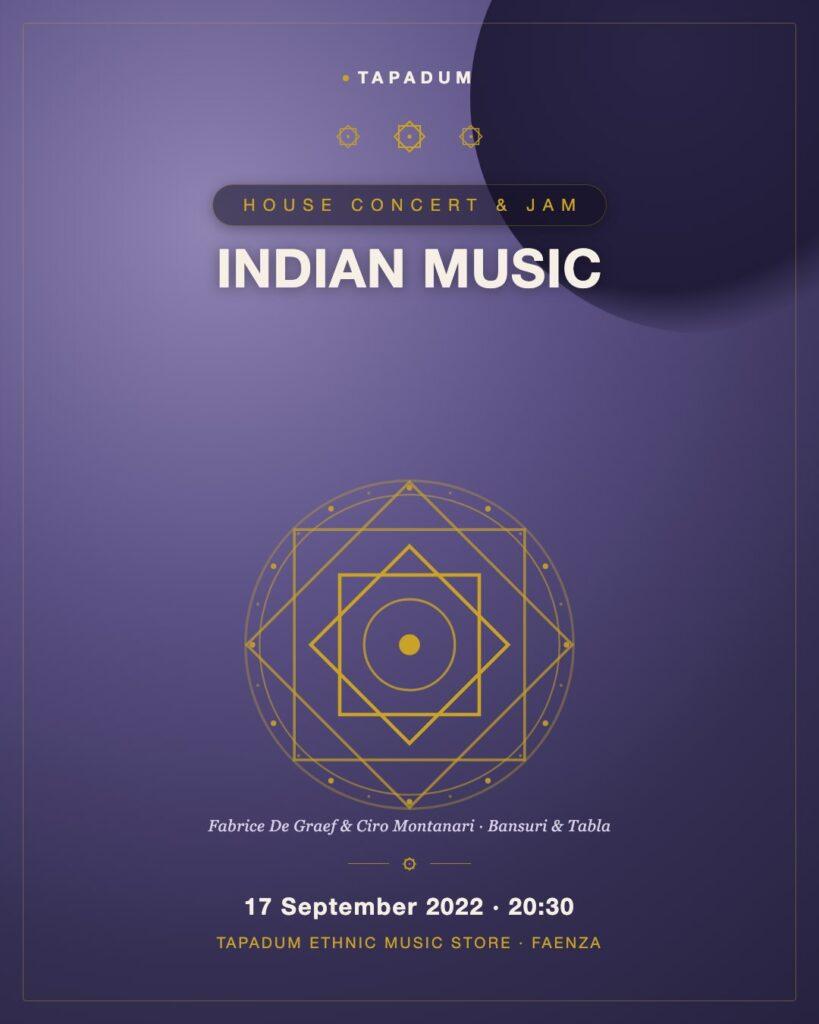
Indian Music at Tapadum: Fabrice De Graef and Ciro Montanari
On 17 September 2022, bansuri master Fabrice De Graef and tabla player Ciro Montanari brought Hindustani classical music to Tapadum in Faenza, opening the indoor season.
September 17 marked our return to indoor concerts after the summer — and we opened the new season with one of the finest pairings of Indian classical musicians we had hosted to date. Twelve people came. Forty-nine more had been thinking about it.
Aperitivo at 20:00, concert at 20:30, jam session at 22:00.
Two Musicians, One Tradition
The evening brought together Fabrice De Graef on bansuri and Ciro Montanari on tabla — two musicians whose paths into Indian classical music ran through years of direct study with the tradition’s greatest living masters.
Fabrice De Graef: One of the Few
Fabrice De Graef is one of the very few professional bansuri players in the Western world. Born in Paris to a classical pianist mother who trained at the École Normale, he began his musical life playing the bombarde alongside his grandfather — a devotee of Breton music — before entering the Conservatoire de Valenciennes to study classical oboe, where he would eventually graduate.
The path toward India began with a scholarship from the Indian government. What followed was nearly eight years of immersive study, living alongside the finest masters available: Hariprasad Chaurasia, the musician who elevated the bansuri from a folk instrument to a concert vehicle in the Hindustani classical tradition; Harsh Wardhan; and the legendary L. Subramaniam, one of the great bridges between Indian classical and Western music.
Fabrice is also one of the very few musicians to perform Celtic music exclusively on the bamboo bansuri — a crossover that reflects not novelty-seeking but a genuine dual immersion. He has spent extended time in Ireland, living close to traditional Irish musicians and absorbing that tradition from the inside.
The result is a musician of extraordinary range: Indian classical depth, Celtic folk fluency, Western conservatoire training — all channelled through a single bamboo flute.
Ciro Montanari: The Farrukhabad and Punjab Traditions
Ciro Montanari began studying tabla in 2003 with Matteo Scaioli in Ravenna, who introduced him to Pandit Sankha Chatterjee — a former professor at the Rabindra Bharati University in Kolkata whose own lineage connects directly to some of the twentieth century’s most important figures: Ustad Masit Khan, Ustad Keramatullah Khan of the Farrukhabad gharana, and Ustad Alla Rakha Khan of the Punjab gharana.
Ciro has travelled repeatedly to India, learning through the traditional guru-shishya approach, and has also studied in Germany and Italy — attending seminars at the Fondazione Giorgio Cini in Venice and working with the Narada Studio association. From 2005 to 2009 he completed the academic programme in non-European musical traditions at the Conservatorio Arrigo Pedrollo in Vicenza.
Since 2012 he has collaborated with the Labyrinth School of Music in Crete, founded by the celebrated musician Ross Daly — one of the world’s leading centres for modal musical traditions. From 2016 he has also been part of Labyrinth Italia, bringing that teaching to Italian students.
The Evening
Hindustani classical music in a small room has a particular quality. The raga unfolds slowly — alap, the unmeasured opening exploration of the modal framework, can last twenty minutes or more before the tabla enters and the rhythmic cycle begins. In a concert hall, that patience can feel like a demand. In a small room with twelve people who came specifically to listen, it feels like an invitation.
Fabrice’s bansuri opened the space. Ciro’s tabla arrived when the time was right. The music found its own tempo, its own direction. After the concert, the jam session gave everyone who had brought an instrument a chance to stay inside what the evening had created.
Tapadum hosts concerts and workshops from across the world. Explore our world instrument collection or follow our upcoming events.
Özgür Yalçın is the founder of Tapadum and the founding member of Karagüneş. He has performed ethnic and world music across Europe for over twenty-five years and builds custom instruments from Tapadum’s workshop in Brisighella, Italy.