
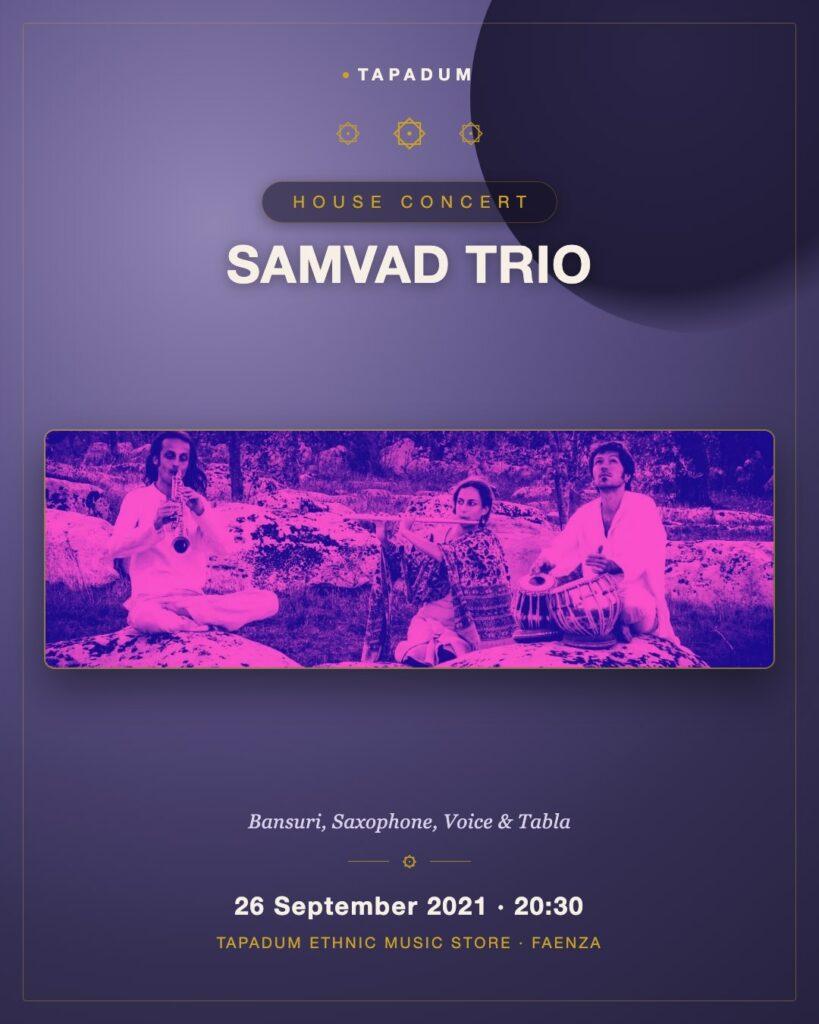
Samvad Trio: Bansuri, Voice, and Tabla at Tapadum
On 26 September 2021, the trio Samvad closed Tapadum's season in Faenza — bansuri, flute, saxophone, voice, and tabla in a dialogue between Indian classical music and Western contemporary sound.
September 26 closed our summer-autumn season with a duo that had been developing a quietly distinctive sound at the intersection of Indian classical music, Western contemporary practice, and ancient melodic material.
Seven people came. Thirty-four more had been thinking about it.
Samvad: The Dialogue
The name says it directly. Samvad means dialogue in Sanskrit — and dialogue is precisely what Igino Giovanni Brunori and Virginia Nicoli have built their musical practice around. A conversation between East and West, between ancient material and contemporary sound, between the microtonal precision of Indian classical music and the broader tonal world of Western flute and saxophone.
The lineup:
- Igino Giovanni Brunori — bansuri, voice
- Virginia Nicoli — traverse flute, saxophone, voice
- Ciro Montanari — tabla
What Makes Samvad Distinctive
Most ensembles that work at the intersection of Indian and Western music make the cultural distance visible — the joining of two separate worlds. What distinguishes Samvad is that the distance has collapsed. The material they work with is ancient, drawn from sources that predate the divisions between East and West that modern ears take for granted. Their attention to microtonal detail — the subtle inflections of pitch that define Indian classical music and that Western equal temperament systematically erases — gives the music a quality of precision and depth that is unusual in cross-cultural projects.
The bansuri carries the melodic weight on Igino’s side. The bamboo flute of North India, played here alongside voice, creates a layered texture in which breath and word share the same instrument. Virginia’s traverse flute and saxophone bring a different tonal world — cooler, more projective — that opens the music outward without losing its centre.
Ciro Montanari’s tabla grounds everything. The tabla’s rhythmic cycles — tala — provide structure without rigidity, a framework within which the melodic dialogue between Igino and Virginia can move freely.
Ancient Material, New Interpretation
Samvad’s particular approach is to take ancient melodic material — songs, modes, melodic fragments from traditions that have been moving across cultures for centuries — and find new interpretations that honour both the source and the present moment. The result is music that sounds neither archaic nor forced. It occupies its own time, its own space.
That quality is rare. It comes from what Igino and Virginia describe as deep attention to sound quality and the dialogue always present between them — not as a technique but as a practice, something cultivated through years of playing together.
Hear Samvad
A live recording that gives a sense of the trio’s sound:
Closing the Season
The Samvad Trio concert closed a remarkable run of events at Tapadum — from the first daf workshop in May through Yasmine, Lulian Ensemble, Rajasthani music, and Gianni Placido’s didgeridoo solo. Each evening had brought a different tradition into the same small space. Samvad, with its refusal to privilege either East or West, felt like an appropriate way to close the chapter.
Tapadum hosts concerts and workshops throughout the year. Explore our handcrafted instrument collection or follow our upcoming events.
Özgür Yalçın is the founder of Tapadum and the founding member of Karagüneş. He has performed ethnic and world music across Europe for over twenty-five years and builds custom instruments from Tapadum’s workshop in Brisighella, Italy.