
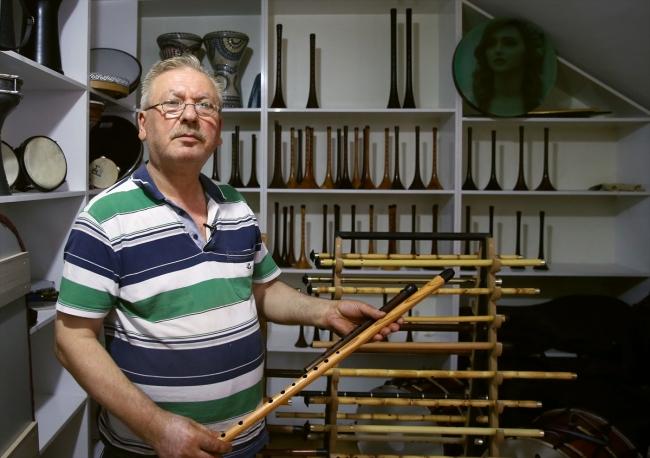
Luthiers · Istanbul, Turkey
Ali Riza Acar
Woodwind Instrument Master
Istanbul-based master of Turkish and Anatolian woodwind instruments — kaval, mey, duduk, zurna, ney — with five decades of craft.
Born into Istanbul’s woodwind tradition, Ali Riza Acar has spent roughly five decades shaping the Anatolian and Turkish wind family — kaval, mey, duduk, zurna, and ney — into instruments that breathe with the precision of a player who has known each shape since boyhood. His workshop, tucked into Istanbul’s craftsman district, supplies woodwind players across Turkey and beyond, and his name surfaces consistently in the small circle of makers whose work passes through both ceremonial repertoires and intimate solo recordings.
Ali Riza is the son of Düdükçü Nuri — “Nuri the Pipe-Maker” — a craftsman whose nickname itself records a life devoted to wind instruments. The Anatolian woodwind craft transmits father-to-son in a tradition where the shaping of a single kaval bore involves judgments no manual records: the warmth of the wood under the hand, the breath resistance at each finger hole, the millimeter-scale adjustments that separate a tuneable instrument from a stiff one. Ali Riza’s apprenticeship started in his father’s workshop and has shaped what is now a fifty-year practice, documented in the Turkish television feature İstanbul’un Zanaatkarları — Kaval Ustası Ali Rıza Acar, where he is identified as Ağaca nefes veren usta — “the master who breathes life into wood.”
Across his five instruments the acoustic logic shifts dramatically. The kaval is rim-blown — sound emerges from the player’s lip across a sharp edge, without a reed — and demands an internal bore precision that varies by a hair’s breadth between models meant for the Anatolian highlands versus those built for sufi sema repertoires. The mey and duduk are double-reed cylindrical pipes whose sound is shaped as much by the reed as by the body, with the duduk’s mournful sustained tones requiring a specific Armenian-Caucasian bore profile that Ali Riza has built across decades. The zurna is louder, conical-bore, ceremonial — historically the outdoor companion to davul drums. The ney is also rim-blown, without reed like the kaval, and carries the sufi devotional tradition’s most introspective voice. Five instruments, five different geometries; Ali Riza’s reputation rests on his ability to hold all five disciplines within a single workshop, a generalism rare even within the Istanbul maker scene.
Turkish national television has profiled his fifty-year practice in features such as Kanal 7’s “Ali Rıza Acar 50 Yıldır Kaval Üretiyor” — a career feature that traces his methods from raw wood selection through bore drilling and tuning. The documentary footage shows the workshop tools — a manual lathe, hand reamers, traditional measurement gauges — and the slow, patient method that has remained unchanged through the decades. His instruments have travelled far beyond Istanbul through retailer networks, but the workshop itself has remained a small, traditional space.
Tapadum carries Ali Riza Acar’s woodwinds as part of its Turkish and Anatolian wind selection, addressing the growing perception that buyers of these instruments increasingly seek the named maker rather than a generic product. Each Ali Riza piece arrives with the small variations that hand-making produces — a slight asymmetry in the embouchure cut, a personal signature in the bore profile — and these variations are now part of what gives the instrument its character. Players who want the recorded sound of Anatolia’s documentary heritage in their own hands will find these instruments part of an ongoing, living tradition.

