
Oud vs Guitar: A Guide for Guitarists
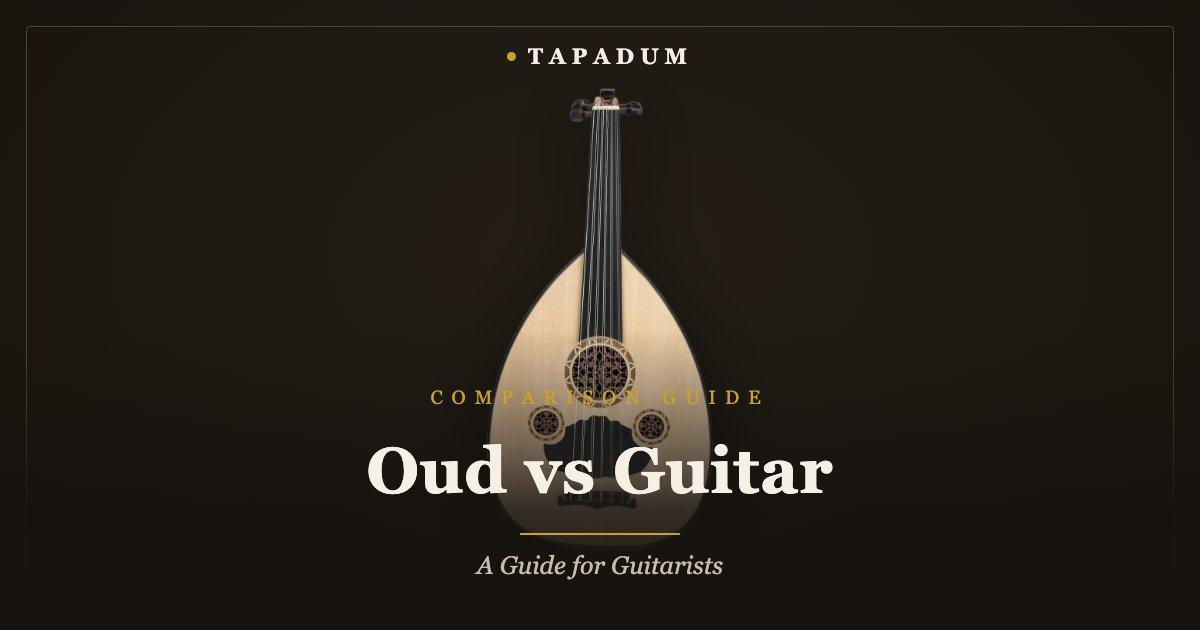
What you’ll learn: the real differences between oud and guitar — fretless versus fretted, paired courses versus single strings, plectrum versus pick technique — and which guitar skills actually transfer when you pick up an oud for the first time.
The single biggest difference between an oud and a guitar is the fingerboard: a guitar’s frets fix your pitch for you, while an oud’s fretless neck puts intonation entirely in your fingers — including the quarter-tones central to Arabic and Turkish maqam music that a fretted instrument physically cannot play. Everything else about the transition, from tuning to right-hand technique, follows from that one structural fact.
The Core Difference: Fretless vs Fretted
A guitar’s frets do a huge amount of invisible work — they guarantee equal-tempered pitch and forgive imprecise finger placement. An oud has none of that. Every note’s pitch is set by exactly where your fingertip lands on the neck, which means the same left-hand shape can land in tune or noticeably flat depending on hand position alone. This is also what makes the oud capable of true microtonal inflection — sliding into a quarter-tone between two “normal” notes — which is a defining sound of maqam music and simply isn’t available on a fretted fingerboard.
Tuning: Courses vs Single Strings
A standard guitar has six single strings. An oud has eleven or twelve strings arranged in five double courses plus a single bass string, each pair of a course tuned in unison to reinforce and thicken the tone. You’re not fingering six independent pitches — you’re fingering five paired pitches plus one bass note, which changes how chords, drones, and melodic doubling work compared to guitar voicing. Turkish and Arabic tuning systems also differ from each other and from any Western guitar tuning, so the reference points you’ve built on guitar don’t map directly onto an oud’s open strings.
Right-Hand Technique: Risha vs Pick
Guitarists already know pick technique, which gives a real head start — but the oud’s risha (plectrum) is played with a different wrist motion, generating both the rhythmic drive and the melodic articulation that in guitar playing gets split between pick attack and fretting-hand slurs. Because there are no frets to lean on for clean note separation, risha technique has to do more of the articulation work than a guitar pick does, which is usually the first real technical wall guitarists hit.
Can a Guitarist Learn Oud Faster?
Some skills transfer directly: rhythmic sense, ear training, general left-hand dexterity, and — for anyone who’s spent time on a fretless bass or done serious string-bending — some intuition for pitch-by-ear rather than pitch-by-fret. What doesn’t transfer is the muscle memory itself; a guitarist’s fretting hand is trained to trust fixed positions, and unlearning that trust is the real work of the first few months. Guitarists with slide or fretless experience typically adapt faster than those coming from purely fretted instruments, but nobody skips the ear-training phase entirely.
Frequently Asked Questions
Is oud harder to learn than guitar?
For a complete beginner, difficulty is comparable — both require building technique from zero. For an experienced guitarist specifically, the oud is harder at first because fretless intonation removes a safety net guitar always provided.
Can guitar skills transfer to oud?
Rhythm, ear training, and general left-hand dexterity transfer well. Fretting-hand muscle memory does not — a guitarist has to relearn pitch placement from scratch on a fretless neck.
Why does the oud have paired strings instead of single strings like a guitar?
The five double courses (plus a single bass string) reinforce and thicken each pitch, giving the oud its characteristic fuller, more resonant tone compared to a guitar’s single-string voicing.
What’s the biggest technical challenge moving from guitar to oud?
Fretless intonation. Without frets, every note’s pitch depends entirely on exact fingertip placement, which takes sustained ear training to internalize.
Should a guitarist start with a Turkish or Arabic oud?
Choose based on the repertoire that interests you rather than ease of transition — Turkish ouds suit brighter, faster melodic lines while Arabic ouds suit deeper, sustained maqam phrasing. Our beginner oud guide covers specific models for both traditions.