
Frame Drums of the World: Daf, Bendir, Riq, and Mazhar Compared
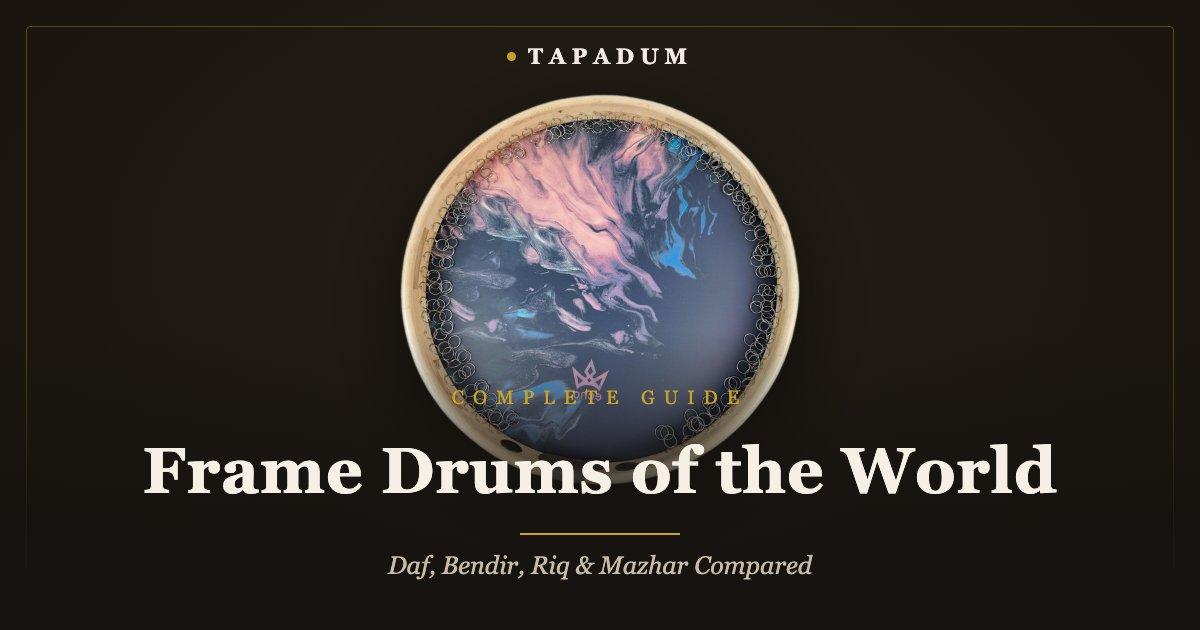
A frame drum is any drum whose head diameter is significantly larger than the depth of its shell — a wide skin stretched over a narrow ring, played by hand rather than with sticks. It’s one of the oldest drum shapes in the world, and the Middle East, Persia, North Africa, and Anatolia each developed their own distinct version: the Persian daf, ringed with jingling chains; the Maghrebi and Anatolian bendir, tuned by internal snares rather than external jingles; the Egyptian riq, a tambourine-like drum with paired brass jingles built for intricate ensemble work; and the larger, deeper-voiced mazhar, built for festive and ceremonial volume rather than subtlety.
They’re often lumped together as “hand drums” or confused with each other by name alone, but each one has a different frame depth, a different jingle mechanism (or none at all), and a different traditional role — from Sufi ceremony to takht ensemble to wedding procession. We’ve written full buying guides for the daf, the bendir, and the riq individually; this page is the map that connects them, and the place to start if you don’t yet know which frame drum you’re actually looking for.
What Makes a Drum a “Frame Drum”?
The defining feature is proportion: a frame drum’s head is much wider than its shell is deep, unlike a goblet drum (darbuka) or a barrel drum, where the body itself provides most of the resonating volume. That wide, shallow shape puts almost all of the instrument’s voice into the skin itself — how tightly it’s stretched, what it’s made of, and what’s attached to the inside or outside edge of the frame.
Frame drums appear independently across nearly every drumming culture on earth, from the Irish bodhrán to the North African bendir to the Sufi daf, which the Berlin Frame Drum School traces to some of the oldest known percussion traditions — the shape itself is an efficient, portable, hand-playable way to get a loud, resonant voice out of very little material. In our own collection, the four instruments below cover the Persian, Arab, and Anatolian branches of that family specifically.
The Persian Daf
The daf is a large, single-headed frame drum, typically 45–60 cm across, with metal rings or small chains hung inside the frame that shimmer against the skin every time it’s struck. It’s the drum most closely tied to Sufi zikr ceremony, where its steady, driving rhythm underpins group chanting and movement, and it has found a second life more recently in sound-healing and meditation circles for the same reason — a deep central tone wrapped in a bright metallic wash.
We go deep on daf construction, ring systems, and buying advice in our full guide: The Daf: From Sufi Ceremony to the Modern Sound Bath.
The Bendir
The bendir is found across North Africa and Anatolia, and its defining feature is internal, not external: instead of jingles hung around the rim, a bendir has one or more gut or nylon snares stretched across the inside of the skin, which buzz against the head when struck to produce a low, buzzing resonance rather than a bright jingle shimmer. Many modern bendirs, including the ones we carry, use an internal tuning mechanism that lets a player adjust head tension without external hardware — a detail that matters more to a buyer than it might sound, since it changes how the drum is maintained day to day.
When we evaluate a bendir for the catalogue, the internal tuning system and snare buzz are the two things we test first, before we even listen to the fundamental tone. Full detail in The Bendir: Choosing, Tuning & Caring for a Frame Drum.
The Riq
The riq is the smallest and most intricate instrument in this family — a tambourine-like frame drum, roughly 20–25 cm across, combining a drumhead with paired brass jingles set into the wooden frame. That combination is what makes it unique among Arabic percussion: a single instrument capable of both a struck drum tone and a controlled jingle shimmer, played with techniques precise enough to carry a full rhythmic role inside a takht ensemble alongside oud, qanun, and ney. Its roots reach back to 8th–9th century Arabic classical music, where it became the standard timekeeper for exactly that kind of chamber ensemble.
We’ve covered riq construction, tuning, and technique in depth already: see Riq: History, Varieties, and Buying Guide.
The Mazhar
The mazhar is the family’s largest and loudest member — a wide, deep-framed drum from Egypt, built with a noticeably thicker head than the riq and its own jingle system, designed to be heard over a crowd rather than played with subtlety. Where the riq earns its place through intricate ensemble technique, the mazhar’s traditional role is festive and ceremonial: it’s the drum you hear driving a Hafla celebration or a zaffa wedding procession, where volume and momentum matter more than nuance.
We don’t currently carry a dedicated mazhar in our catalogue, but it belongs in this comparison because so many buyers searching for a “large riq” or a “loud Egyptian frame drum” are actually describing a mazhar without knowing its name.
Comparing the Four at a Glance
| Instrument | Origin | Jingle system | Traditional role |
|---|---|---|---|
| Daf | Persia / Kurdistan | Internal metal rings/chains | Sufi zikr ceremony, sound healing |
| Bendir | North Africa / Anatolia | Internal snare (buzz, not jingle) | Folk and devotional ensembles |
| Riq | Egypt / Arabic classical | Paired brass jingles | Takht ensemble timekeeping |
| Mazhar | Egypt | Larger jingle set, thicker head | Festive/ceremonial (Hafla, zaffa) |
Which Frame Drum Should You Start With?
Match the drum to the tradition and role you actually want, not just to size:
- Want the meditative, ceremonial sound of Sufi music or sound healing? Start with the daf.
- Want a folk or devotional drum with a deep, buzzing internal resonance and simple maintenance? Start with the bendir.
- Want to play inside an Arabic classical ensemble, with technical jingle control? Start with the riq.
- Want the biggest, loudest voice in the family for festive percussion? Look for a mazhar — though be aware it’s a specialist instrument, not a beginner’s first choice.
All three instruments we carry — daf, bendir, and riq — also connect to our wider percussion cluster: for rhythmic vocabulary once you’ve picked an instrument, see our guides to Essential Darbuka Rhythms and Clay vs Aluminum Darbuka, or the broader context in Percussion Instruments in Middle Eastern Music and Irregular Rhythms in Middle Eastern Music. If your interest leans toward meditation and sound work specifically, our Sound Healing Instruments guide covers the daf alongside handpan, steel tongue drum, and more.
Frequently Asked Questions
What is the difference between a daf and a bendir?
The daf uses external metal rings or chains hung inside the frame that produce a bright metallic jingle. The bendir uses an internal gut or nylon snare stretched across the skin, producing a deeper buzzing resonance instead of a jingle. They also come from different traditions — Persian/Kurdish Sufi ceremony for the daf, North African and Anatolian folk and devotional music for the bendir.
What is the difference between a riq and a mazhar?
The riq is smaller (roughly 20–25 cm), with a thinner head and paired brass jingles, built for intricate technical playing inside an ensemble. The mazhar is larger and louder, with a noticeably thicker head, built for festive and ceremonial contexts where volume matters more than subtlety.
Which frame drum is easiest for a beginner?
The daf and bendir are generally the more approachable starting points — both reward a steady, driving hand pattern without the precise jingle-control technique the riq requires. The riq has a steeper technical learning curve because its brass jingles need to be controlled, not just struck.
Is a frame drum the same as a tambourine?
Not quite. A basic tambourine is usually a simple frame with loose jingles and no true skin tension system built for tone. A riq is a specific, tuned frame drum that happens to combine a real drumhead with jingles — closer to a hybrid of drum and tambourine than either alone.
Do all frame drums have jingles?
No. The bendir has no external jingles at all — its voice comes from an internal snare buzzing against the skin. The daf, riq, and mazhar all use some form of jingle or ring system, but the mechanism and placement differ across all three.