
Steel Tongue Drum Buyer’s Guide: Scales, Sizes, and How It Differs From a Handpan
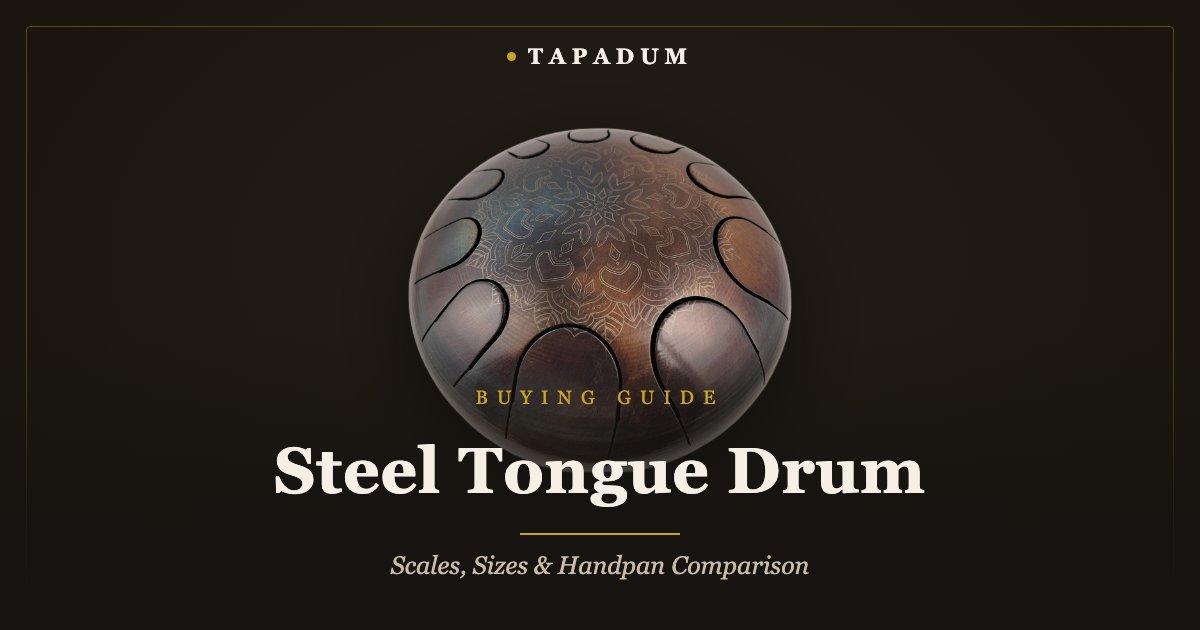
A steel tongue drum is a sealed steel shell with a set of tuned “tongues” cut into the top face — strike one with a hand or mallet and it rings out a single clear note, with no wrong notes possible because every tongue is pre-tuned to the same scale. Most beginner models, including all of ours, are tuned to D Kurd, a gentle minor scale that sounds musical no matter what order you strike the notes in. At around €140, it’s one of the most accessible entry points into melodic percussion — genuinely playable in the first five minutes, with no music theory required.
It’s often confused with the handpan, and the confusion is fair: both are UFO-shaped steel instruments tuned to the same family of scales, both get used for meditation and sound healing, and both produce a similarly warm, sustained tone. But they’re built differently, played differently, and priced very differently. A handpan is two hand-shaped steel half-shells glued together with dimpled tone fields, typically costs several times more, and takes real technique to control. A steel tongue drum is a single welded shell with cut tongues, played with mallets or fingers, and rewards you on the first strike.
Below: how the instrument actually works, where it came from, how to choose between an 8-note and 10-note model, and exactly where it parts ways with a handpan.
What Is a Steel Tongue Drum?
The body is a single sealed steel shell — no seams, no glued halves. The top face has a set of tongue-shaped slits cut into it, and each isolated “tongue” between the cuts is a separate note: its length and mass determine its pitch, the same physics behind a wooden slit drum or a mbira. A center hole underneath the shell, sometimes called the GU, works on the same Helmholtz resonance principle as an ocarina or an empty bottle — it lets the whole body add depth and sustain to whatever note you strike above it.
Because the tongues are cut and tuned at the factory, there’s no tuning maintenance and no way to play an out-of-scale note. That’s the entire appeal for a first-time buyer: pick it up, strike any tongue in any order, and it sounds intentional.
A Short History: From Propane Tank to Meditation Room
The idea is old — wooden slit drums with tongue-shaped cuts were built independently by cultures across Africa, Southeast Asia, and Mesoamerica (the Aztec teponaztli is one well-documented example), originally for long-distance signaling and ritual music, not melody in the Western sense. The steel version is recent. In 2007, American engineer Dennis Havlena cut tongues into an empty propane tank as a cheaper alternative to the Swiss steel instrument that directly preceded the handpan — invented in 2000 and, at the time, both expensive and nearly impossible to buy due to years-long waiting lists. Havlena published his cutting plans for free, and a DIY-building community grew from that single act. A year later, Graham Doe built on the same idea under the Hapi Drum name, arranging larger tongues at the compass points with smaller ones between them — a layout that shaped how most production tongue drums are still built today.
That origin story explains the price gap you’ll see everywhere: the steel tongue drum was invented specifically to be the affordable, buildable version of an instrument that had become a luxury item.
Steel Tongue Drum vs Handpan: What’s Actually Different
| Feature | Steel Tongue Drum | Handpan |
|---|---|---|
| Construction | Single sealed shell, cut tongues | Two shaped half-shells glued together, dimpled tone fields |
| Typical price | €140–150 (our range) | Several times more |
| Played with | Mallets or fingers | Hands only, specific striking technique |
| Learning curve | Playable immediately | Real technique required for tone control |
| Dynamic range | Simpler, consistent sustain per note | Wider tonal and dynamic range, more overtone control |
Neither instrument is a downgrade of the other — they’re built for different goals. If you want to sit down and immediately play something musical, without years of technique, the tongue drum wins. If you want the deeper dynamic control and overtone complexity that comes from years of handpan practice, that instrument rewards the investment differently. For a deeper look at how the handpan sounds and plays, see our complete handpan guide.
8 Notes or 10 Notes? Choosing Your Scale Size
Every beginner model in D Kurd — a diatonic minor scale built around a central low note ringed by higher tones — is available in two sizes:
- 8 notes — more compact, lighter to carry, and the more common choice for a first instrument. It’s enough range for full melodic phrases without overwhelming a beginner with choices.
- 10 notes — a wider melodic range for the same D Kurd scale family, useful once you’ve outgrown the 8-note layout and want more notes to move between.
Our 8-Note Steel Tongue Drum (Flower of Life, D Kurd) and 10-Note Steel Tongue Drum (Geometric Mandala, D Kurd) are tuned identically within their note count — the engraved pattern on the face (mandala, lotus, yin-yang, sacred geometry, and others) is a cosmetic choice, not a sound one. Pick the design you’ll want to look at every day; the notes underneath are the same.
What to Look For When Buying
Note count matches your goal. Buying your first tongue drum purely for relaxed, no-wrong-notes play, an 8-note model is plenty. Want more melodic room to grow into, go 10-note.
Hands or mallets. Most steel tongue drums respond well to both bare fingers and rubber-tipped mallets. Mallets give a slightly brighter attack and are easier for beginners to land accurately on a tongue; fingers give a softer, warmer tone once you’re comfortable.
Portability. At this size and weight, a tongue drum travels easily — a real advantage over a handpan if you want to bring an instrument to a class, a retreat, or a friend’s living room.
Tuning is fixed, not adjustable. Unlike a guitar or oud, there’s nothing to tune yourself. If a tongue ever sounds off after years of heavy use, that’s a repair question, not a routine maintenance one.
Frequently Asked Questions
What scale is a steel tongue drum tuned to?
Most beginner steel tongue drums, including our full range, are tuned to D Kurd — a diatonic minor scale built around a central low note surrounded by higher tones. It’s chosen specifically because every combination of notes sounds musical, with no wrong notes possible.
Is a steel tongue drum easier to play than a handpan?
Yes. A steel tongue drum is playable within minutes because every tongue is pre-tuned and any striking order sounds intentional. A handpan requires real technique to control tone and dynamics, and typically costs several times more.
Should I buy an 8-note or 10-note steel tongue drum?
An 8-note drum is more compact and is the more common first instrument. A 10-note drum gives you a wider melodic range within the same D Kurd scale family — useful once you want more notes to move between.
Do I play a steel tongue drum with my hands or with mallets?
Both work. Rubber-tipped mallets give a brighter attack and are easier for beginners to strike accurately; bare fingers give a softer, warmer tone once you’re familiar with the tongue layout.
Where does the steel tongue drum come from?
It’s a modern instrument, invented in 2007 by American engineer Dennis Havlena, who cut tongues into a propane tank as an affordable alternative to the expensive Swiss original. Its underlying idea — tuned tongues cut into a resonant body — goes back to wooden slit drums built independently across Africa, Southeast Asia, and Mesoamerica.
[…] it like a nitrided handpan instead — light oil, same method as above. New to the instrument? Our steel tongue drum buyer’s guide covers scales and sizes, and our complete handpan guide explains how the families […]