
Bouzouki vs Buzuq: Two Long-Necked Lutes, Two Traditions
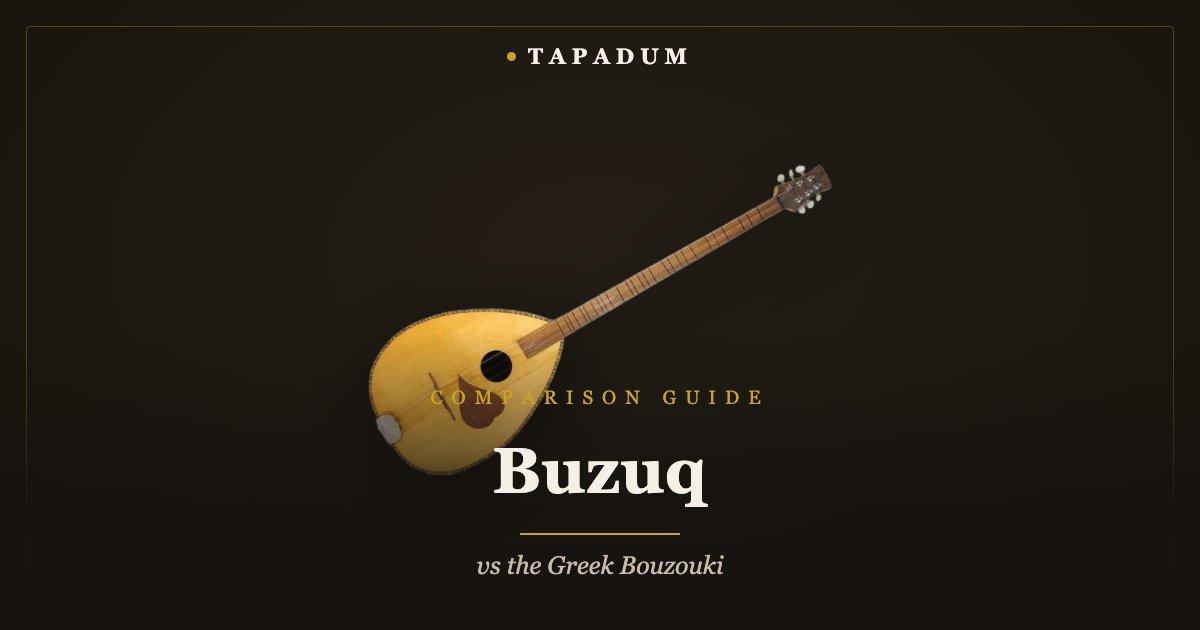
What you’ll learn: why a buzuq and a bouzouki are often mistaken for the same instrument, the fretting and tuning differences that actually separate them, which musical traditions each one serves, and how to decide which long-necked lute belongs in your hands.
A buzuq and a bouzouki are not the same instrument wearing two names. They share a common ancestor — the long-necked tanbur-family lutes that spread across the Ottoman and Persian world — but they grew apart in opposite directions. The bouzouki settled into fixed, equal-tempered frets built for Greek chordal music. The buzuq kept its frets movable, tuned by ear to the quarter-tones of Arabic and Kurdish maqam. That single difference in the fretboard changes everything else: the tuning, the playing technique, and the music each instrument can honestly perform.
If you already play or sing in the maqam system — Arabic, Kurdish, or related Levantine repertoire — the buzuq gives you the microtonal flexibility that fixed frets can’t. If your ear is set on Greek rebetiko or laiko, with its chordal harmony and standardized scales, the bouzouki is the right instrument, and we’ve already covered choosing between a trichordo and tetrachordo bouzouki in a companion guide. This piece looks at the other branch of the family: what the buzuq is, how it diverged from its Greek cousin, and when it’s the better choice.
Where Each Instrument Comes From
The bouzouki’s modern story starts in Anatolia. Greek refugees carried a related long-necked lute with them to Greece in the early 1900s, and the instrument was reshaped there into the bouzouki that powers rebetiko music — the urban blues of Greek port cities, recognized by UNESCO as Intangible Cultural Heritage in 2017.
The buzuq took a different route. It’s the working instrument of Levantine folk music in Lebanon, Syria, Palestine, and Jordan, and it holds an equally central place in Kurdish folk music and in the devotional music of Yarsanism. Its own ancestry traces back further, to Persian and Turkish long-necked lutes in the wider saz and tanbur family — the same root system that eventually produced instruments like the oud and the Anatolian caglama, though each followed its own path toward a different sound.
Lebanon gave the buzuq one of its most famous champions almost by accident. Hanna Rahbani — father of the Rahbani brothers, Assi and Mansour, who would go on to write for Fairuz — ran a string of village coffeehouses and played buzuq there to entertain friends. That rustic, coffeehouse sound later found its way into the Rahbani-Fairuz recordings that shaped modern Lebanese music, giving the buzuq a bright, unmistakable voice in a body of work far beyond its village roots.
Frets Tell the Real Story
Look at the neck before you look at anything else. A bouzouki’s frets are metal, fixed permanently into the fingerboard — typically 27 of them, spaced for a 12-tone equal-tempered chromatic scale. That fixed grid is what lets a bouzouki player stack chords and switch keys the way a guitarist does.
A buzuq’s frets are tied — thin gut or nylon loops wrapped around the neck, movable by hand. A typical buzuq carries around two dozen adjustable frets, and a player repositions them to match the specific maqam being performed, unlocking quarter-tone intervals that a fixed fretboard simply cannot produce. We reposition frets on every buzuq we set up before it ships, because a factory-standard layout rarely matches the exact maqam a player wants to work in from day one.
This is the single fact that explains every other difference between the two instruments. A fixed fret is a promise of consistency across keys. A movable fret is a promise of precision within one scale. Neither is better — they’re built for different musical grammars.
Tuning and Stringing
A buzuq is normally strung with two courses of metal strings (occasionally three), played with a plectrum, tuned D-A-D in the common Arabic configuration — though the movable frets mean that tuning can shift to fit whatever maqam a piece calls for. The smaller body and longer neck give it a sharp, percussive attack with a long, drone-like sustain, well suited to single-line melodic playing.
A bouzouki carries more strings and more sustain-friendly stringing. The trichordo (three-course, six-string) version is the traditional rebetiko instrument, tuned D-A-D like the buzuq but with fixed frets underneath it. The tetrachordo (four-course, eight-string) version, popularized by Manolis Chiotis in the 1950s and tuned C-F-A-D, added a full octave of range and made chordal, guitar-like accompaniment possible — details we cover fully in the trichordo vs tetrachordo guide.
Buzuq vs Bouzouki at a Glance
| Feature | Buzuq | Bouzouki |
|---|---|---|
| Home tradition | Levantine folk (Lebanon, Syria, Palestine, Jordan), Kurdish and Yarsani music | Greek rebetiko and laiko |
| Frets | Movable, tied — roughly 24, repositioned per maqam | Fixed metal, typically 27, equal temperament |
| Strings | 2 courses of metal strings (occasionally 3) | 3 courses / 6 strings (trichordo) or 4 courses / 8 strings (tetrachordo) |
| Common tuning | D-A-D (Arabic), adjustable by maqam | D-A-D (trichordo) or C-F-A-D (tetrachordo) |
| Body | Smaller body, longer neck | Larger, pear-shaped body |
| Playing style | Plectrum, melodic single lines, drone-like sustain | Plectrum, melodic and chordal accompaniment |
| Sound character | Sharp, percussive attack, microtonal | Fuller, sustained, harmonically rich |
How They Sound in Practice
Play a phrase on a buzuq and you hear the maqam breathing — the quarter-tones between notes that Western equal temperament rounds away. It’s a melodic instrument first, built to trace a single vocal-like line with a sharp, percussive attack.
Play the same register on a bouzouki and the character changes. The trichordo still carries that older, leaner melodic voice, but the tetrachordo in particular opens the door to full chords and harmonic accompaniment, closer in function to a mandolin or a small guitar. Neither instrument is a substitute for the other — a rebetiko standard played on a buzuq loses its chordal backbone, and a maqam taqsim played on a bouzouki loses its microtonal color.
Which One Should You Buy?
Base the decision on the repertoire you actually want to play, not on how similar the two instruments look on a shelf.
Choose a buzuq if you sing or play in the maqam system, want quarter-tone flexibility, or are drawn to Levantine, Kurdish, or Yarsani repertoire. Our Professional Buzuq is built for exactly this — a handcrafted long-necked lute set up with adjustable frets ready for Arabic tuning out of the box.
Choose a bouzouki if your goal is Greek music. Pick the trichordo for traditional rebetiko repertoire and historical accuracy, or the tetrachordo for wider harmonic range and modern laiko playing — we walk through that decision in detail in the bouzouki buyer’s guide.
If you’re not sure which tradition you’re aiming for yet, that uncertainty is itself the answer: start by listening to a handful of recordings in each style before you commit to a fretboard you can’t easily change your mind about later.
Frequently Asked Questions
Is a buzuq the same instrument as a bouzouki?
No. They share a distant common ancestor in the tanbur/saz family of long-necked lutes, but they diverged into different instruments — different frets (movable vs fixed), different tuning logic, and different musical traditions (Levantine/Kurdish maqam music vs Greek rebetiko).
Can you play Greek bouzouki music on a buzuq?
Not accurately. Greek chordal repertoire depends on a fixed, equal-tempered fretboard to stack consistent chords across keys. A buzuq’s movable frets are set for one maqam at a time, which makes it unsuited to the harmonic language of rebetiko or laiko.
What tuning does a buzuq use?
D-A-D is the most common Arabic tuning for a two-course buzuq, but because the frets are movable, players retune and reposition frets to match whatever maqam a piece requires — there’s no single fixed standard the way there is on a bouzouki.
Which instrument is harder to learn?
They’re difficult in different ways. A buzuq asks for a trained ear for microtonal intervals and fret placement; a bouzouki asks for chordal technique and scale fluency across a fixed fretboard. Neither is a natural first step from Western guitar — both reward patience.
Do the buzuq and bouzouki share a common ancestor?
Yes. Both descend from long-necked lutes in the broader Ottoman and Persian tanbur family, but geography split them: one branch settled in Greece and standardized around fixed frets, the other stayed in the Levant, Kurdistan, and Iran and kept its frets adjustable for maqam music.
[…] shared name sound can be misleading. Our buzuq and bouzouki comparison explains the differences in tuning logic, fret system and musical context. If your decision is […]