
The Greek Bouzouki: Trichordo vs Tetrachordo — A Complete Guide to Choosing Your First One
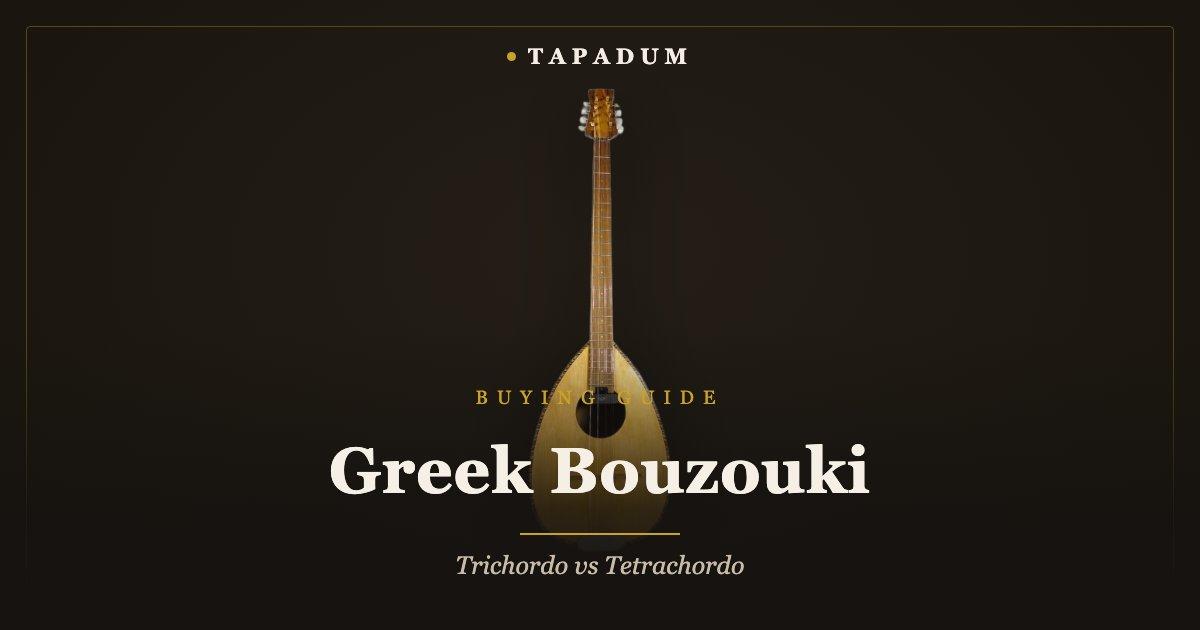
A Greek bouzouki is a long-necked, pear-bodied plectrum lute built around one of two tuning systems: the older three-course trichordo, tuned D–A–D, or the newer four-course tetrachordo, tuned C–F–A–D. If you want the sound that built rebetiko — the modal, tremolo-driven voice of 1920s Greek urban song — start with a trichordo. If you want an instrument that plays chords easily and covers modern Greek laiko and pop repertoire, the tetrachordo is the standard choice almost every working musician owns today.
The two versions aren’t just a matter of taste. They represent two different eras of the same instrument. The trichordo is what Greek refugee musicians from Asia Minor were playing in the hash dens and ports of Piraeus in the 1920s and ’30s, after the population exchange brought Anatolian Greek communities — and their long-necked tanbur-family lutes — into mainland Greece. The tetrachordo is a 1950s redesign, credited to virtuoso Manolis Chiotis, that added a fourth course and reshaped the tuning to borrow the logic of a guitar’s top four strings. One instrument carries the weight of a UNESCO-recognised musical tradition; the other is what most working bouzouki players actually reach for on stage. A first-time buyer needs to know which era they’re buying into before they know which one to buy.
At Tapadum we carry both lineages: an eight-string tetrachordo built around the modern C–F–A–D voicing, and a three-course electro-acoustic trichordo with a built-in pickup for stage use. Below is how to tell them apart, what each one is actually for, and where the confusingly-named Irish bouzouki and the Kurdish/Iranian buzuq fit into the picture — because all three get searched for under the same word, and only one of them is what most people mean by “bouzouki.”
What Is a Greek Bouzouki?
The Greek bouzouki is a long-necked lute in the tanbur family — the same broad instrument lineage that includes the Turkish saz and baglama. It reached its modern form in Greece in the early 20th century, evolving from instruments like the Turkish bozuk (a name some historians point to as the direct root of “bouzouki”) and the tamboura carried by Greek communities from Asia Minor and Constantinople. When the 1923 population exchange moved these communities into mainland Greek port cities, their long-necked lutes came with them — and found a new home in rebetiko, the urban song style built in the tavernas of Piraeus and Thessaloniki.
The body is a deep, rounded bowl-back or staved bowl, built for sustain and a strong low end. Players strike the strings with a plectrum rather than fingerpicking, producing the instrument’s signature fast tremolo on sustained notes — the sound most people associate with Greek music generally, even if they’ve never heard the word “bouzouki” itself.
Trichordo vs Tetrachordo: The Real Difference
Course count and tuning are what separate the two instruments, and each one carries a different playing logic.
| Feature | Trichordo | Tetrachordo |
|---|---|---|
| Courses / strings | 3 courses, 6 strings | 4 courses, 8 strings |
| Tuning | D–A–D | C–F–A–D |
| Era | 1920s–1930s (early rebetiko) | 1950s onward (Manolis Chiotis redesign) |
| Best for | Traditional rebetiko, modal drone playing | Chords, fast solos, laiko and modern Greek pop |
The trichordo’s D–A–D tuning is built for droning and modal melody — the open strings ring together in a way that suits the scales rebetiko is built on, but it resists Western chord shapes. Manolis Chiotis solved that by adding a fourth course and retuning the top four strings to mirror the intervals of a guitar’s top four strings (tuned down a step). That single change let the bouzouki absorb chord vocabulary, harmonic movement, and faster solo lines — and it’s why the tetrachordo, not the trichordo, became the instrument you hear behind almost every modern Greek pop and laiko recording.
Rebetiko: The Sound the Bouzouki Was Built For
Rebetiko is the reason the trichordo bouzouki still matters. Born among working-class and refugee communities in early-20th-century Greek port cities, it draws on Greek, Anatolian, Roma, and Jewish musical influences, and its lyrics speak plainly about poverty, exile, prison, and hashish — subjects that got it banned from Greek radio for decades. In 2017, UNESCO inscribed rebetiko on its Representative List of the Intangible Cultural Heritage of Humanity, recognising it as a living tradition rather than a historical footnote. That recognition sits alongside a genuine revival: over the last two decades, a new generation of Greek and diaspora musicians has returned to the trichordo specifically, treating the “old” tuning as the more expressive one rather than the obsolete one.
In curating our bouzouki collection, we kept both instruments in the catalogue for that reason — the trichordo isn’t a downgrade from the tetrachordo, it’s a different instrument for a different repertoire.
Choosing Between the Two: Which One Should You Buy?
Match the instrument to the music you actually want to play, not to string count alone.
- Choose a trichordo if: you want to play or study rebetiko specifically, you’re drawn to modal, drone-based melody, or you already play saz/baglama and want the closest Greek relative.
- Choose a tetrachordo if: you want to play contemporary Greek music, you want chord accompaniment as well as melody, or you’re coming from guitar and want a tuning logic that transfers.
- Consider an electro-acoustic model if: you plan to play with a band or on stage — a built-in pickup avoids miking a soundhole in a live mix.
There’s no wrong first instrument here, but there is a wrong expectation: a trichordo won’t easily give you Western pop chord shapes, and a tetrachordo won’t automatically sound like classic 1930s rebetiko. Decide on the sound first.
What to Look For When Buying a Greek Bouzouki
Beyond course count, three things matter for a first purchase:
Body construction. Look for a solid, well-seated bowl or staved back — this is where the instrument’s characteristic sustain and low-end resonance come from. A poorly glued or overly thin bowl loses both.
Electro-acoustic vs. fully acoustic. If you’ll ever play outside a practice room, a built-in pickup saves you from feedback problems with an external mic. Our Electro-Acoustic Greek Bouzouki (6 strings) pairs a hand-built acoustic body with a TAP pickup — the pickup brand most commonly used on bouzoukis — specifically for that reason.
Fingerboard length and course spacing. The tetrachordo’s extended neck (added by Chiotis to fit the fourth course) means slightly wider left-hand stretches than a trichordo. If you have smaller hands or are transitioning from a shorter-necked instrument like a baglama, factor that in before buying.
Our Greek Tetrachordo Bouzouki (8 Strings) is built around the modern C–F–A–D voicing described above, pairing a deep sustained low end with the chord range that makes it the standard choice for contemporary players.
Bouzouki vs Other Long-Necked Lutes: Don’t Get Confused
“Bouzouki” gets searched for three different instruments, and only the Greek one is discussed above:
- Irish bouzouki — a flat-backed instrument developed in Irish folk music in the 1960s–70s, tuned differently (commonly GDAD or GDAE) and built with a flat, guitar-style back rather than the Greek bowl body. Despite the shared name, it’s a different instrument built for a different tradition entirely.
- Buzuq — a related but distinct long-necked lute from the Levantine and Kurdish/Iranian tradition, with its own fretting and tuning conventions built for Arabic maqam music rather than Greek modal melody. The name similarity is a real source of shopping confusion, not just a coincidence — both instruments likely trace back toward the same Ottoman-era Turkish long-neck lute family. See our full bouzouki vs buzuq comparison guide for the fretting and tuning breakdown.
If you’re shopping specifically for the instrument behind rebetiko, laiko, or modern Greek popular music, the Greek bouzouki above is the one you want.
Frequently Asked Questions
What is the actual difference between a trichordo and tetrachordo bouzouki?
A trichordo has three courses (6 strings) tuned D–A–D and is built for the modal, drone-based melodies of traditional rebetiko. A tetrachordo has four courses (8 strings) tuned C–F–A–D, a tuning developed in the 1950s that mirrors a guitar’s top strings and makes chord playing far easier.
Can a beginner start on a tetrachordo bouzouki?
Yes. The tetrachordo is the more common instrument today and its guitar-like top-string logic is often easier for players coming from guitar. Choose it if you want to play contemporary Greek music or want chords available from day one.
Is the Irish bouzouki the same instrument as the Greek bouzouki?
No. They share a name and a long neck, but the Irish bouzouki has a flat back, different tuning (commonly GDAD or GDAE), and was developed for Irish folk music in the 1960s–70s — decades after the Greek instrument had already taken its modern form.
What is the standard tuning for a Greek bouzouki?
It depends on the model. Trichordo (three-course) bouzoukis use D–A–D. Tetrachordo (four-course) bouzoukis, the more common modern instrument, use C–F–A–D.
Do I need an electro-acoustic bouzouki to perform live?
Not strictly, but it makes live sound far easier. A built-in pickup lets you plug straight into a mixer or amp without miking the soundhole, which matters most in a band setting where feedback control is difficult with an external mic.