


Description
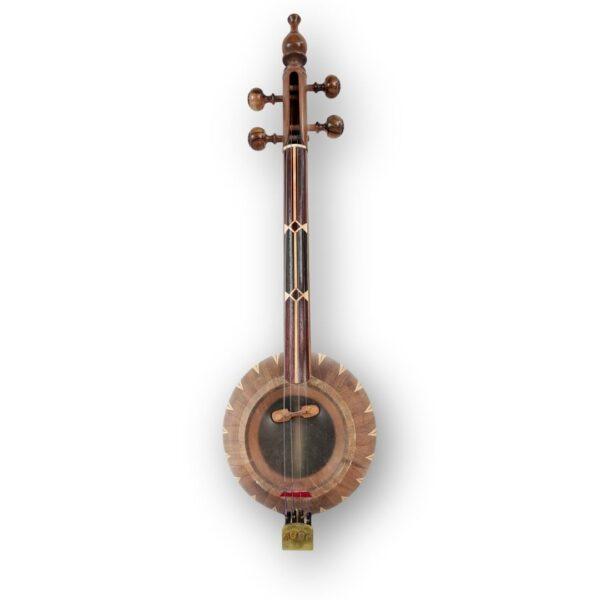
The Lori Kamancheh from Tapadum is a high-quality handmade Persian spike fiddle built in the traditional Lori regional style, designed for players who want an authentic instrument with the expressive, vocal-like voice that defines Persian classical music. Handcrafted by experienced luthiers, this kamancheh offers the tonal depth, bow responsiveness, and visual character of a serious performance instrument.
Traditional Lori Construction
The Lori kamancheh represents a regional variation of the broader Persian kamancheh tradition, named after the Lori (Lur) peoples of western Iran. The Lori style is known for its slightly larger resonator and distinctive decorative character compared to the urban Tehran kamancheh. The body is a spherical resonator — the spike (metal rod) passes through the bowl and rests on the player’s knee, giving the instrument its name (kamancheh meaning “little bow” in Persian).
Wooden Bowl with Skin Membrane
The resonator bowl is carved from hardwood and covered with a stretched natural skin membrane that serves as the soundboard. The skin’s responsiveness to bow pressure is what gives the kamancheh its signature vocal quality — every bow change produces a nuanced tonal shift that closely mimics human singing. The bowl’s spherical shape amplifies the strings’ vibrations and projects the sound outward in all directions.
Four-String Setup with Bow
The four strings are played with the included horsehair bow, held beneath the hand, with the instrument positioned vertically on the knee. This upright playing position — unlike the violin’s horizontal stance — allows the performer to rotate the instrument itself to facilitate string changes, a technique distinctive to Persian spike fiddles. The bowing technique emphasizes long, expressive phrases and ornamental detail.
Technical Specifications
| Type | Persian Kamancheh (Lori regional style) |
| Bowl | Carved hardwood |
| Soundboard | Natural skin membrane |
| Neck | Hardwood, unfretted |
| Strings | 4 strings |
| Tuning | Typically G-D-A-E (varies by repertoire) |
| Spike | Metal rod (rests on knee) |
| Bow | Horsehair bow with adjustable tension (included) |
Who This Kamancheh Is For
The Lori Kamancheh suits players committed to Persian classical music, students of Iranian dastgāh modal system, and violin or cello players adding the kamancheh’s distinctive voice to their working instruments. Because the kamancheh is fretless and bowed, it demands developed intonation and bow-control skills. Complete beginners with no prior bowed-string experience will face a steep learning curve; some prior violin or cello background accelerates progress significantly.
Music Genres & Traditions
The kamancheh is central to Persian classical music (radif), Iranian folk traditions, Azerbaijani mugham, and Kurdish music. It’s also increasingly featured in world music fusion, film scoring, and contemporary cross-cultural projects. The instrument’s vocal character makes it a preferred melody voice in ensemble settings where violin would sound too Western. Learn more about the broader kamancheh tradition and its regional variations.
The Spike-Fiddle Family
As a spike fiddle, the kamancheh belongs to the same broad family as the Central Asian ghijak and the Turkish kabak kemane, yet its spherical bowl and skin soundboard give it a warmer, more vocal tone than many of its relatives. Within the radif — the canonical repertoire of Persian classical music — the kamancheh carries long modal melodies through the continuous slides and microtonal inflections that a fretted instrument cannot reproduce, which is why it remains the bowed voice of choice in traditional Iranian ensembles.
Care & Maintenance
Store at moderate humidity (45–55%) — the skin membrane is especially sensitive to humidity changes. Dry air tightens the skin and, if very dry, can split it; humid conditions slacken it. Keep the bow hair rosined for grip but wipe excess rosin from the strings and body after each session. Loosen the bow when not in use to preserve hair tension. Have the skin and spike inspected by a luthier every couple of years.
Explore more of Tapadum’s bowed instruments, the wider family of string instruments, and Persian relatives such as the setar.


Reviews
There are no reviews yet.