


Description
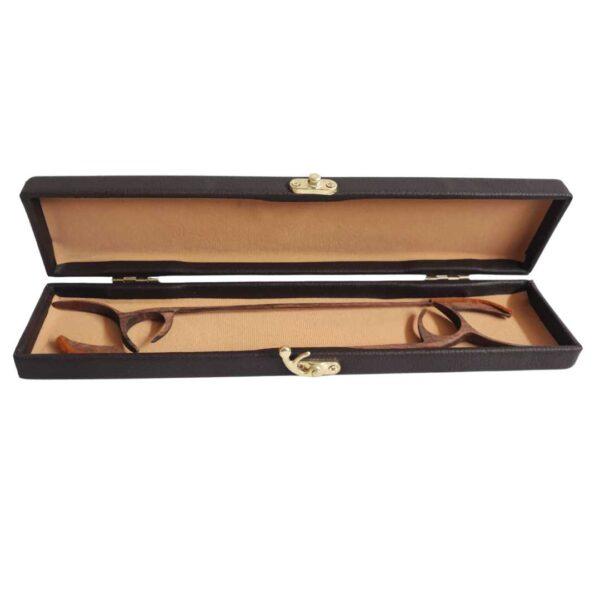
This santur sticks set contains three handmade pairs of wooden hammers for the hammered dulcimer and the santur. It is meant for players who hold their hammers in the hand and want spare pairs ready, from beginners to teachers and performers. Each stick has a flat, leaf-shaped head with an open cut-out and a long, slender shaft; unlike Persian zahme, it has no finger grip.
Leaf-Shaped Wooden Heads
The head of each stick is cut flat in the shape of a leaf, with an open window in the centre. The cut-out removes wood from the head, so the stick stays light at the striking end and comes back easily from the strings. The plain wooden head gives a clear, direct attack.
Players who want a softer sound sometimes glue a thin strip of felt or leather to the striking face. With three pairs in the set, you can adapt one pair this way and keep the others plain.
How These Sticks Are Held
Without a finger grip, each stick is held along its shaft in the hand, the way many players of the hammered dulcimer hold their hammers. The long shaft gives the hand room, and the light head lets the stick bounce off the strings for quick repeated notes.
If you play the Persian santur with the traditional hold between three fingers, choose sticks with a finger grip, such as our Persian santur sticks set.
Technical Specifications
| Specification | Details |
|---|---|
| Product | Hammered dulcimer and santur sticks |
| Quantity | 3 pairs (6 sticks) |
| Head | Flat, leaf-shaped, with open cut-out |
| Material | Wood, handmade |
| Hold | In the hand (no finger grip) |
| Instruments | Hammered dulcimer, santur |
What Is Included with the Santur Sticks Set
- Three pairs of hammered dulcimer and santur sticks (6 sticks)
Who These Sticks Are For
The set suits beginners learning even strokes, teachers who keep sticks for their students, and performers who want backups at concerts. Browse our santur accessories for strings and tools, or the santur and hammered dulcimer collection for instruments.
Music and Traditions
The hammered dulcimer family is played across the world: the Persian santur, the cimbalom of Eastern Europe, and the folk dulcimers of the British Isles and North America. These sticks are for players in any of these traditions who hold their hammers along the shaft rather than between three fingers.
Care and Storage
Store the sticks flat or in a soft pouch so the slender shafts do not bend, and keep them away from heaters and damp rooms. Check the heads around the cut-out from time to time; a crack there should be repaired before you play, since a split head can catch on the strings.



Reviews
There are no reviews yet.