
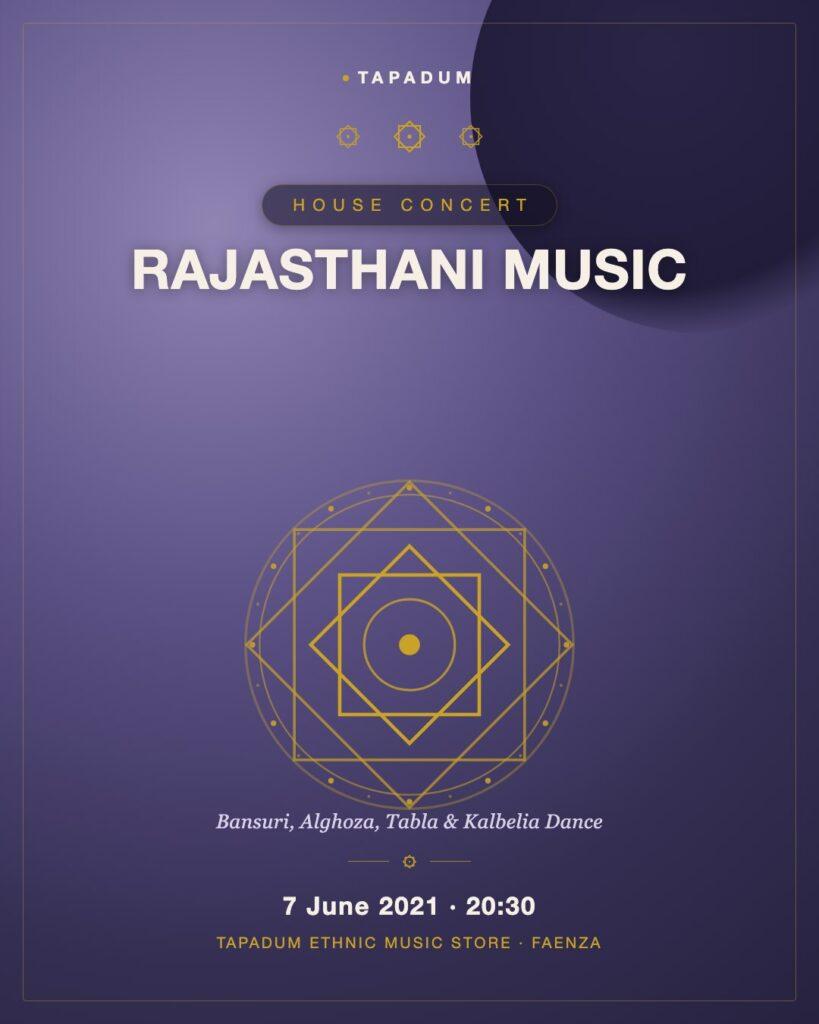
Rajasthani Music at Tapadum: Bansuri, Tabla, and Kalbelia Dance
On 7 June 2021, three artists brought the folk and classical music of Rajasthan and Sindh to Tapadum in Faenza — bansuri, alghoza, tabla, and the UNESCO-listed Kalbelia snake dance.
Two days after the Lulian Ensemble had filled our space with Iranian classical music, we opened the doors again — this time to the sounds of Rajasthan, Sindh, and the Hindustani tradition.
Two people came to this first date. The music deserved a larger room, but the intimacy was not without its own quality.
Three Artists, Three Traditions
The evening brought together three artists whose work spans the folk and classical traditions of Northwest India and Pakistan:
- Simon Prasad — bansuri, alghoza
- Monica Monsun — Kalbelia dance
- Gabru Khan — tabla
The Instruments and the Dance
The bansuri is the transverse bamboo flute of North India, one of the oldest instruments in the subcontinent’s musical history and the instrument most closely associated with Krishna in Hindu iconography. In the Hindustani classical tradition, the bansuri was elevated to a concert instrument largely through the work of Pandit Hariprasad Chaurasia in the twentieth century — before that it was considered primarily a folk instrument. Simon Prasad moves between both worlds.
The alghoza is a different instrument entirely: a pair of end-blown flutes played simultaneously, one carrying the melody while the other drones. Associated with the folk music of Rajasthan, Sindh, and Punjab, it requires circular breathing to sustain the continuous sound that defines it. The effect is hypnotic — a single player producing what sounds like two voices at once.
Gabru Khan‘s tabla provided the rhythmic foundation. The tabla — two drums played together, the right-hand dayan producing melodic pitched strokes and the left-hand bayan providing bass — is the central percussion instrument of Hindustani classical music. Its vocabulary of named strokes and rhythmic cycles, tala, is one of the most sophisticated percussion systems in the world.
Monica Monsun danced Kalbelia — the serpentine folk dance of the Kalbelia community of Rajasthan, recognised by UNESCO as an Intangible Cultural Heritage of Humanity. The dance is characterised by continuous spinning movements that mirror the motion of the snake, the traditional symbol of the Kalbelia people. Performed in full costume, it transforms the music from a listening experience into something total — sound, movement, and colour unified.
Rajasthan, Sindh, and the Hindustani World
The music of Rajasthan occupies a particular place in the broader landscape of South Asian traditions. It is at once ancient and alive — desert folk music that has absorbed influences from Sufi devotional practice, Mughal court music, and the itinerant musician communities that have carried it across generations and geographies.
The Sindhi connection adds another dimension: the musical cultures of Rajasthan and Sindh share deep roots, divided now by a political border that the music does not recognise. The alghoza itself crosses that border freely — equally at home in a Rajasthani village and a Sindhi wedding.
A Rare Evening
Classical Indian music and Kalbelia dance rarely share the same small room in Emilia-Romagna. On June 7, they did — and for those present, it was a reminder of how much musical world exists beyond the European traditions that dominate most concert programming.
The same trio returned two days later, on June 12, for a second performance. By then, word had reached a few more people.
Tapadum hosts concerts from across the Mediterranean, Middle East, and South Asia. Explore our world instrument collection or follow our upcoming events.
Özgür Yalçın is the founder of Tapadum and the founding member of Karagüneş. He has performed ethnic and world music across Europe for over twenty-five years and builds custom instruments from Tapadum’s workshop in Brisighella, Italy.