
Ziryab and the Birth of the Lute: How the Oud Reached Europe
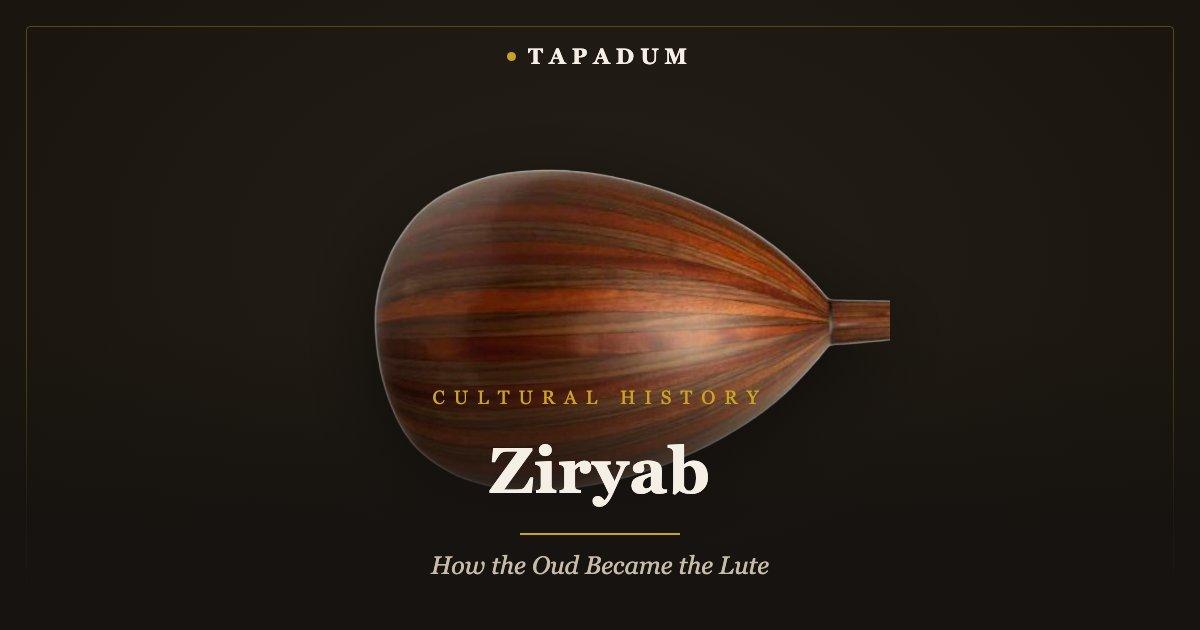
What you’ll learn: who Ziryab was and why 9th-century Córdoba is the hinge point in the oud’s history, what he actually changed about the instrument, how it crossed from Baghdad to Al-Andalus to become the European lute, and why “oud” and “lute” are, etymologically, the same word.
Most instrument histories move in one direction: invented somewhere, refined somewhere else, done. The oud’s story bends through a single, well-documented figure — a musician exiled from Baghdad who reshaped an instrument, founded a school for it, and, without meaning to, set in motion the chain of events that gave Europe the lute. His name was Ziryab, and the instrument he changed still carries his fingerprints today.
Who Was Ziryab?
Ziryab (c. 789–c. 857) was a singer, oud player, composer, and teacher, first trained in Baghdad under the renowned musician Ibrahim al-Mawsili at the Abbasid court. His nickname — from the Persian and Kurdish word for jay-bird, pronounced zaryāb — reportedly came from his dark complexion and honeyed voice. After leaving Baghdad during the reign of the caliph al-Ma’mun, he traveled west and was welcomed as court musician by Abd ar-Rahman II of the Umayyad dynasty in Córdoba, in what is now Spain. That move — from the heart of the Abbasid world to its far western frontier — is the reason this story exists at all.
The Fifth String and the Humors
Before Ziryab, the standard oud carried four courses of strings. He is credited with adding a fifth, tied to a piece of music theory as much as an engineering fix: he dyed the four original strings in colors meant to symbolize the Aristotelian humors, and dedicated the new fifth string to the soul. He also replaced the wooden plectrum with one cut from an eagle’s quill, changing the instrument’s attack and tone. Neither change was cosmetic — a fifth course widens the instrument’s range, and the two together mark one of the earliest documented moments where an oud maker’s choices were framed in explicitly theoretical, not just practical, terms.
Founding the First Conservatory
Ziryab is widely credited with founding what is often considered the world’s first music conservatory, in Córdoba, where he formalized the teaching of harmony and composition rather than passing technique down informally from player to player. He is considered a founder of the Andalusian music tradition that spread through North Africa, and his influence reached well past music — he is credited with popularizing seasonal fashion changes, new grooming habits, and the practice of serving a meal in separate courses (soup, main, dessert), all exported through his students across Iberia and North Africa. The conservatory detail matters for the oud specifically: it is the first clear evidence of the instrument being taught as a formal discipline, with a codified technique, rather than an oral craft passed within a single household or court.
From Al-Andalus to the Lute
The oud most likely reached Western Europe through the Umayyad conquest of the Iberian Peninsula beginning in 711 AD — decades before Ziryab’s own arrival, but it was the flourishing Andalusian court culture he helped shape that gave the instrument its platform to spread north. The name itself is the clearest fossil of that journey: Arabic al-ʿūd (“the wood”) lost its al- prefix as the word moved into European languages, surfacing as laúd in Spanish, liuto in Italian, luth in French, Laute in German, and lute in English — all sharing the same opening sound. As the instrument settled into European musical life, it changed further: frets were added to suit the harmonic and multi-voice demands of Western composition, a structural shift the fretless oud never took. By roughly 1300–1340, European luthiers had reshaped it enough that the lute stood as a genuinely distinct instrument from its oud ancestor — related by name and origin, but built for a different musical logic.
Why This Story Still Matters
The oud and the lute are, in a real sense, the same instrument separated by a single historical migration and several centuries of divergent evolution — one kept its fretless neck and quarter-tone vocabulary for maqam, the other grew frets and reshaped itself around European harmony. Ziryab sits at the hinge of that split: the court he built in Córdoba is the clearest point where the instrument’s Eastern and Western paths were still touching. If you’re curious about the instrument’s structure and how to choose one today, our complete guide to oud types and tuning covers that ground; if it’s the more recent players who carried the oud’s living tradition forward that interest you, see Famous Oud Players & Iconic Recordings.
Frequently Asked Questions
Who was Ziryab?
Ziryab was a 9th-century musician, singer, and teacher, trained in Baghdad and later court musician to Abd ar-Rahman II in Córdoba, where he founded what is considered the world’s first music conservatory and became a formative figure in Andalusian musical culture.
What did Ziryab actually change about the oud?
He is credited with adding a fifth string course, dyeing the strings to symbolize the Aristotelian humors with the new string representing the soul, and switching from a wooden plectrum to one cut from an eagle’s quill.
Why do “oud” and “lute” sound similar?
Both come from the Arabic al-ʿūd (“the wood”). As the instrument moved into Europe through Al-Andalus, the word lost its al- prefix and became laúd, liuto, luth, Laute, and lute across Spanish, Italian, French, German, and English.
Is the lute just a European oud?
They share a common ancestor and name, but the lute developed frets to suit Western harmonic composition, while the oud stayed fretless to preserve the quarter-tones and microtonal inflections central to maqam — by roughly 1300–1340 they had become genuinely distinct instruments.
Did Ziryab invent the oud?
No — the oud predates Ziryab by centuries, with roots in ancient Mesopotamia and Persia. Ziryab’s contribution was refining an existing instrument and formalizing how it was taught, not inventing it.