
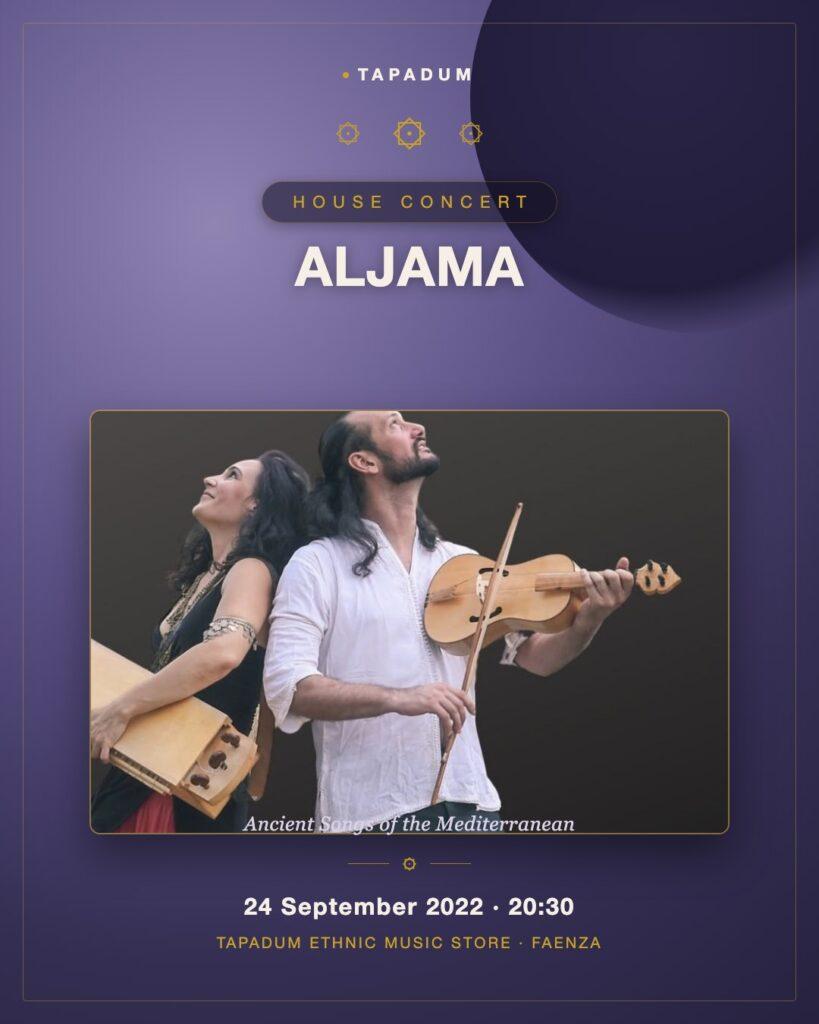
Aljama at Tapadum: A Musical Journey from Al-Andalus to Turkey
On 24 September 2022, the duo Aljama traced the Mediterranean diaspora from Al-Andalus to Turkey at Tapadum in Faenza — Sephardic romances, Cantigas, and Andalusian music on medieval strings and oud.
September 24 brought one of the most historically rich programs we have hosted — a musical and temporal journey through the Mediterranean, tracing the migrations of Sephardic, Christian, and Muslim communities from medieval Iberia to the shores of Turkey.
Nine people came. Twenty-nine more had been thinking about it.
What Is Aljama?
The name carries its history precisely. Aljama was the term used to designate the Arab and Sephardic minority communities still present on the Iberian Peninsula after the fall of the Arab Empire — communities whose expulsion and dispersal set one of the great cultural migrations of the Mediterranean world in motion.
The project takes that history as its starting point and follows it geographically and temporally: from the ancient Sephardic, Christian, and Muslim communities of Al-Andalus, through the diaspora routes that carried those communities — and their music — eastward across the Mediterranean toward Turkey over the course of centuries.
The Musicians
Claudio Merico and Giulia Tripoti are the core duo behind Aljama, produced by Karkum Project. Their instrument lists reflect the breadth of the historical territory they cover:
- Claudio Merico — viella, rebec, violin, symphonia, Arab-Andalusian rebab, oud, vocals
- Giulia Tripoti — voice, bendir, flutes, saz, symphonia, percussion, vocals, psaltery
The viella and rebec are medieval bowed string instruments — the ancestors of the modern violin — heard here alongside the Arab-Andalusian rebab, the instrument from which the European bowed string family ultimately descends. The oud and saz connect the music to its Turkish and Eastern Mediterranean destinations. The symphonia — a hurdy-gurdy — adds a drone beneath the melodic lines that gives the music its ancient, continuous quality.
Giulia’s vocal work carries the program. The Sephardic romances — ballads preserved in Ladino, the Judeo-Spanish language carried by exiled communities for five centuries — require a particular clarity and restraint. These are not art songs. They are memory songs, kept alive by communities in displacement.
The Repertoire: From Romances to Cantigas to Al-Ala
The program moves through three distinct but related bodies of material.
The Sephardic romances are the oldest layer — songs in Ladino that preserve medieval Castilian Spanish alongside Hebrew, Arabic, and local influences accumulated over centuries of diaspora. They carry the emotional texture of a people who maintained their cultural memory through song across generations of displacement.
The Cantigas de Santa Maria — thirteenth-century Galician-Portuguese devotional songs compiled under Alfonso X of Castile — represent the Christian layer of the same Iberian world, a repertoire that shows the depth of Arab-Andalusian influence on medieval European music.
Musica Al-Ala Andalusa is the classical Andalusian musical tradition preserved in North Africa — carried there by Muslim communities expelled from Iberia after 1492, maintained in Morocco, Algeria, and Tunisia in forms that have changed little over five centuries.
Three communities, three faiths, one shared musical space. The Mediterranean as it actually was, before the divisions that followed.
The Album
Aljama, the duo’s album produced by Karkum Project, documents a research and performance process begun in 2018. The recordings move between purely melodic and meditative moments and more rhythmic, involving passages — the full emotional range of a repertoire that has carried everything from grief to celebration across half a millennium. More information and audio are available at karkumproject.it.
Hear the Music
A live recording that gives a sense of the duo’s sound:
Tapadum hosts concerts from across the Mediterranean and beyond. Explore our handcrafted instrument collection or follow our upcoming events.
Özgür Yalçın is the founder of Tapadum and the founding member of Karagüneş. He has performed ethnic and world music across Europe for over twenty-five years and builds custom instruments from Tapadum’s workshop in Brisighella, Italy.