
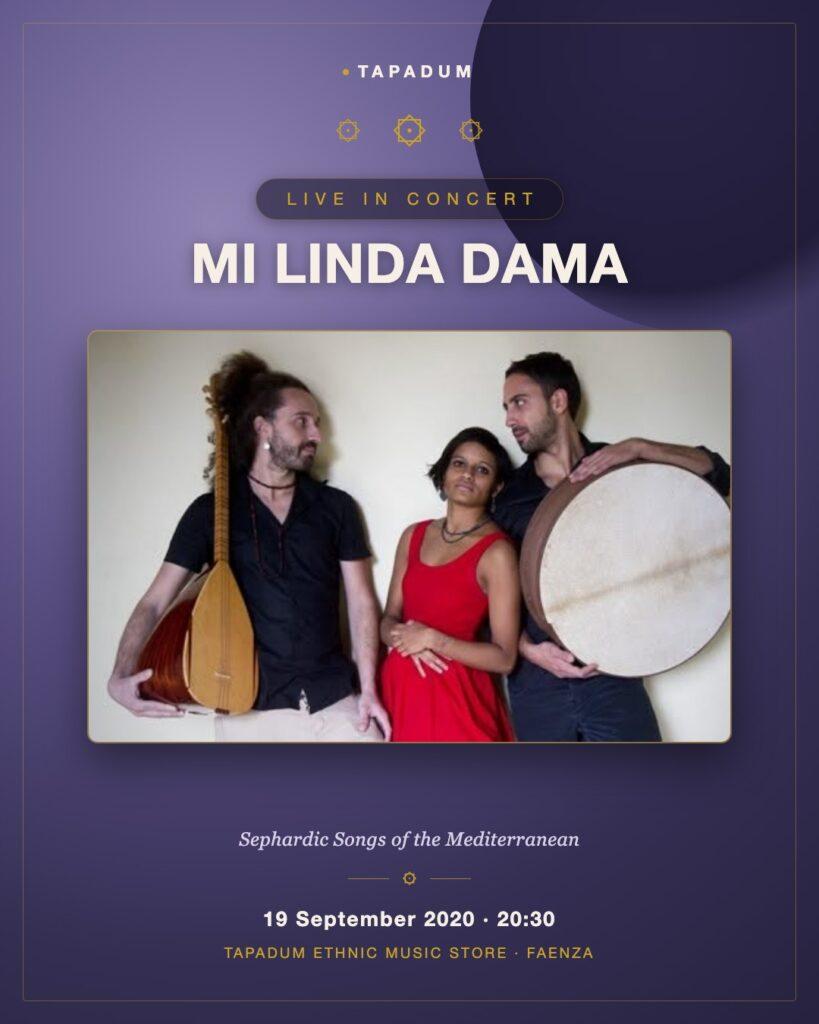
Mi Linda Dama at Tapadum: Sephardic Songs and Mediterranean Roots
On 19 September 2020, the trio Mi Linda Dama brought Sephardic song to Tapadum in Faenza — voice, Turkish saz, bouzouki, and darbuka reviving five centuries of Mediterranean diaspora music.
September 19 brought one of the most distinctive projects we have hosted to date. Mi Linda Dama — a trio rooted in Sephardic tradition and Mediterranean fusion — filled our home concert space in Faenza with ancient songs reborn in fresh arrangements.
Twenty-nine people came. For an autumn evening in 2020, that felt like a statement.
Mi Linda Dama: Ancient Songs, Modern Voice
Founded in 2015, Mi Linda Dama draws from the Sephardic musical tradition — the songs carried by Jewish communities expelled from Spain in 1492, dispersed across the Mediterranean, and preserved in languages that blended Castilian Spanish with Hebrew, Arabic, Greek, and Turkish over five centuries of migration.
The trio that evening:
- Namritha Nori — voice, loop
- Giulio Gavardi — guitar, Turkish saz, bouzouki, synth, soprano saxophone
- Niccolò Giuliani — cajón, darbuka, frame drums, wave drum, palmas, effects
The instrument list tells the story immediately. Turkish saz beside bouzouki, darbuka beside cajón, loop pedal beside ancient vocal melody. Mi Linda Dama does not treat Sephardic music as a museum artifact. They treat it as living material — capable of absorbing new influences, new sounds, new arrangements — without losing the emotional weight that makes it matter.
Their approach is fusion in the truest sense: not the blending of surfaces, but the recognition that these songs were always already hybrid, always already moving, always already carrying the traces of every culture the Sephardic diaspora passed through on its way across the Mediterranean.
Two Albums, One Journey
By the time they came to Tapadum, Mi Linda Dama had released two albums on Radici Music Records and performed over two hundred concerts across Italy.
Matesha (2017) takes its title from the Sephardic tradition of Saturday afternoon gatherings — young people of the community sitting around a swing, matesha, singing ancient stories of ladies and knights, loves and passions, their eyes meeting across the music. The album features collaborations with Sergio Marchesini on accordion, Alvise Seggi on double bass, and Enrico di Stefano on saxophone.
Skalerica (2019) goes deeper — peoples, traditions, scents, and colours; stories of exploration and diaspora along the length of the Mediterranean, a sea that sometimes gives and sometimes swallows. The title means something that brings everything to the surface, a chance to re-emerge from the depths. Collaborators include Maurizio Camardi on saxophone and duduk, Robindro Nikolic on bass clarinet, and Gabriele Gagliarini on percussion.
In 2017, Mi Linda Dama won the national prize “Folk and World: Nuove Generazioni” and the Musica nelle Aie competition in Faenza — a connection to our own territory that made the invitation feel particularly right.
See and Hear Their Work
Mi Linda Dama’s full catalogue of live recordings and studio work is available on their YouTube channel.
Festival Credits Worth Noting
Mi Linda Dama has performed at Folkest, Mercantia, Klezmer e Dintorni in Bologna, the Festival della Musica e Arti del Mediterraneo in Cagliari, and MusicaAMuseo at VenetoJazz in Venice — among many others. The breadth of that list reflects how well their music travels across different audiences and contexts.
What the Evening Felt Like
Sephardic music carries a particular emotional quality that is difficult to describe without hearing it — a combination of longing, beauty, and rootedness in loss that comes from five hundred years of displacement made into song. In a small room in Faenza, with twenty-nine people listening, that quality was present and undeniable.
Namritha Nori’s voice carried the ancient melodies with the kind of clarity that makes old songs feel urgent. Giulio Gavardi moved between instruments — Turkish saz, bouzouki, guitar — finding the right timbre for each piece. Niccolò Giuliani held the rhythmic architecture together with darbuka and frame drums that connected the music to its Mediterranean roots.
It was one of those evenings that stays with you.
Tapadum hosts concerts from across the Mediterranean and beyond. Explore our handcrafted instrument collection or follow our upcoming events.
Özgür Yalçın is the founder of Tapadum and the founding member of Karagüneş. He has performed ethnic and world music across Europe for over twenty-five years and builds custom instruments from Tapadum’s workshop in Brisighella, Italy.