
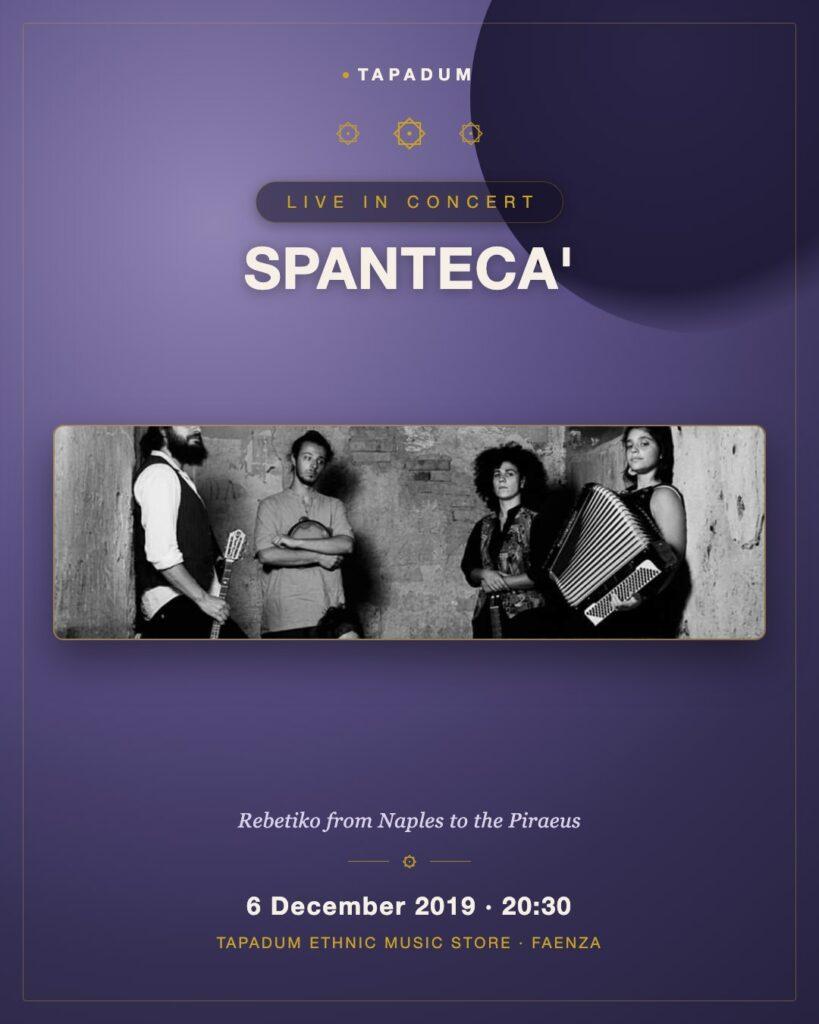
Spanteca’ in Faenza: Rebetiko from Naples to the Piraeus
On 6 December 2019, the Neapolitan band Spanteca' brought Greek rebetiko to Tapadum in Faenza — bouzouki, accordion, and voice telling songs of migration and the Mediterranean port underworld.
For our third concert at Tapadum, we invited a band from Naples that had been on our radar for some time. Twenty people came that evening. One hundred sixteen more had marked they were thinking about it — the highest interest we had seen since opening night.
Σπαντεκά — Spanteca’ — did not disappoint.
What Is Rebetiko?
Before the music started, a brief word about what rebetiko is — because it is not a word most people in Faenza had encountered before that evening.
Rebetiko was born in the suburban neighbourhoods of Piraeus in the early twentieth century, a fusion of local Greek folk music with the sounds brought by Greek refugees expelled from Istanbul and Izmir following the catastrophe of 1922. The rebetes — the people who played and lived this music — were the children of that diaspora. Marginally employed, socially marginalised, living at the edges of cities and legality. At night, the tekès — the taverns — filled with hookah smoke, drink, and music played and danced until dawn.
Their songs tell of migration, desperate love, poverty, imprisonment, and the hard life of the urban periphery. The music is a hybrid, born of exodus. As Spanteca’ put it simply: gut music. Music that comes from the stomach, not the head.
Spanteca’: Naples Meets the Piraeus
The name itself tells the story. Spanteca’ is a Neapolitan word, not Greek — derived from the Latin pantex, meaning belly. The band chose it deliberately, seeing a natural kinship between Naples and the world of rebetiko: two Mediterranean port cultures, both shaped by poverty and resilience, both producing music of extraordinary emotional directness.
The lineup that evening:
- Peppe Treccia — bouzouki, tzouras, baglamas
- Elisa Guarraggi — voice
- Huw Williams — guitar
- Júlia Costella — accordion
- Salvatore La Rocca — percussion
Five musicians from different geographic and artistic backgrounds who had found each other in Naples through a shared love of sounds that travel and cultures that move. The bouzouki and tzouras gave the music its distinctly Greek texture; the accordion and voice pulled it toward something more Southern Italian; and the percussion held it all together in rhythms that felt ancient and urgent at the same time.
Elisa Guarraggi sang with the kind of controlled passion that rebetiko requires — not theatrical, but deeply felt. The texts dealt with migration, longing, and the dignity of the dispossessed. In the room a few kilometres from Faenza’s city centre, the material felt surprisingly immediate.
The Imaginary Thread Between Naples and the Piraeus
What Spanteca’ does is not imitation or recreation. They draw an imaginary thread between Naples and the Piraeus — two port cities, two peoples of the sea, two cultures with the same belly. The band described their project as an identification with the rebetiko spirit rather than a strict musicological reconstruction. They chose pieces from the rich rebetiko repertoire and gave them new voice, filtering them through their own backgrounds and sensibilities.
The result is music that sounds both old and alive. The bouzouki rings with the particular metallic clarity that distinguishes it from any other plucked instrument. The accordion adds warmth and a slight melancholy. The percussion drives without dominating. And the voice — always the voice in rebetiko — carries the weight of everything the songs are about.
Tapadum as a Meeting Point
This was our third concert in as many months since opening. The pattern was becoming clear: Tapadum was not just a place to buy and build instruments. It was becoming a meeting point for musicians and music that rarely found a stage in this part of Italy.
Rebetiko is not common in Emilia-Romagna. A band from Naples playing Greek music born of Turkish-Greek exile is not the kind of thing that appears on the usual concert circuit. But at our home concert space in Faenza, in a small room that smelled of wood and strings, it made complete sense.
Tapadum continues to host concerts from across the Mediterranean and beyond. Explore our handcrafted instrument collection or follow our upcoming events.
Özgür Yalçın is the founder of Tapadum and the founding member of Karagüneş. He has performed ethnic and world music across Europe for over twenty-five years and builds custom instruments from Tapadum’s workshop in Brisighella, Italy.