
How to Tune a Persian Setar
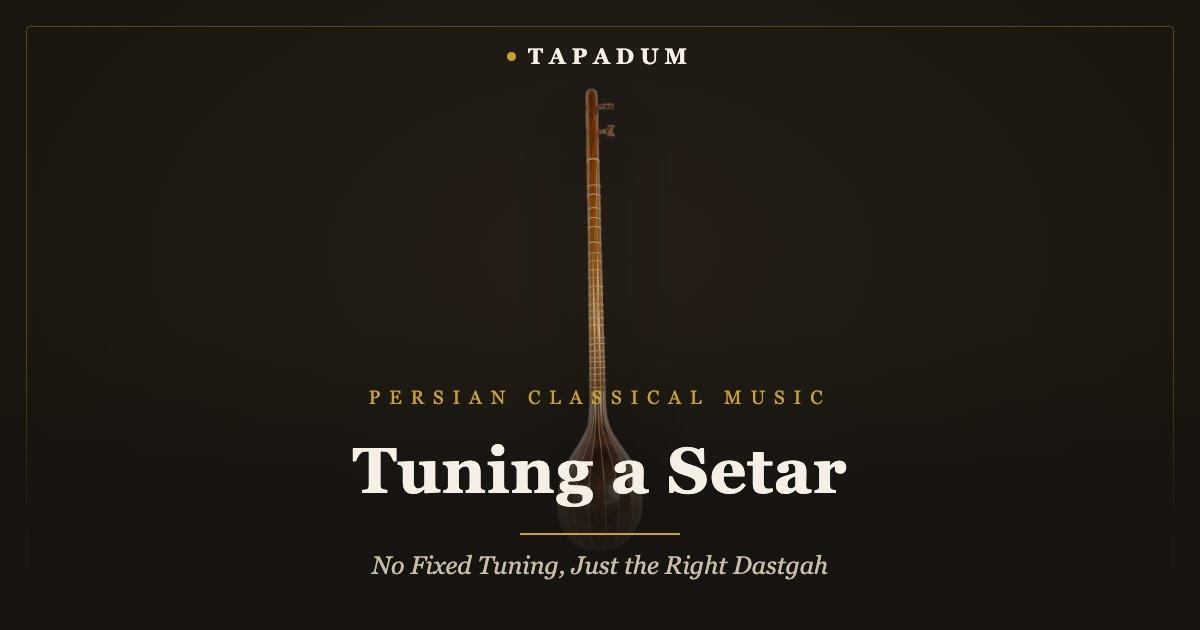
What you’ll learn: why a setar doesn’t have one fixed tuning the way a guitar does, what each of its four strings is for, the most common starting tuning for beginners, and how to care for its traditional wooden friction pegs.
A Persian setar doesn’t have a single correct tuning — its four strings are retuned depending on the dastgah (modal system) being played, the singer’s range, or the ensemble it sits in. That flexibility is a feature, not a complication: once you understand what each string does, adjusting for a new piece takes seconds, not a full re-learning of the instrument.
This guide covers why setar tuning works this way, what each string is for, the most common starting tuning, and how to keep wooden friction pegs holding steady.
Why Setar Tuning Isn’t Fixed Like a Guitar’s
A guitar is tuned the same way for almost everything you play on it. A setar isn’t, because Persian classical music is organized around dastgahs — modal systems that each carry their own characteristic intervals, ornamentation, and repertoire. Retuning one or two strings to suit the dastgah being performed lets the setar resonate properly with that mode’s key notes, rather than fighting against a fixed tuning that only suits some of them.
String Order and What Each One Does
The setar’s four strings run, from the player’s perspective, roughly as: a white (highest) string, a yellow string, a drone string, and a bass string. Despite the name setar meaning “three strings,” a fourth was added in the eighteenth century and every modern setar carries it. The two lower strings are often tuned in unison or an octave apart, but not always — their exact relationship shifts with the dastgah, which is why setar players describe tuning as something adjusted piece to piece rather than set once.
The Most Common Starting Tuning
For a beginner, the most useful reference point is the tuning associated with Shur — the dastgah most other Persian modes and pieces are considered to branch from. Shur’s characteristic intervals (a neutral second, minor third, and perfect fourth) make it the natural first tuning to learn, both because it’s foundational to the repertoire and because most instructional material assumes it as a starting point. From there, adjusting toward other dastgahs like Chahargah becomes a matter of shifting one or two strings rather than relearning the instrument.
Aural vs Electronic Tuning
Two methods work, and most players end up using both. An electronic tuner gets you to a precise, repeatable pitch quickly and is the easier starting point for a beginner. The aural method — tuning one string to a reference pitch, then adjusting the rest by ear — takes longer to develop but is how the setar has traditionally been tuned, and it’s the skill that eventually lets you adjust on the fly mid-rehearsal without stopping to check a device.
Caring for Wooden Friction Pegs
Traditional setars use wooden friction pegs rather than geared guitar-style tuners, which means the peg holds tension through friction against the peg box, not mechanical leverage. Pegs can slip in high humidity and stick in dry conditions — a light application of peg compound (or plain soap in a pinch) helps a slipping peg grip without over-tightening it. Turn pegs gently and push inward slightly as you turn; forcing a stuck peg risks cracking the peg box.
When to Retune
Beyond switching dastgahs, retune whenever the setar has sat through a significant humidity or temperature change — wood movement affects string tension more on a setar’s light frame than on a solid-bodied instrument. New strings also need several days of settling and repeated retuning before they hold pitch reliably.
Frequently Asked Questions
Does a setar have one correct tuning?
No. Setar tuning changes depending on the dastgah (modal system) being played, the singer’s range, or the ensemble — it’s adjusted piece to piece rather than fixed like a guitar’s standard tuning.
How many strings does a setar have, and how are they tuned?
Four strings, despite the name meaning “three strings” — a fourth was added in the eighteenth century. The two lower strings are often tuned in unison or an octave apart, but the exact relationship shifts with the dastgah.
What’s a good starting tuning for a beginner?
The tuning associated with Shur, the dastgah most other Persian modes are considered to branch from. It’s the standard reference point in most instructional material.
Should I use an electronic tuner or tune by ear?
Both are valid. An electronic tuner is faster and more precise for a beginner; tuning by ear takes longer to develop but is the traditional method and eventually lets you adjust without a device mid-rehearsal.
How do I stop a setar’s tuning pegs from slipping?
Apply a small amount of peg compound (or soap in a pinch) to a slipping wooden friction peg, and push gently inward while turning. Avoid over-tightening, which risks cracking the peg box.