Percussion Accessories: Cases and Stands for Handpan, Darbuka and Tombak
What you’ll learn: the three levels of handpan protection and which one your travel actually calls for, why a goblet drum needs a case built around its head and rim, what a handpan stand has to leave uncovered to keep the instrument sounding right, and which accessory is worth buying first.
Percussion accessories for hand-played drums come down to two jobs: protecting the instrument in transit and holding it safely while you play. There is no reed, no string set, no consumable part here — which is why the decisions are one-time ones, and why getting them right matters more than with instruments you re-buy parts for. A handpan is a tuned steel shell whose tone fields go out of voice if they take a hit; a tombak or darbuka carries a head and rim that are the first things to suffer in a crowded car boot.
This guide covers what we actually stock for those instruments — three grades of handpan case, a hard case for goblet drums, and two stands — and how to pick between them.
What Percussion Accessories Cover
Our percussion accessory range is deliberately narrow, and it is worth saying what is and is not in it. It covers protection (cases and bags) and support (stands) for the handpan and for goblet drums. It does not cover replacement heads, and sticks and mallets live elsewhere — santur hammers and the Persian zahme sit in the santur accessory range, since that is the instrument they are cut for.
| Need | What covers it | Price |
|---|---|---|
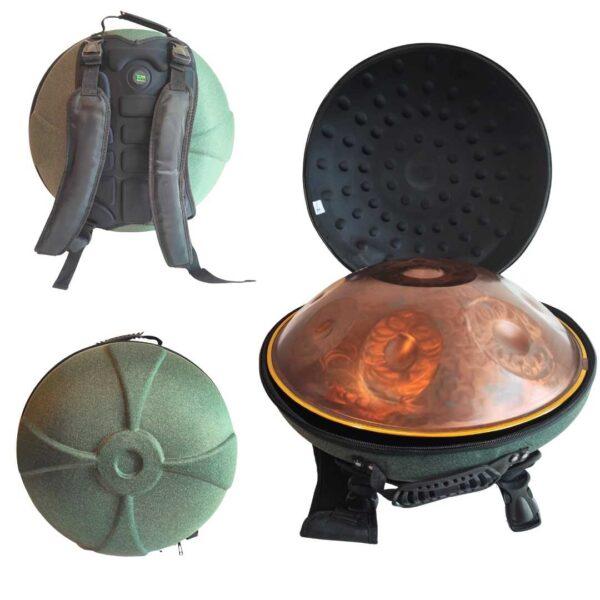
| Everyday handpan carrying | Handpan Case – Safety Bag | €175,00 |
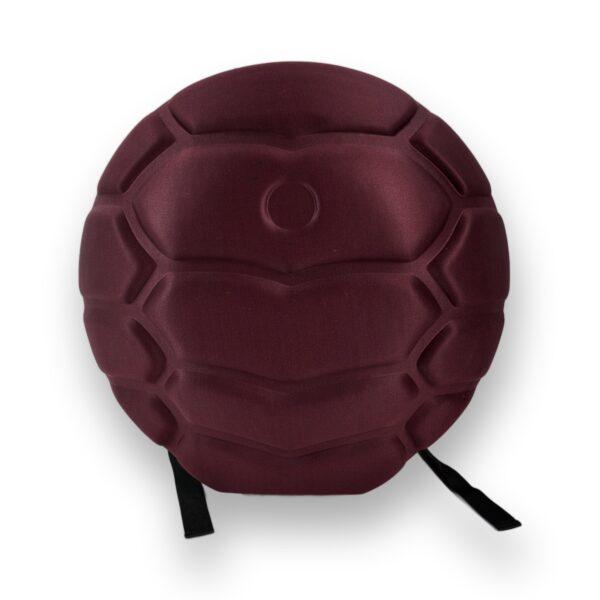
| Regular gigging with a handpan | Handpan Case Tortoise – Safety Bag | €189,00 |
| Air travel and rough handling | Hard Case for Handpan – Cargo Case | €219,00 |
| Transporting a tombak or darbuka | Tombak Hard Case – EVA Backpack Case | €129,00 |
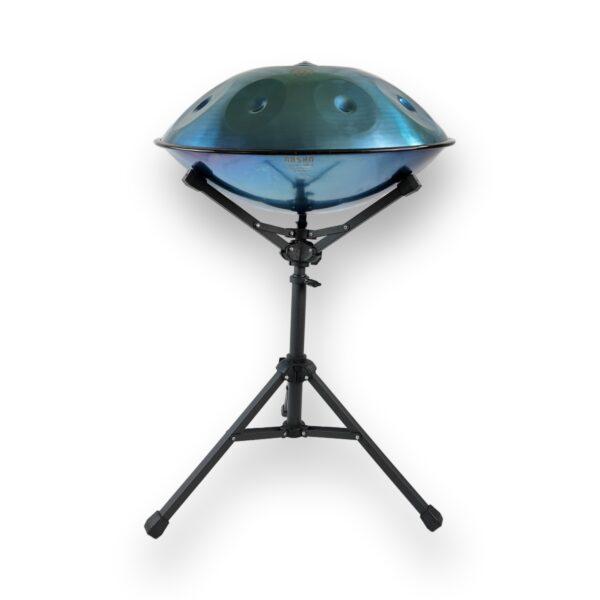
| Playing height for a handpan | Handpan Stand – Mahan V100 | €85,13 |
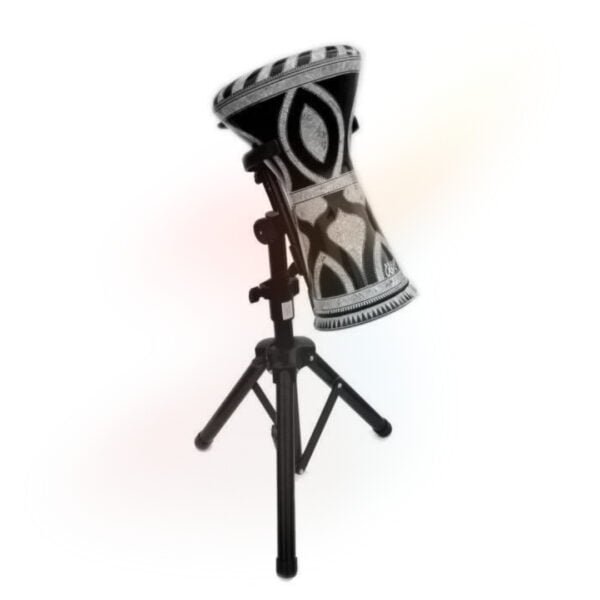
| Holding a darbuka upright | Darbuka Stand | €199,16 |
Handpan Protection: Three Levels, One Question
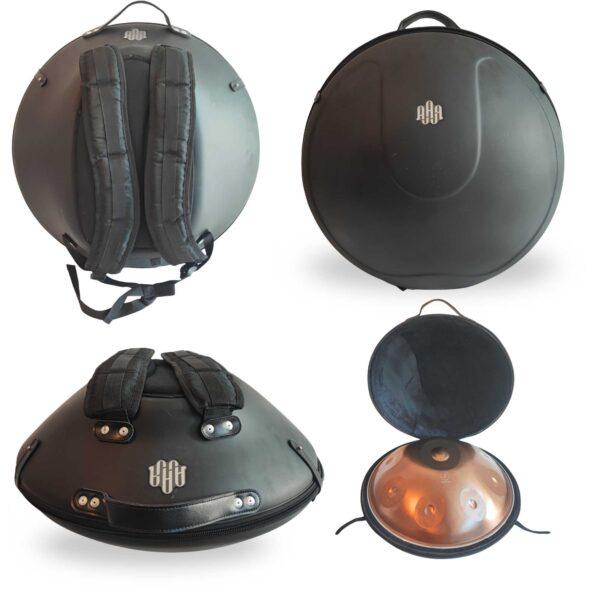
All three handpan cases carry on backpack straps and all three keep the instrument centred so the tone fields never touch the shell wall. What separates them is the outer shell — and the honest way to choose is to ask how the instrument travels, not how much protection sounds reassuring.
| Safety Bag | Tortoise | Cargo Case | |
|---|---|---|---|
| Shell | Durable PU plastic | Molded hard shell, tortoise relief | Reinforced fiberglass |
| Closure | Zip | Zip | Secure locking system |
| Carry | Backpack straps | Backpack straps, 2.3 kg | Handles + adjustable shoulder straps |
| Built for | Rehearsals, sessions, daily carry | Frequent gigs, weather, scuffs | Air travel, road trips |
| Price | €175,00 | €189,00 | €219,00 |
The entry-level Safety Bag is a padded shell with reduced-pressure interior padding, 61 × 61 × 32 cm, shockproof and weather-resistant. For a player carrying an instrument between home, a rehearsal room and the occasional session, it is the whole answer.
The Tortoise sits deliberately in the middle. Its molded shell is pressed into a segmented tortoise-shell relief, and those raised panels are structural rather than decorative — they stiffen the shell and spread an impact across the surface instead of letting it reach the instrument. At 2.3 kg it still carries like a backpack, which is the point: rigid security without the bulk of a flight case.
The Cargo Case is the one to buy if the handpan gets checked as luggage. Reinforced fiberglass, impact-absorbing interior, and a locking closure rather than a zip — the three things that matter when the instrument leaves your hands and travels somewhere you cannot see it. If you never fly with the instrument, you are paying for protection you will not use.
Whichever level you choose, the case does nothing about the other threat to a handpan: moisture. Steel rusts, and the inside of a closed case after an outdoor session is exactly the wrong environment. Wipe the instrument down before it goes in, and do not store it damp.
A Hard Case for Goblet Drums
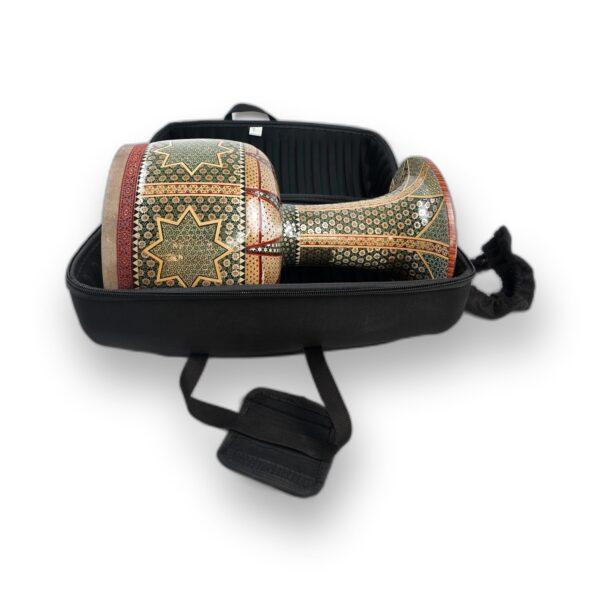
The Tombak Hard Case is built around the specific weakness of a goblet drum: the head and the shell rim. Protection works in three layers — a rigid EVA outer shell that holds its shape and takes the hit, a ribbed foam lining that cushions the body against vibration, and a soft felt pouch that slips over the drum so the head and rim get their own padding inside the case.
Practically, it is a clamshell: a full dual zip opens the case flat, so you are not forcing the drum past a half-open lid. It carries three ways — removable padded backpack straps, a reinforced top handle, and a shoulder strap — and the interior measures 51 × 31 cm, sized for standard tombaks.
That measurement is the thing to check before ordering. A clay darbuka or a large aluminium one is not the same shape as a tombak, so measure your drum’s height and widest diameter against the case interior rather than assuming a goblet drum is a goblet drum.
Stands: Height for a Handpan, Stability for a Darbuka
The two stands solve different problems. A handpan stand is about playing position; a darbuka stand is about keeping the drum where you put it.
The Mahan V100 is a folding tripod in powder-coated steel with a matte black finish, and the detail that matters most is what it does not cover. A four-arm cradle opens in a wide X and supports the instrument’s curved underside at four points with soft tips, leaving the gu port underneath free to breathe — the port is part of how a handpan resonates, and a solid pad across it dampens the instrument you paid for. The legs splay and lock for a low, wide footprint, the centre column is telescopic, and setup needs no tools.
The Darbuka Stand is a simpler proposition: adjustable height, a secure grip on the shell, and a universal fit across body sizes. It holds the drum upright and stable for seated play, and keeps the shell and head off hard floors between sessions — which for a clay drum is the difference between a long life and one bad knock.
What to Buy First
Three realistic starting points:
- A new handpan owner playing at home. The stand before the case. You are not travelling yet, and a stand fixes playing height and keeps a heavy steel shell off the floor — the most likely source of damage in a room.
- A player carrying an instrument to sessions. The Safety Bag, or the Tortoise if you are out weekly and in weather. Both carry as backpacks, which is what actually determines whether you take the instrument out.
- A performer who flies. The Cargo Case, without hesitating over the price difference. A checked handpan in a soft bag is a repair bill waiting to happen, and retuning a knocked tone field is not a home job.
If you are still choosing the instrument, our handpan buyer’s guide and the guide to how a handpan is tuned cover scale and size, and essential darbuka rhythms is where to start on the goblet-drum side. Players of long-necked lutes will find the equivalent list in our saz and baglama accessories guide. Every accessory here is checked at our Brisighella, Italy showroom before it is listed, matched to the instrument it serves rather than sold as generic hardware.
Frequently Asked Questions
Do I need a hard case for a handpan, or is a padded bag enough?
A padded bag is enough for carrying the instrument by hand — home, rehearsals, local sessions. A hard case earns its price when the handpan leaves your control: checked airline baggage, cargo, or shared transport. The middle option, a molded hard-shell backpack case, covers frequent gigging without flight-case bulk.
Will a tombak case fit my darbuka?
Only if the measurements match. The Tombak Hard Case has a 51 × 31 cm interior and is sized for standard tombaks; darbukas vary in height and rim diameter, and clay bodies in particular are wider. Measure your drum before ordering rather than assuming all goblet drums share dimensions.
Does a handpan stand affect the sound?
It can. The gu port on the underside is part of how the instrument resonates, so a stand that presses a solid surface against it dampens the tone. An open cradle that supports the curved underside at a few soft contact points — four, in the case of the Mahan V100 — leaves the port free and keeps the sound intact.
How do I stop a handpan from rusting?
Keep it dry and do not store it damp. Wipe the instrument down after playing, especially after an outdoor session or a humid room, and let it dry before it goes into a closed case — sealed moisture is worse than open air. A case protects against impact, not corrosion.
Is a darbuka stand necessary if I play seated with the drum on my lap?
Not for playing, but it changes what happens between sessions. A stand keeps the shell and head off hard floors and out of the way of feet and chair legs, which is where most avoidable damage to a clay drum comes from. For seated play it also fixes a consistent height and angle.
The Percussion Accessory Range
All six items in our percussion accessories range, alongside the instruments they serve in our percussion collection:
-
Read more

-
−8%Add to cart
-
SaleSelect options This product has multiple variants. The options may be chosen on the product page
-
−28%Add to cart
-
−12%Add to cart
-
SaleSelect options This product has multiple variants. The options may be chosen on the product page