Choosing a Hand Drum for Beginners: Darbuka, Cajon or Udu
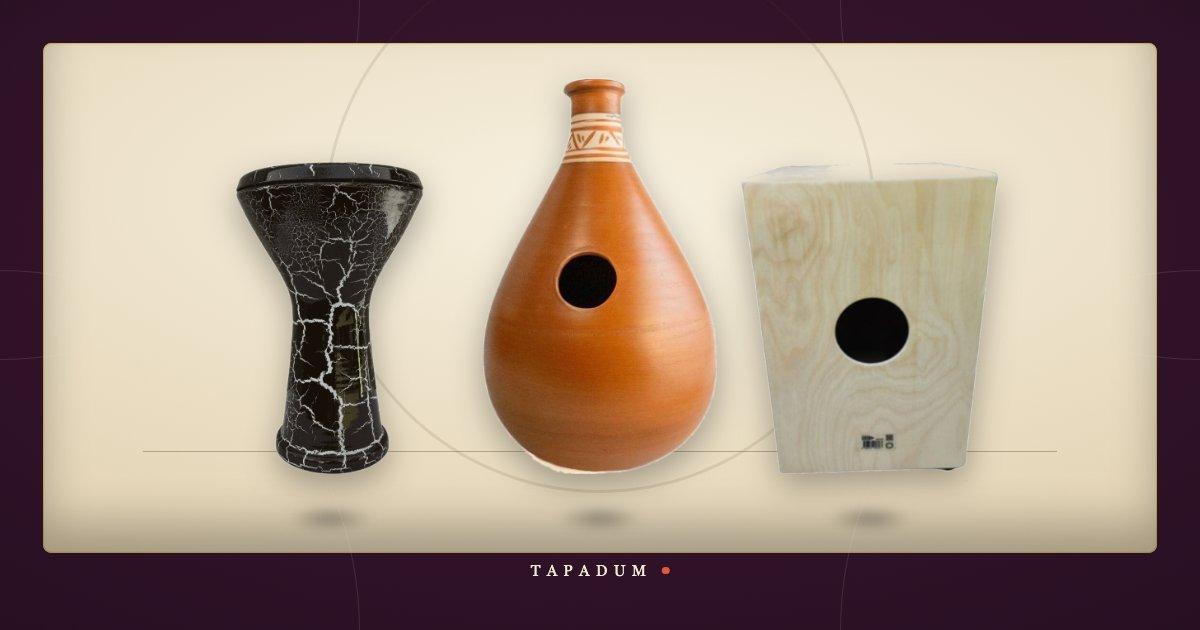
What you’ll learn: how a darbuka, a cajon and an udu actually differ in your hands, which of the three gives you a sound you enjoy on the first evening, what changes when you are playing to unwind rather than to perform, and a straight recommendation for each starting point.
If you are looking for a hand drum for beginners and your goal is calm rather than the stage, three instruments come up again and again: the darbuka, the cajon and the udu. The short answer is that they solve different problems. The udu asks almost nothing of you technically and is the quietest by a wide margin. The cajon gives you a low bass and a sharp slap within minutes, and you sit on it. The darbuka is the most expressive of the three and also the one with the steepest first month.
None of them requires tuning knowledge, notation, or a teacher to produce a sound worth listening to on day one. What actually separates them is volume, how they sit in a room, and how long before your hands stop fighting the instrument. This guide compares those three things directly, using the models we keep in stock.
The Short Answer: Which of the Three Fits You
| Instrument | First satisfying sound | Volume | How you hold it | Start here if… |
|---|---|---|---|---|
| Udu | Immediate | Quiet | On the lap or floor | You want slow, meditative playing in a flat with neighbours |
| Cajon | Within an hour | Loud | Seated on the drum | You want bass and snare from one instrument, and you have room |
| Darbuka | A few weeks for the full voice | Bright and carrying | Under the arm or on the thigh | You want the widest expressive range and will practise |
If you want one sentence: buy the udu for stillness, the cajon for immediate groove, the darbuka for the long road.
What Counts as a Hand Drum Here — and What Doesn’t
This guide covers drums struck with bare hands, where the pitch is fixed and rhythm is the material you work with. That excludes the melodic instruments people often meet in the same context. A handpan or a steel tongue drum plays notes and scales; those belong to a different decision entirely, and we cover them in our steel tongue drum guide and in building a sound bath set.
Frame drums — the Persian daf, the Turkish bendir — are hand drums too, but they form their own family with their own technique, and they are usually a second instrument rather than a first. If that is where you are heading, read frame drums for meditation instead.
The Darbuka: The Most Expressive, and the Steepest
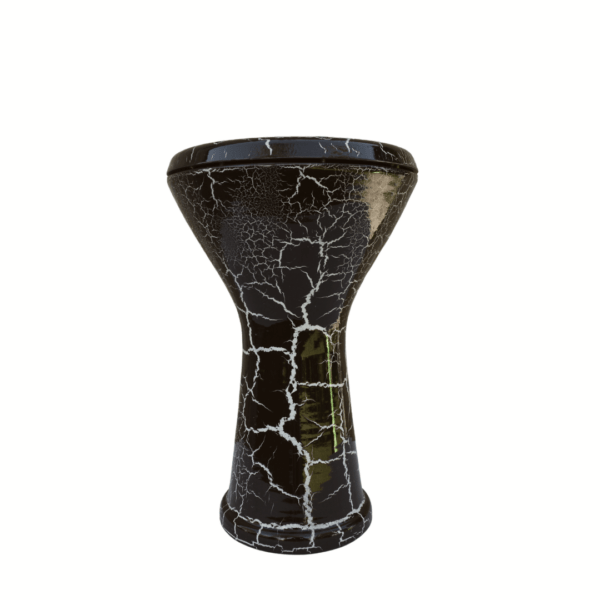
The darbuka is a goblet drum — a narrow-waisted single-headed drum played with both hands. You will also see it called doumbek across much of the English-speaking world, tabla in Egypt, and classed by scholars as a goblet drum. Same instrument, four names.
Its whole language is built from two sounds: the doum, a low tone struck in the centre of the head, and the tek, a sharp crack played with the fingers at the rim. The doum comes easily. The tek is what takes time — a clean, ringing tek needs a relaxed hand and a specific fingertip contact, and most players spend the first few weeks getting a dull thud instead. That is normal, and it is the honest reason the darbuka is not the fastest instrument on this list to enjoy.
For a first darbuka we point people at the Egyptian Darbuka Travel Light. It has a fiberglass body rather than clay or cast metal, weighs 2.4 kg, stands 44 cm tall, and carries a 22 cm synthetic head tuned with an Allen key. Two of those details matter more than they sound. Fiberglass will not crack if it is knocked, unlike a clay shell. And a synthetic head does not react to humidity the way goatskin does, so it holds its pitch through a damp autumn without any attention from you — a real advantage when you are still learning what the drum is supposed to sound like.
Before any hand drum reaches our shop I play it for tone and response, and the thing I check first on a beginner darbuka is whether the rim gives a usable tek without force. A drum that only speaks when you hit it hard teaches you bad hands.
If you decide the darbuka is your instrument, the complete darbuka buying guide covers the clay, aluminium and copper shells in depth, and maksum, baladi and malfuf are the three rhythms to learn first.
The Cajon: You Sit On It, and It Does Two Jobs
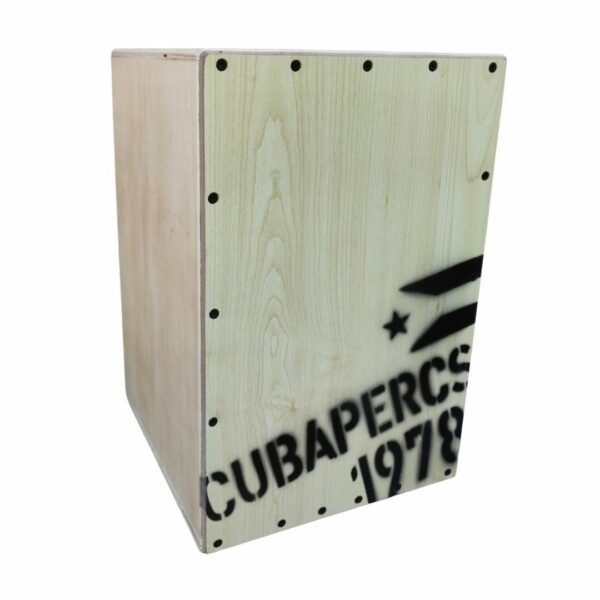
The cajon is a wooden box drum from coastal Peru that entered flamenco in the late 1970s and has since become the default portable percussion instrument in acoustic music worldwide. You sit on top and strike the front panel.
That single panel produces two distinct sounds with no technique required: strike the middle and you get a round bass note; strike the top edge and the panel snaps against internal cables for a bright, snare-like crack. That is why the cajon is the quickest of the three to feel musical — within an hour you have a kick and a snare, which is enough to play along with almost any recording.
Our Cajon By Cuba Percs N.2 has a beech and poplar body with an implanted birch soundboard, two cable systems with adjustable tension, slip-resistant plastic feet, and measures 30 × 30 × 45 cm at 3.5 kg. The adjustable cables matter: how much snare buzz you want is a genuine matter of taste, and being able to loosen it is the difference between an instrument you keep and one you tolerate.
Two honest drawbacks. It is the loudest of the three — a cajon played properly fills a room and travels through a floor. And it is furniture-sized; it doubles as a stool, which some people love and others find awkward in a small flat. Our cajon buying guide covers the classic-versus-bongo cajon question if you are choosing between models.
The Udu: The One Built for Slowness
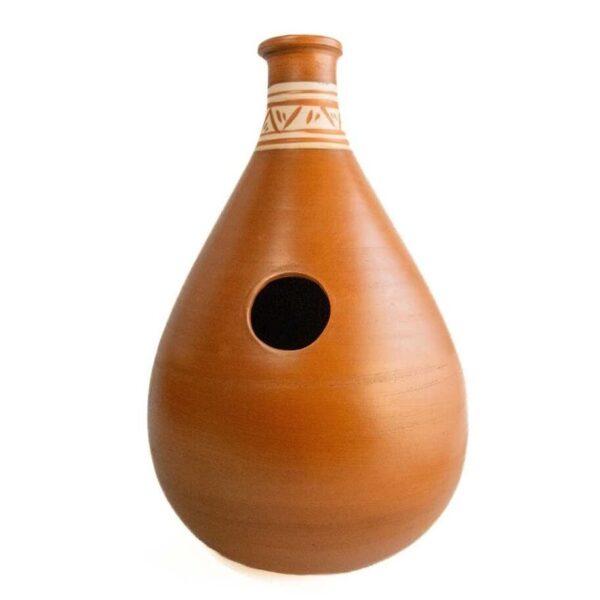
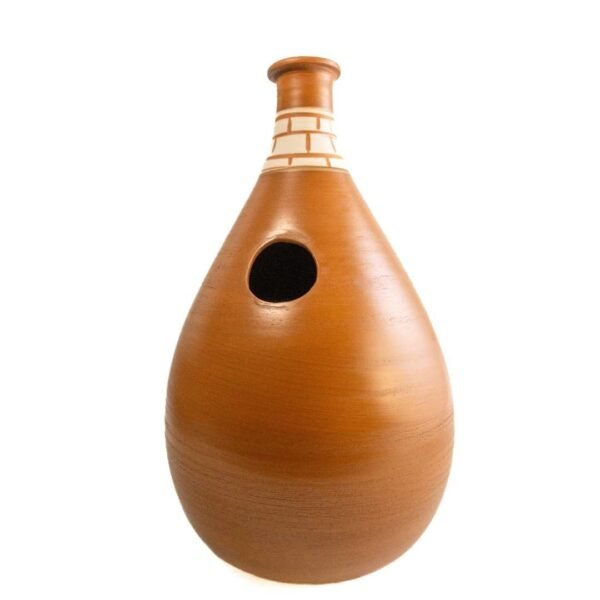
The udu is a clay vessel drum from the Igbo people of Nigeria, where the word means simply vessel or pot. It began as a water jar with an extra hole cut in the side, and that hole is still the whole point of the instrument.
Cover the side hole with your palm and release it, and the drum produces a deep, bending whoop — a pitch that drops as the air moves. Nothing else on this list makes that sound. The rest of the body responds to fingertips with soft, dry taps. The result is an instrument with a small dynamic range and an unusually large amount of colour inside it, which is exactly why it suits playing alone in the evening.
It is also, by a clear margin, the quietest of the three. A darbuka carries down a corridor; an udu barely leaves the room. If you live in a flat, share walls, or want to play at eleven at night, this is the practical answer.
Ours are handmade and hand-tuned in clay — the Professional Udu Drum n.1 is where most people start, with larger n.7 and n.8 bodies available if you want more bass. The trade-off is fragility: clay breaks, and an udu wants a padded bag and a spot on the floor rather than a shelf edge. It is also not a dance-music instrument; if you want to drive a groove, this is the wrong choice. Our full guide to the udu drum covers its history and playing technique in detail.
Side by Side
| Egyptian Darbuka Travel Light | Cajon Cuba Percs N.2 | Professional Udu n.1 | |
|---|---|---|---|
| Body | Fiberglass | Beech and poplar, birch face | Hand-shaped clay |
| Head | 22 cm synthetic, tunable | None — the panel is the head | None — the clay is the body |
| Weight | 2.4 kg | 3.5 kg | Light, varies by piece |
| Size | 44 cm tall | 30 × 30 × 45 cm | Sits on the lap or floor |
| Relative volume | Bright, carries | Loudest | Quietest |
| Time to a sound you like | Weeks for the full voice | Under an hour | Immediate |
| Durability | High — will take a knock | High | Fragile — it is clay |
| Needs tuning? | Rarely, and it is one key | No | No |
What Actually Matters When You’re Playing for Calm
Buying advice written for performers optimises for projection and stage presence. If you are buying to unwind, four different things decide whether the drum stays in use or ends up in a cupboard.
Volume, honestly assessed. The most common reason a hand drum stops being played is that its owner becomes self-conscious about the neighbours. Judge this before tone, not after.
Where the effort lands in your hands. The darbuka works the fingertips and the edge of the palm at the rim; the cajon uses flat hands against a hard panel; the udu is almost entirely fingertips and one flat palm. Anyone with wrist or joint problems generally finds the udu the most forgiving and the cajon the most tiring over a long session.
Posture. You sit upright on a cajon, which is good for the back but fixes you in one position. A darbuka sits under the arm or across the thigh and asks you to lean slightly. An udu rests on the lap or on the floor between the legs and lets you sit however you like.
No maintenance anxiety. A synthetic head and a clay body both stay where they are. Natural goatskin, by contrast, moves with the weather and wants attention — a wonderful thing for an experienced player and a source of quiet frustration for a new one.
On the wellbeing question itself, we would rather point you at the evidence than make a claim. The science of group drumming sets out what controlled studies have actually measured, with sources. What we can say from the shop floor is narrower and safer: people come back for the instrument they were not embarrassed to play, and that is usually the quiet one.
Which One to Start With
You live in a flat and want to play in the evening. Udu. It is the only one of the three that does not force a conversation with your neighbours.
You want to play along with music you already listen to. Cajon. Bass and snare in one box, and it works with a guitar in the room.
You are drawn to Middle Eastern and Turkish rhythm and expect to keep at it. Darbuka. It costs you the most patience and gives back the most range. Start with the Travel Light and move to clay or copper later if the instrument sticks.
You are buying for a group, circle or class. Darbukas, because a set of matched drums is what a circle actually needs, and because their voices separate clearly when several people play at once.
All three are in stock in our percussion collection, and if you are still torn between families rather than models, tombak versus darbuka covers the closest neighbour to the goblet drum.
Frequently Asked Questions
Which hand drum is quietest for an apartment?
The udu, clearly. Its sound is produced by air moving inside a closed clay vessel rather than by a stretched head, so it has a small dynamic range and very little carry. A darbuka and especially a cajon both project through walls and floors when played properly. If shared walls are your main constraint, the udu is the only one of the three that solves the problem rather than managing it.
Do I need to tune a beginner hand drum?
Not in any ongoing sense. A cajon and an udu have nothing to tune. A darbuka with a synthetic head, like the Egyptian Darbuka Travel Light, is tuned once with an Allen key and then stays put, because synthetic heads do not respond to humidity. Natural goatskin heads do move with the weather and need adjusting, which is one reason we suggest a synthetic head for a first instrument.
Can I learn a hand drum without a teacher?
Yes, for all three, though to different depths. The cajon and the udu give up most of their basic vocabulary on the first evening. The darbuka has a genuine technique behind the tek stroke that is faster to learn with someone correcting your hand, but plenty of players start alone with a rhythm like maksum and add lessons later.
Is a cajon really a hand drum?
Yes. It is played with bare hands on a wooden panel rather than on a stretched skin, which makes it a box drum rather than a membranophone, but the technique and the role are the same as any other hand percussion instrument. Players often use brushes or light beaters on it as well, which is not usual for a darbuka or an udu.
Which of the three suits a sound bath or meditation group?
The udu, and to a lesser extent the darbuka played softly. A sound bath is usually built on sustaining instruments — bowls, gongs, sometimes a handpan — with percussion providing texture rather than a beat. The udu’s soft attack sits underneath that well. A cajon is generally too loud and too rhythmically definite for the context.