
One Instrument, Three Makers: What Actually Changes?
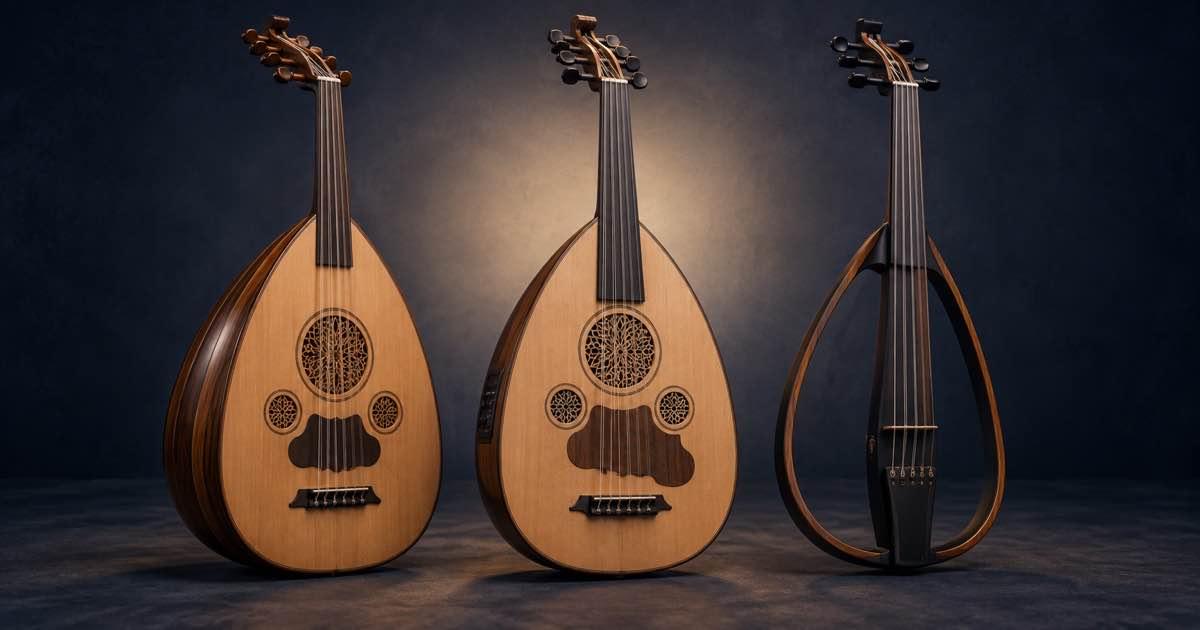
In brief: Two ouds can share the same basic family yet feel made for different musical lives. The useful comparison is not a price ladder. It is a look at construction, acoustic or amplified use, tuning hardware and the player’s actual setting. Here we compare three current Tapadum examples: a silent electric oud by Mustafa Gezerdag, a professional Turkish oud by Feramis Aktas, and a Sultan Plus oud by Yildirim Palabiyik.
One instrument, three makers does not mean three interchangeable versions of the same object. An oud is always a short-necked, fretless lute, but the choices around its body, electronics, tuning hardware and intended musical setting change what the player asks of it.
That distinction matters because labels such as “professional” and “premium” do not explain an instrument on their own. A player deciding between three ouds needs to know what is physically different, where they expect to play, and which demands belong to their own practice rather than the instrument.
Start with the musical situation, not the maker’s name
A maker’s name can tell you where an instrument comes from. It cannot replace the practical questions. Will you mostly practise at home? Do you need to connect to amplification? Are you looking for a Turkish oud response, an instrument that can move between Turkish and Arabic repertoire, or a quieter practice solution?
The three examples below answer different versions of those questions. None is presented as the “best” oud in the abstract. Each has a distinct construction brief.
| Example | What is documented | Useful starting question |
|---|---|---|
| Mustafa Gezerdag MG-E2 | Silent electric oud with guitar pegs; frame-style construction without a conventional soundbox | Do I need a quieter, amplified practice and performance setup? |
| Feramis Aktas Professional Turkish Oud | Concert-grade Turkish oud with built-in pickup, made for live use, recording and amplified ensembles | Do I need an acoustic oud that is ready to connect when required? |
| Yildirim Palabiyik Sultan Plus Oud | Acoustic oud intended to work across Turkish and Arabic musical settings | Do I want one acoustic instrument for more than one repertoire direction? |
Maker one: Mustafa Gezerdag and the silent-electric route
The MG-E2 silent electric oud by Mustafa Gezerdag begins with an unusually direct decision: it does not rely on a conventional resonant soundbox. Its frame-style construction and guitar pegs point to a player whose central need is controlled volume and straightforward tuning hardware.
“Silent” should not be read as soundless. It means the instrument is designed for an amplified signal rather than for filling a room acoustically in the way a traditional bowl-backed oud does. That makes it relevant for headphone practice, home playing where volume needs care, recording workflows and amplified performance.
This is not a shortcut around technique. A fretless neck still asks the player to listen closely to intonation, work carefully with the risha and learn the musical language they want to play. What changes is the environment around that work.
Maker two: Feramis Aktas and the working acoustic oud
The Professional Turkish Oud by Feramis Aktas is documented as a concert-grade instrument with a built-in pickup, intended for live use, recording and amplified ensembles. Its starting point is different from the MG-E2: it remains an acoustic oud, while retaining a practical route to amplification.
That combination suits a player who expects the acoustic voice to remain central but may also play with other musicians, perform through a system or record. The built-in pickup is a function, not a measure of musical worth. It answers a workflow question: can this instrument enter an amplified setting without adding a separate external solution?
Feramis Aktas’s example also shows why “professional” needs unpacking. In this context, it describes the intended use and construction level stated for the instrument. It does not promise that the oud will make a beginner’s first months effortless, or that every advanced player will prefer the same response.
Maker three: Yildirim Palabiyik and a broader repertoire brief
The Yildirim Palabiyik Sultan Plus Oud is described as an acoustic oud for musicians seeking an instrument that can work across Turkish and Arabic musical settings. That makes repertoire the centre of the decision.
Turkish and Arabic oud traditions are related, but they are not identical choices of tuning, sound ideal or musical phrasing. A player may be drawn to both, or may still be discovering where their listening will lead. In that case, an oud built with a broader repertoire brief can be worth discussing before a purchase.
The important point is not to treat “versatile” as a vague compliment. Ask what you will actually play during the next six months. A recording, a teacher’s repertoire and the tuning you plan to use are more useful evidence than a general desire for an instrument that does everything.
What actually changes from one maker’s oud to another?
Three areas usually change the conversation most: the acoustic system, the way the instrument meets amplification, and the musical job it is built to do.
1. The acoustic system
A conventional acoustic oud uses its body and soundboard to project into the room. A silent electric oud uses a different route, designed around an amplified signal. This is a structural difference, not a cosmetic one. It affects where the instrument is comfortable to use and what additional equipment may be part of the setup.
2. The connection to amplification
A built-in pickup lets an acoustic oud enter a recording or ensemble context with less additional setup. It does not make amplification automatically simple: the player still needs to think about a suitable amplifier, monitor level and the character of the sound they want. But it can make that option part of the instrument from the beginning.
3. The repertoire brief
An oud is not neutral simply because it has no frets. Tuning, string choice, playing approach and the musical tradition around the instrument all shape the experience. Before comparing woods or labels, decide whether you are learning a particular repertoire, working between traditions or solving a volume problem at home.
A practical rule: compare the instrument’s documented construction and intended use with your own next musical step. Do not use the maker’s reputation, a finish detail or a price difference as a substitute for that match.
How to compare three ouds before you buy
A useful comparison can be done in five questions:
- Where will I play most often? A shared apartment, a rehearsal room and a stage create different needs.
- Will I need amplification soon? If yes, decide whether you want an acoustic oud with a pickup or a purpose-built silent electric route.
- Which repertoire is leading the choice? Start with the music you want to learn, not a generic product tier.
- What tuning hardware feels manageable? Peg type and tuning routine are part of daily practice.
- What support will I have? A teacher, a reliable tuner and a clear setup conversation make the first months more useful.
For a wider foundation, see our complete guide to oud types, tuning and first choices. If you are beginning from scratch, our beginner oud guide starts with the decisions that matter before product labels do.
Frequently asked questions
Does a higher-priced oud always sound better?
No. Price alone cannot tell you whether an oud suits your repertoire, room, tuning needs or level of experience. Compare documented construction and intended use first.
Is a silent electric oud only for professionals?
No. It is for a player whose main need is controlled-volume or amplified use. The learning work remains real, but the instrument can fit a quieter practice environment.
Does a built-in pickup replace an amplifier?
No. A pickup gives the oud a way to connect to amplification. The player still needs an appropriate amplification and monitoring setup.
Can one oud serve both Turkish and Arabic repertoire?
Some instruments are designed with a broader repertoire brief, but the right choice still depends on the tuning, music and teacher you plan to follow. Discuss those details before buying.
What should I compare first between makers?
Start with construction, acoustic or amplified use, tuning hardware and repertoire. These are more useful than treating a maker’s name as a ranking system.