
Tapadum Handpan Tuner: A Free Online Tuner and Overtone Analyzer for Every Handpan
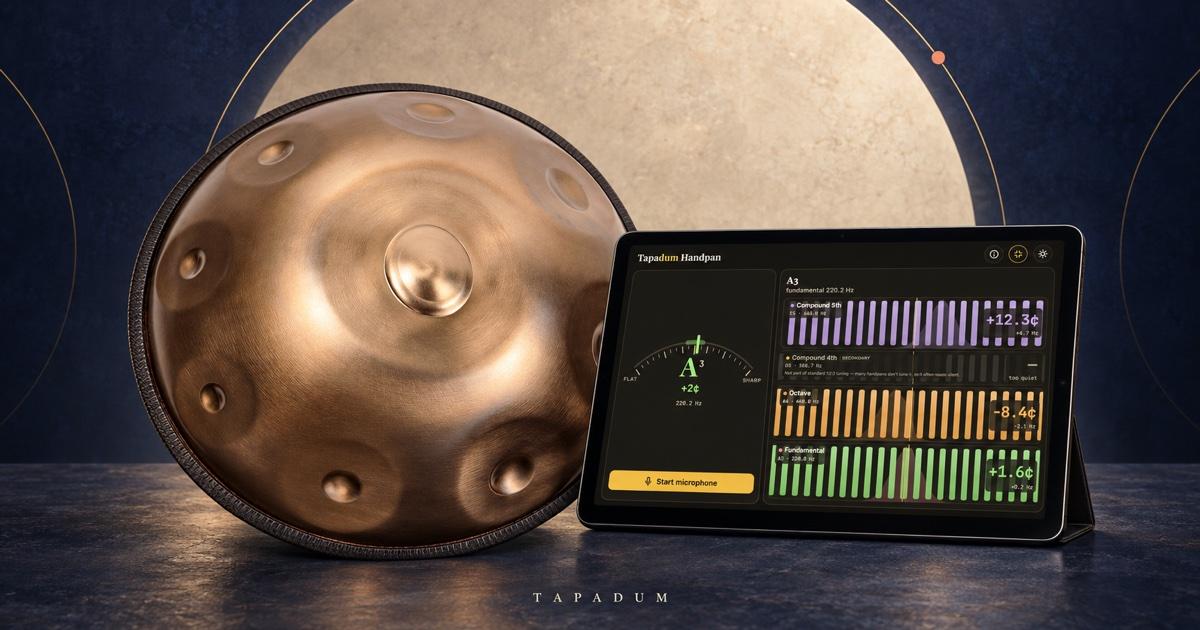
What you’ll learn: why an ordinary tuner misreads a handpan, how to check every note of yours with a free online handpan tuner that measures all three tuned partials, how to read the gauge, the strobe strips and the coloured rings, what the numbers mean and when to worry, how to use it to check a used handpan before you buy, and what a phone microphone honestly cannot tell you.
A handpan tuner has a harder job than a guitar tuner, because a handpan note is not one pitch but three. The Tapadum Handpan Tuner is a free online handpan tuner and overtone analyzer that measures all three. It runs in the browser on a phone, a tablet or a computer. There is nothing to install and no account to create.
We built it for a simple question that players ask us often: has my handpan drifted? The instrument is also called a handpan drum, a hand pan or a pantam, and whatever you call it, the question is the same. A note can sound dull or wavering long before an ordinary tuner shows anything wrong. This guide explains why, and walks through the tool screen by screen.
Why a Handpan Tuner Has to Read Three Pitches
Every tone field on a handpan is hammered until three of its resonances agree. They sit close to a 1:2:3 relationship: the fundamental, the octave above it, and the compound fifth above that. For A3 that means 220 Hz, 440 Hz and 660 Hz ringing together. Acoustic research on the instrument describes the same three components; see the University of York thesis Analysis and Synthesis of the Handpan Sound.
When the three line up, the note sings with a long, clear sustain. When one drifts, the note dulls or starts to beat, even if the fundamental is still correct. An ordinary chromatic tuner looks only at the fundamental, so it can call a tired note “in tune”. Our article on how a handpan is tuned covers the hammering side of this in detail.
There is a second problem. Most tuners estimate pitch from the repeating shape of the whole waveform. Drifted overtones bend that shape. In our own tests we fed the tuner a synthetic note with a perfect fundamental, an octave 12 cents sharp and a fifth 25 cents flat. A waveform-based reading called the fundamental 5 cents flat. It was not. So this tuner uses that method only to name the note. The cents you see come from the measured spectral peak of each partial.
Getting Started: Microphone, Scale and Reference Pitch
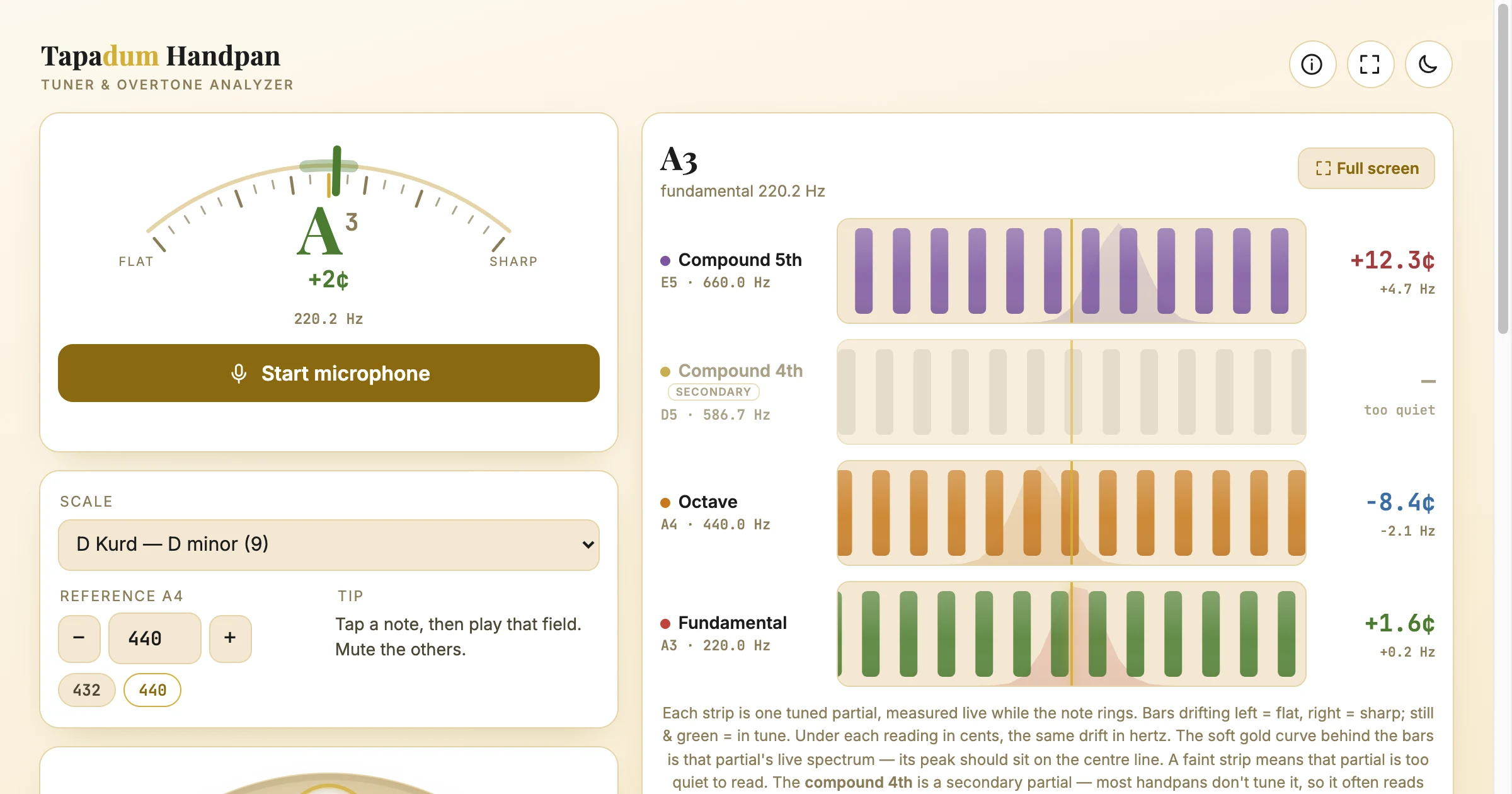
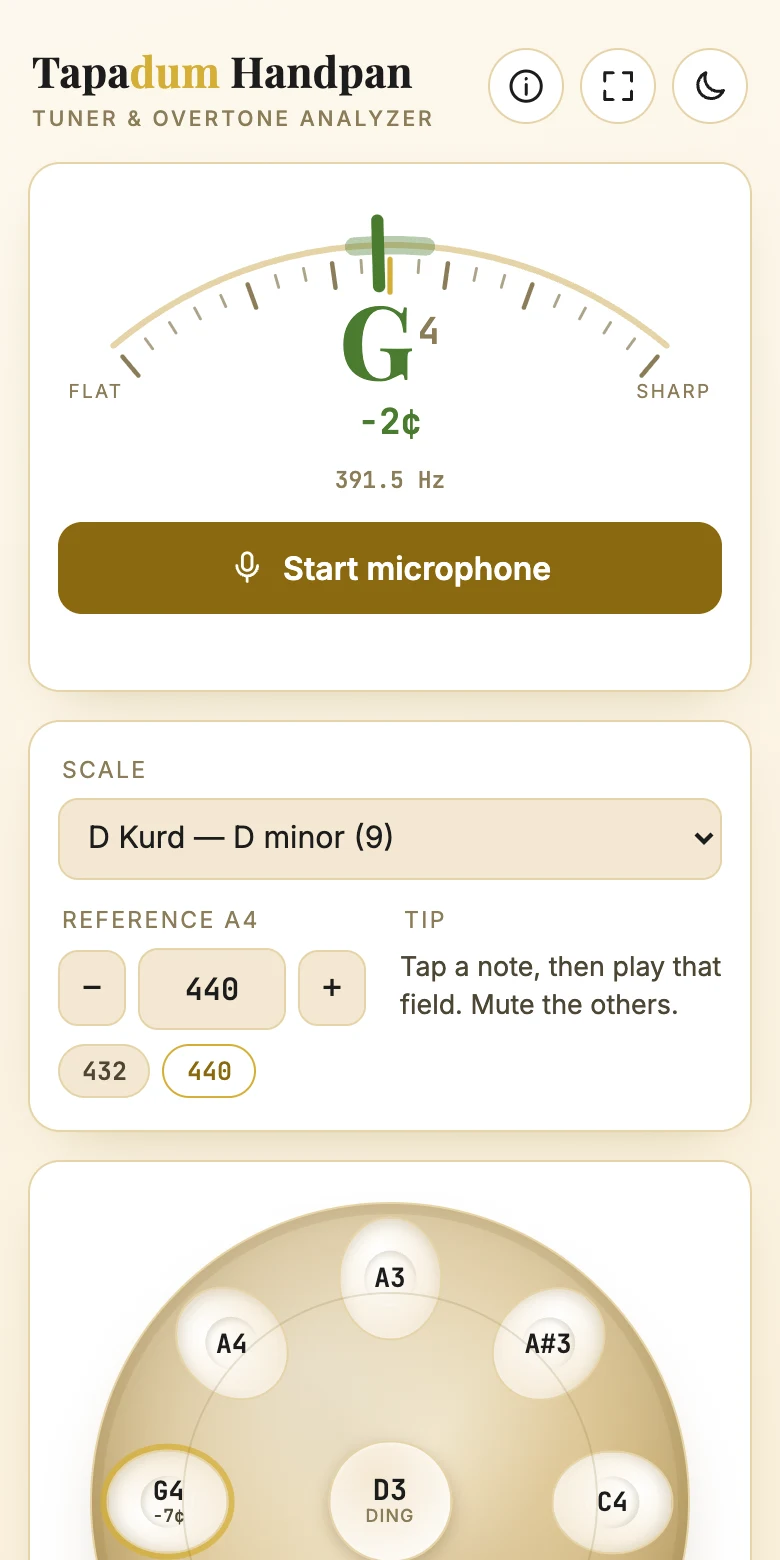
Open handpan.tapadum.com and press Start microphone. Your browser asks for permission once. A thin level bar appears under the button and moves with every sound. If it moves, the tuner can hear you.
Next, choose your scale. There are twelve named handpan scales, among them D Kurd with 9 and with 12 notes, D Hijaz (Hicaz), C# Annaziska, D Celtic Minor (Amara), D Pygmy, E Equinox and D Sabye. If yours is missing, New custom scale lets you enter a ding and up to twenty tone fields. It is saved on your device. Free mode needs no scale at all: play any note and the tuner finds the nearest one.
Finally, check Reference A4. Handpans are built to a reference pitch, commonly 440 Hz and sometimes 432 Hz, so both have a one-tap shortcut. Not sure which you own? Measure a few notes at 440. If every note reads about 32 cents flat, the instrument is a 432 Hz one.
Reading the Note: The Gauge
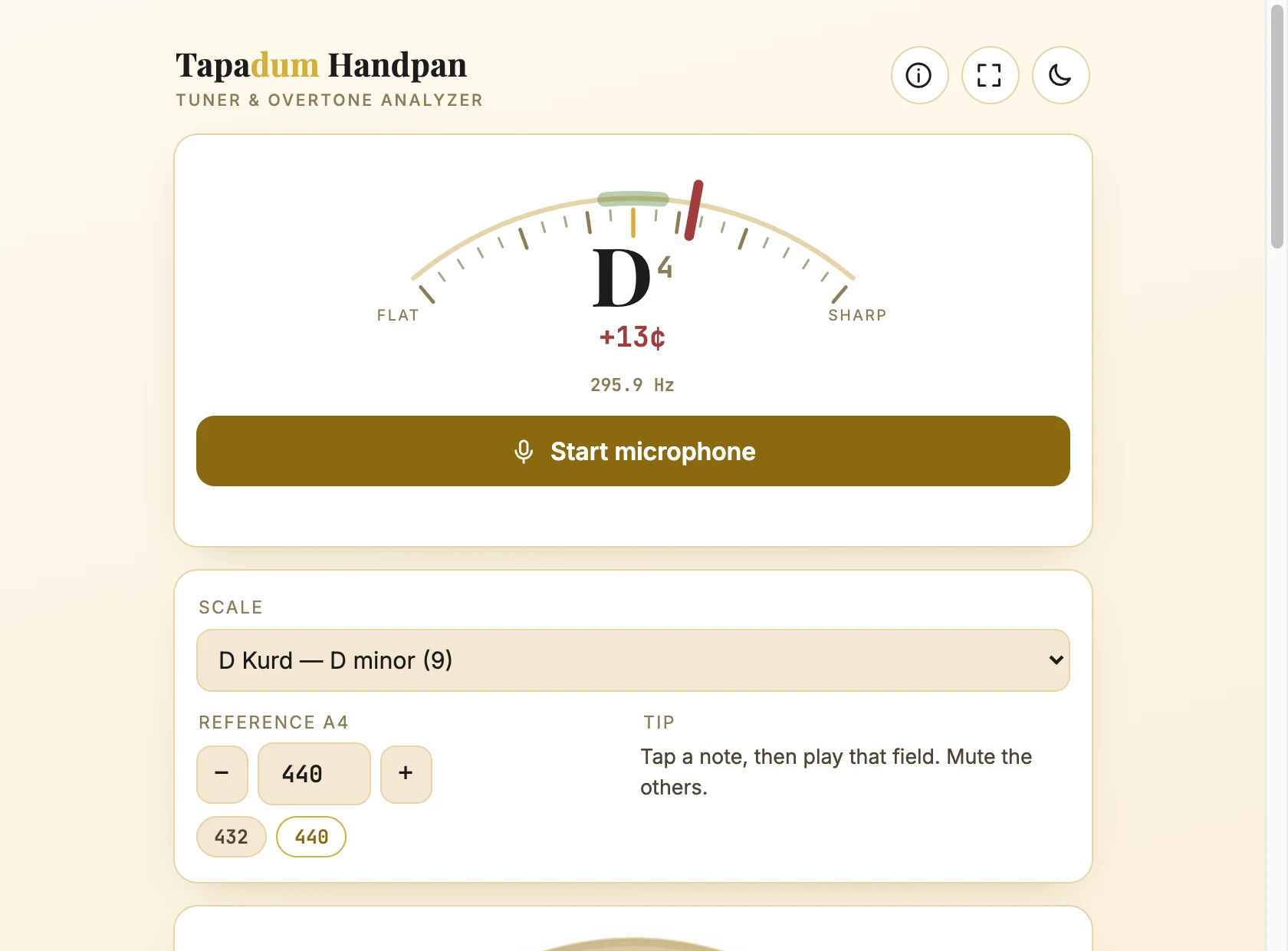
Strike one note and let it ring. The arc at the top shows its name, its octave and how far the fundamental sits from pitch. The scale runs from 50 cents flat on the left to 50 cents sharp on the right. A cent is one hundredth of a semitone.
The green zone in the middle covers 6 cents either side of perfect. Inside it, the marker and the note turn green. Outside it, the marker turns blue for flat or red for sharp. Under the arc you also see the measured frequency in hertz.
One habit makes every reading cleaner. If neighbouring notes sing along, rest a hand on them. Sympathetic ringing is part of the handpan’s charm, but it muddies a measurement.
Reading the Partials: Four Strobe Strips
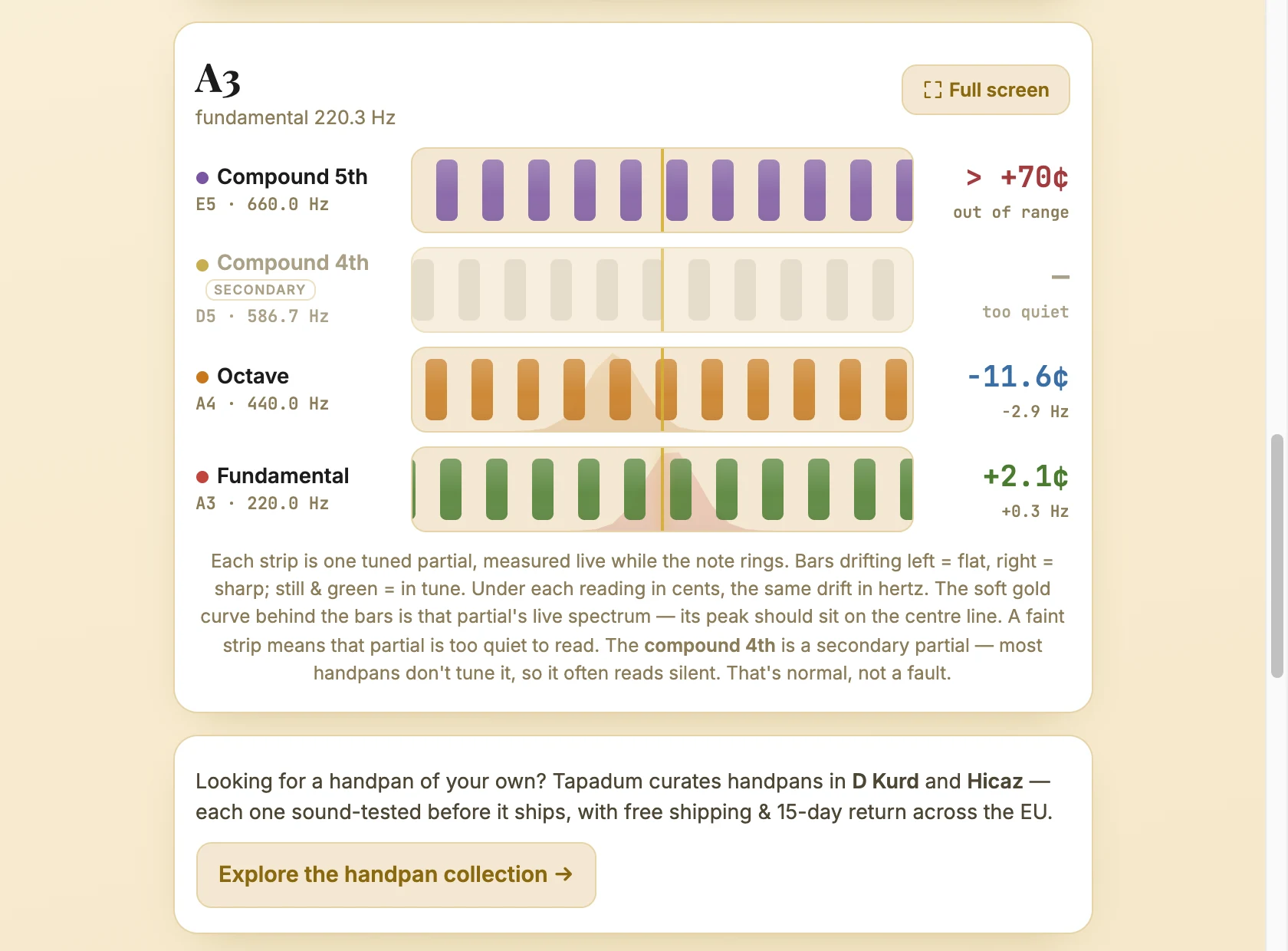
The panel beside the gauge is the overtone analyzer. Each strip is one partial, measured about twenty times a second while the note rings. The bars work like a strobe tuner. They drift left when that partial is flat and right when it is sharp. When they stand still and turn green, that partial is in tune.
Beside each strip you get two numbers: the drift in cents, and the same drift in hertz. Behind the bars, a soft curve shows the live spectrum around that partial. Its peak should sit on the centre line.
- Fundamental – the note itself.
- Octave – twice the fundamental.
- Compound 5th – three times the fundamental. It is the quietest of the three, so it is the hardest to read.
- Compound 4th – marked secondary. It is not part of standard 1:2:3 tuning and most handpans do not tune it. A silent strip here is normal, and it never counts against a note.
Two honest messages can replace a number. Too quiet means the partial is below the noise floor, so there is nothing to measure. > +70¢ or < −70¢ means a partial has drifted beyond the search window. The tuner knows which way it went, but not how far. It says so, rather than inventing a figure.
Checking the Whole Instrument
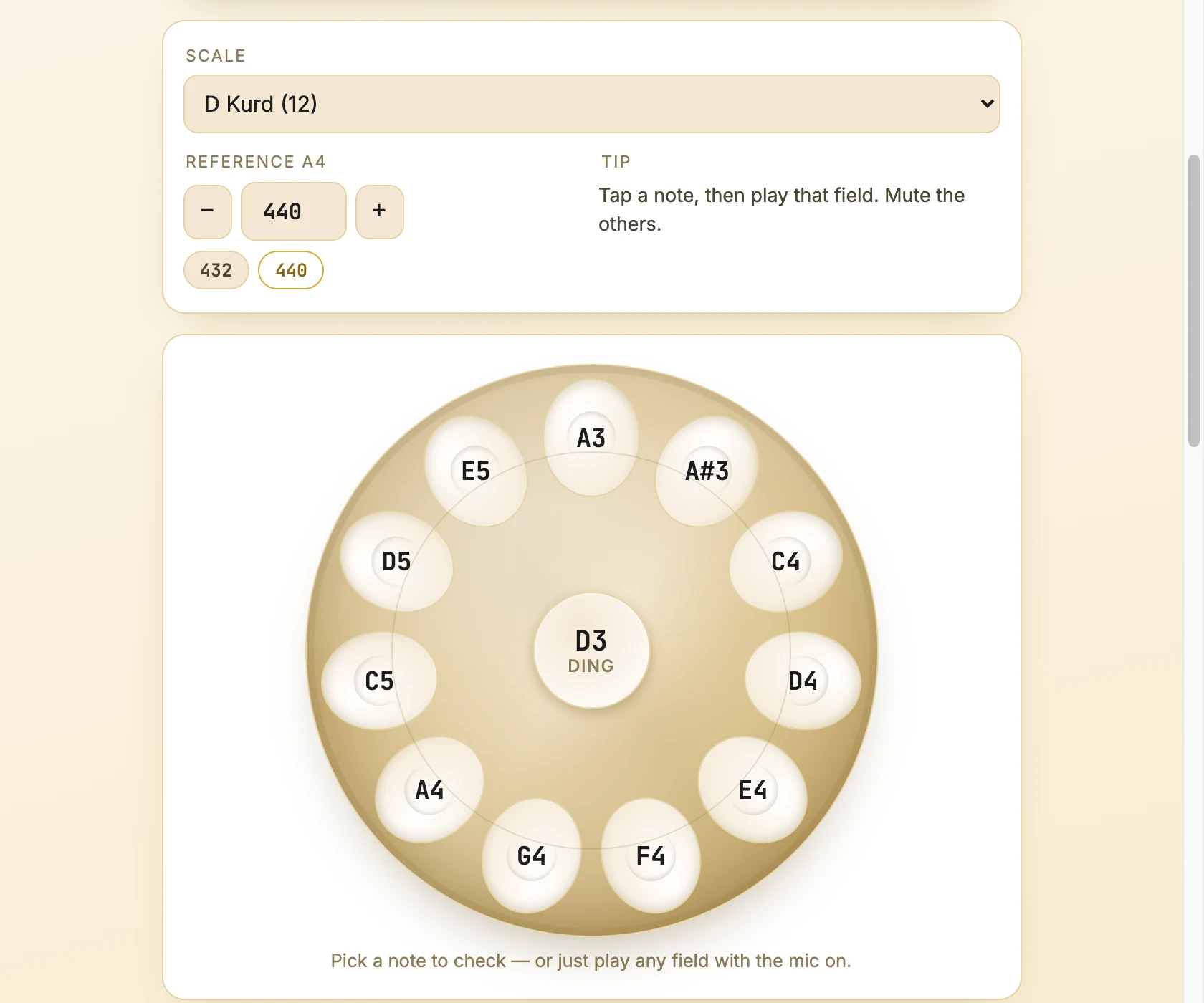
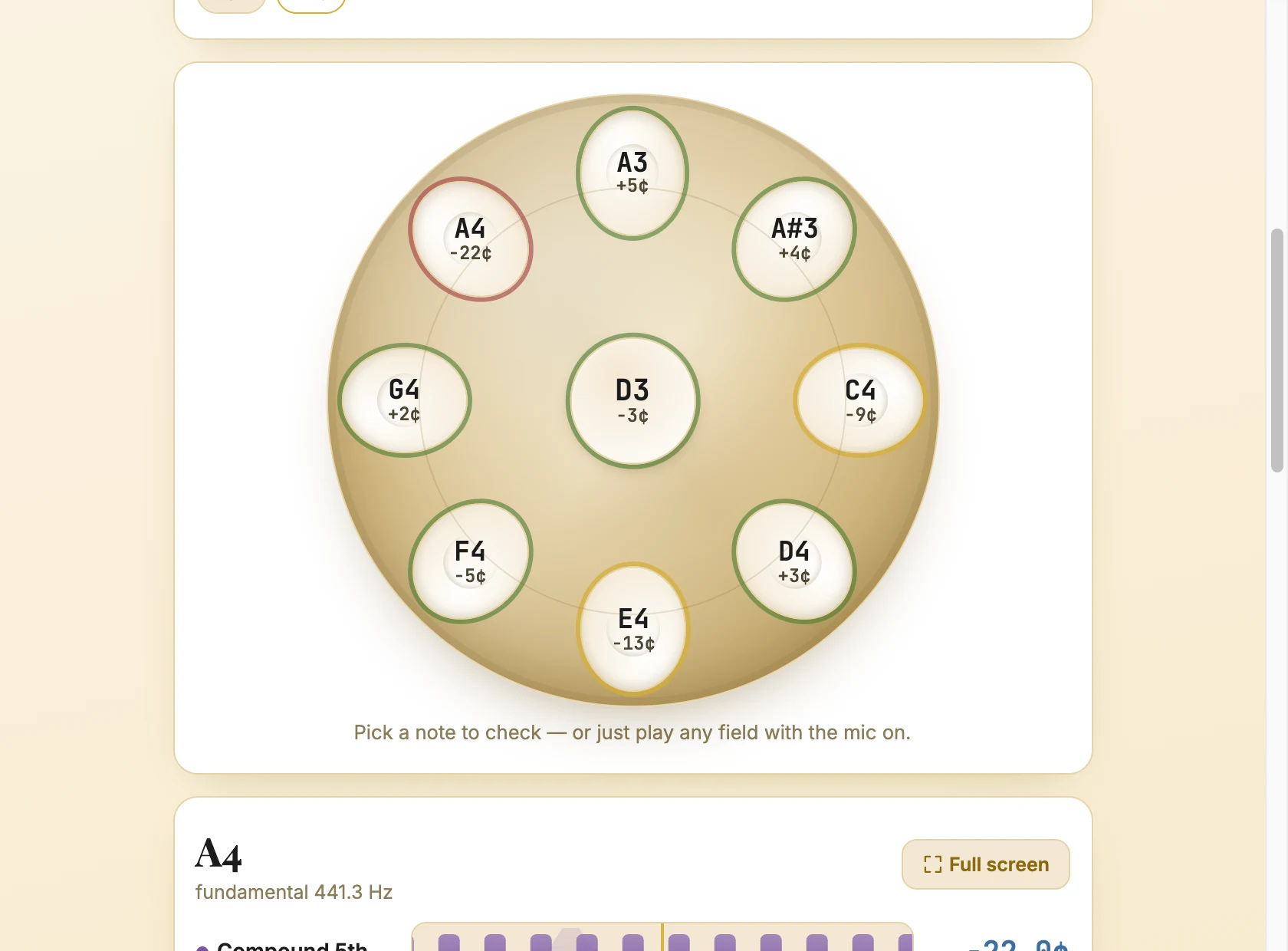
You do not need to mute between notes. A fresh strike starts a new measurement, so you can walk round the instrument note by note. After each settled reading, the matching field on the drawn pan gets a coloured ring and a number.
| Ring | Worst tuned partial | What it usually means |
|---|---|---|
| Green | within 6 cents | The note is in tune. |
| Amber | 6 to 15 cents | Close, but not settled. Worth a second reading. |
| Red | more than 15 cents | The note has drifted. Measure it again in a quiet room. |
The number under each note is the reading that earned the ring: its worst tuned partial. In a few minutes the pan becomes a map of the whole instrument. One red note among eight green ones is a very different story from an instrument that is amber all round.
Full Screen for Tablets and the Workshop Bench
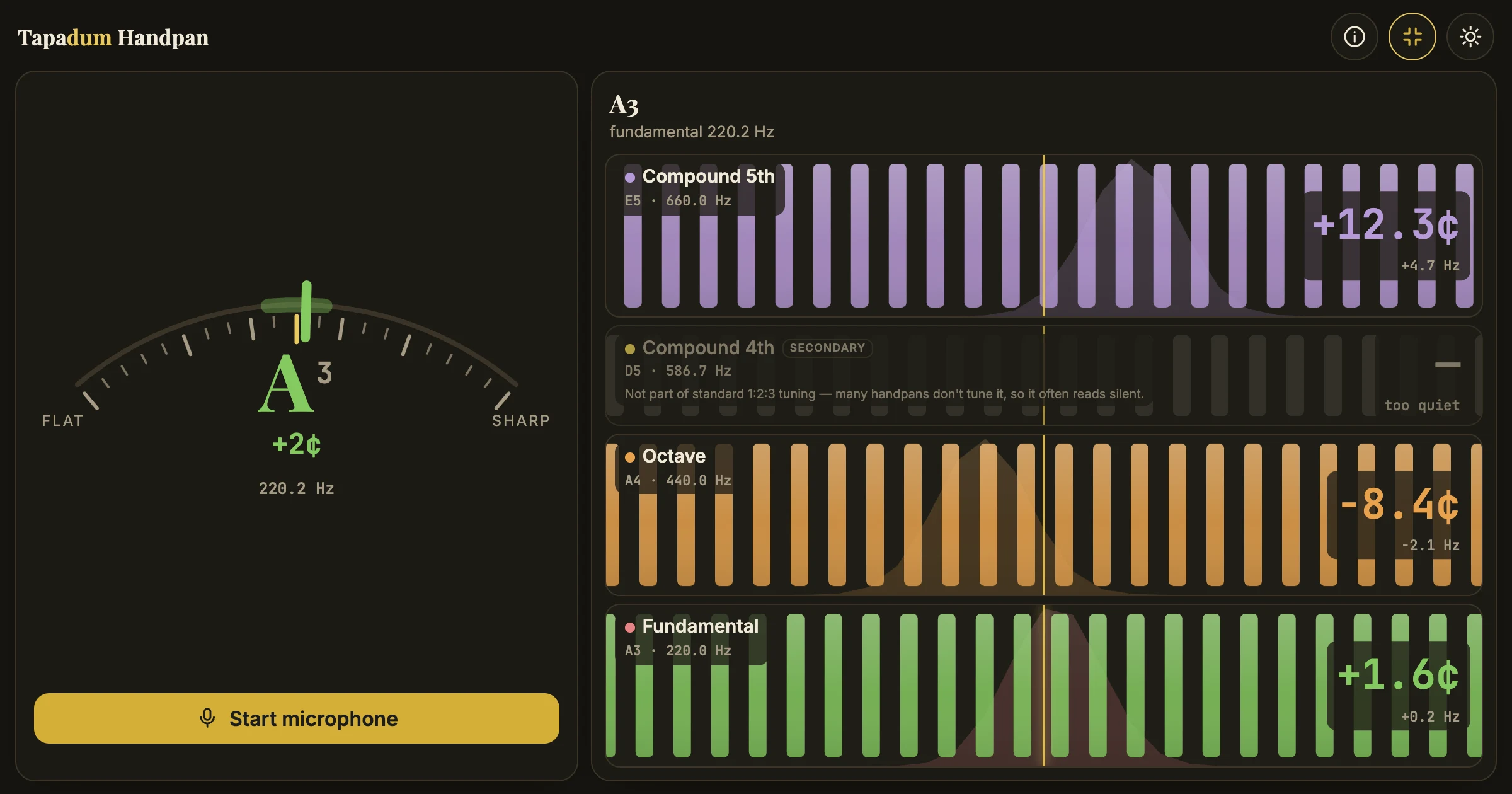
On a tablet or a computer, press the full-screen button or the F key. The layout rearranges to fill the screen. The note and its gauge sit on one side, and the four partial bands take the other. It is easy to read from across a bench.
With a keyboard, Space starts and stops the microphone and the arrow keys step through the notes of the scale. Esc leaves full screen. A dark theme is one tap away, which helps in a dim room. On an iPhone the same view opens inside the page, because that browser does not offer true full screen to web pages.
Checking a Used Handpan Before You Buy
A second-hand handpan can be a good buy, and tuning is the one thing photographs never show. Retuning is skilled hammer work, so a drifted instrument carries a real cost. A five-minute check on your phone tells you what you are looking at.
- Ask to try the instrument in a quiet room, and open the tuner on your phone.
- Select the scale the seller names, and confirm the reference pitch, 440 or 432 Hz.
- Play every note once, ding included, and let each one ring for a few seconds.
- Look at the map. Mostly green is what you hope to see; give any amber note a second reading.
- Treat a red ring, above all on the ding, as a reason to ask questions.
- Repeat any bad reading. One stray number in a noisy room proves nothing.
The same check works on the day a new instrument arrives. If you are still choosing, our guide to the best handpan for beginners explains scales, note counts and steel types. The handpans for sale in our collection are sound-tested before they ship. They range from an entry-level D Kurd handpan with nine notes to twelve-note instruments, and the tuner includes presets for the D Kurd and D Hicaz layouts in our collection.
What This Tuner Cannot Do
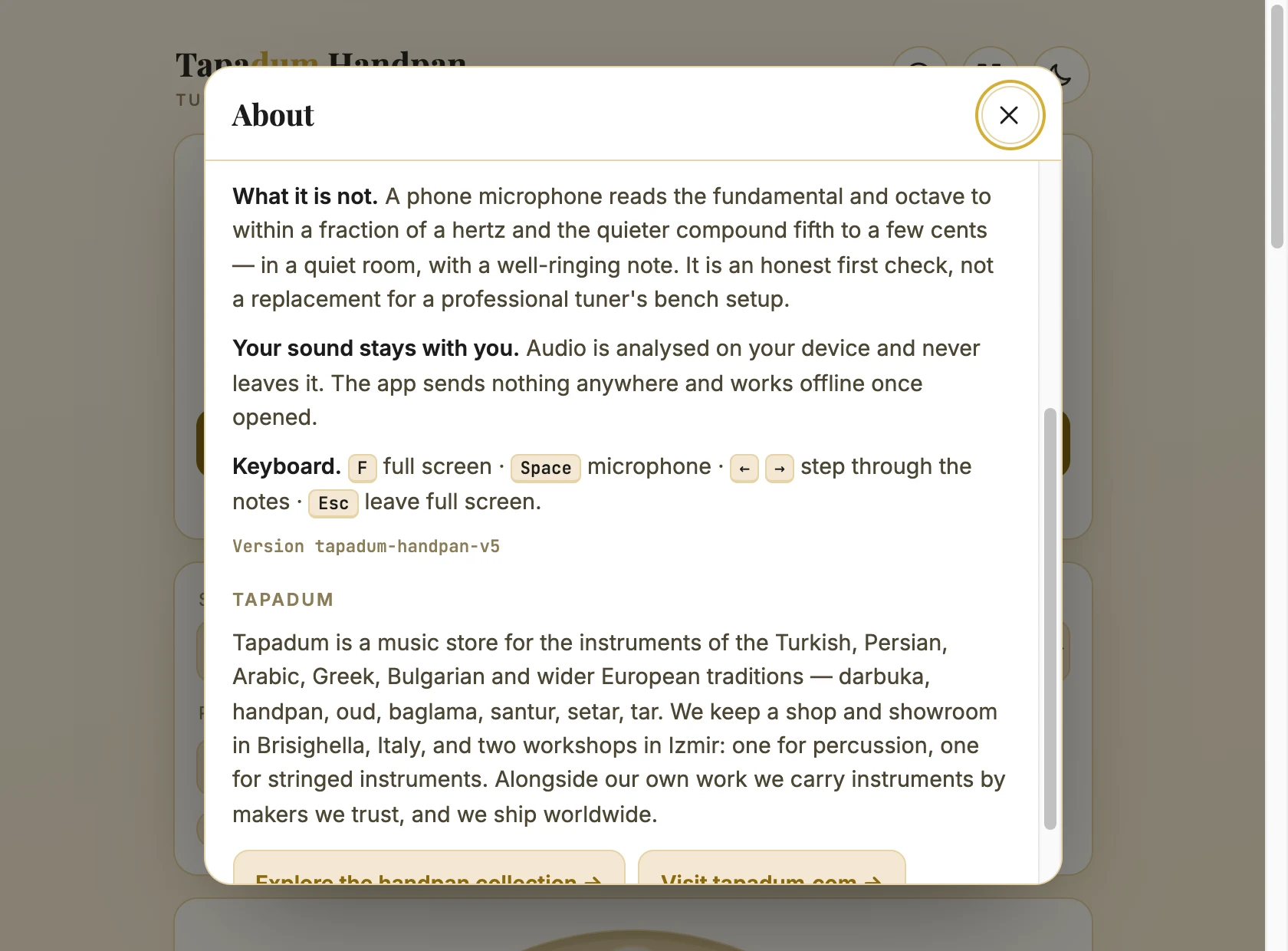
We would rather be clear about the limits. In a quiet room, with a well-ringing note, a phone microphone reads the fundamental and the octave to within a fraction of a hertz. The quieter compound fifth reads to within a few cents. That is enough to tell a healthy note from a drifted one. It is not a replacement for a professional tuner’s bench setup, and the app says so on its own About page.
Against synthetic test notes with known errors, the measuring engine recovers each partial to within a fraction of a cent. A real room is less kind. If the tuner hears a lot of background sound between your notes, it shows a short warning that readings may wander.
It also cannot fix anything. A handpan is retuned with hammers on the steel itself. Every blow moves all three partials at once, and a wrong one can be permanent. Use the readings to find out whether and where your instrument has drifted, then talk to its maker or to a professional tuner. Good habits slow drift down in the first place; see our handpan care guide.
Free, Offline and Private
The tuner is free, with no advertising and no sign-up. Sound is analysed on your device and never leaves it. The page makes no request to any outside server. After the first visit it also works without a connection, so it is happy in a workshop or a field with no signal.
You can add it to your home screen like any app. On an iPhone, open it in Safari, tap Share, then Add to Home Screen. On Android, open it in Chrome, tap the menu, then Install. Open it once from the new icon while you are still online, so it can save its files.
Frequently Asked Questions
Can I use an ordinary tuner on a handpan?
You can, and it will show the fundamental. It will not show the octave or the compound fifth, which are tuned just as carefully and drift just as easily. A note can read correct on a guitar tuner and still sound dull. A dedicated handpan tuner measures all three partials, which is where the useful information is.
How do I know if my handpan is out of tune?
Play each note alone, let it ring, and read its three main strips. A healthy note holds all three within a few cents. A partial 10 to 15 cents away is usually audible as a dull or wavering note. Beyond that the note starts to sound sour. Always repeat a bad reading in a quiet room before you worry.
Does it work for a 432 Hz handpan?
Yes. Set Reference A4 to 432 with the shortcut beside it, and every target moves with it. If you do not know your instrument’s reference, check a few notes at 440 first. When all of them read about 32 cents flat, the handpan was built at 432 Hz.
Why does the compound 4th strip show nothing?
Standard handpan tuning is 1:2:3: fundamental, octave and compound fifth. The compound fourth is not part of it. Most instruments do not tune it, and it is often simply absent. The tuner marks that strip as secondary, and a silent reading there is normal. It never counts against a note.
Can I retune my handpan myself with this?
We would not. The tuner tells you where a note stands. Moving it means hammering the steel, and each blow shifts all three partials together. A mistake can be permanent. Use the readings to describe the problem precisely, then take the instrument to its maker or to a professional tuner.
Does it work on a phone, a hand pan of any brand, and offline?
Yes to all three. It runs in the browser on iPhone, Android, tablets and computers, and it measures any handpan, pantam or handpan drum, whoever made it. After the first visit it opens without a connection. Nothing is recorded or uploaded at any point.
Handpans From Our Collection
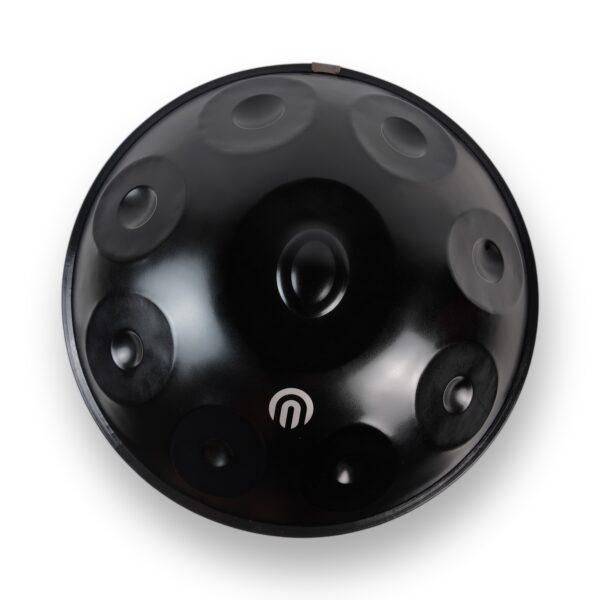
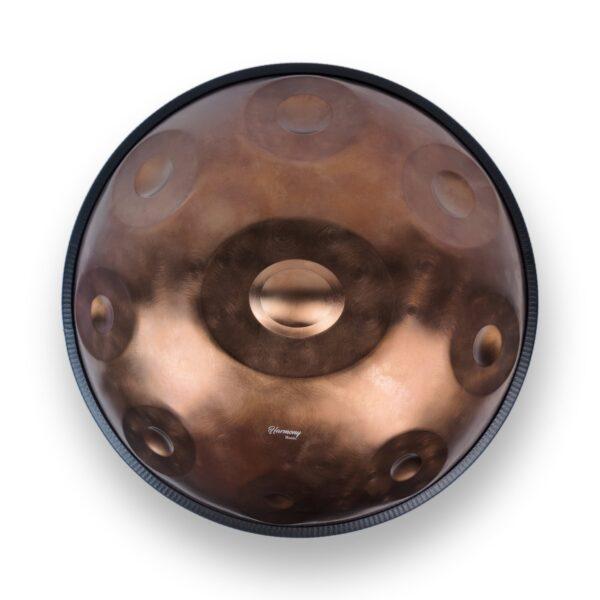
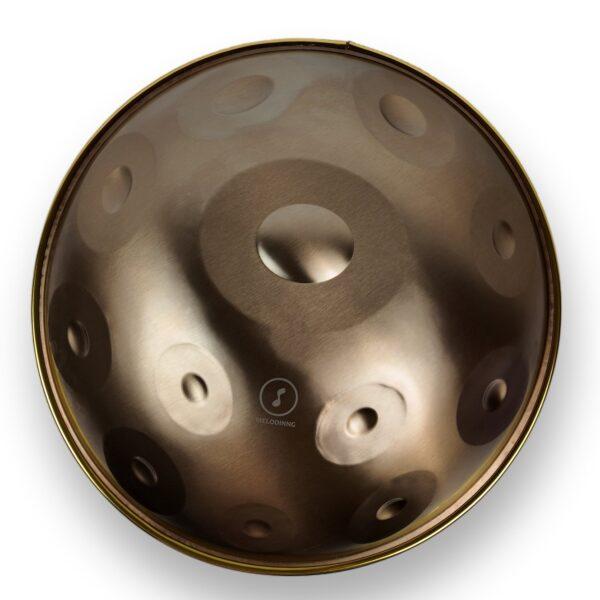
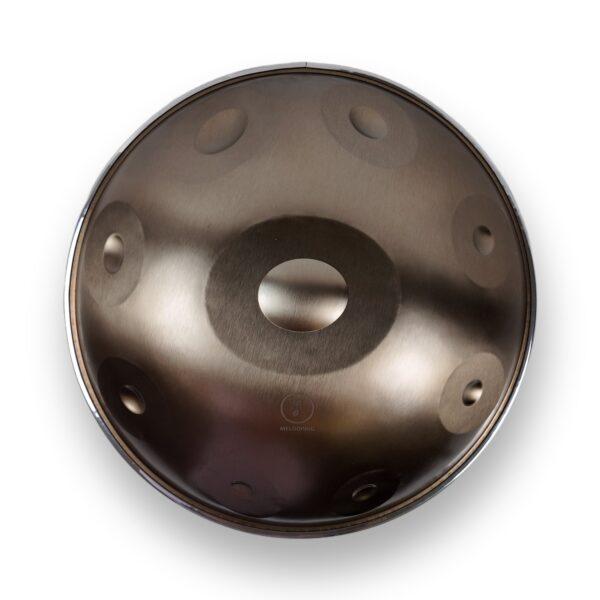
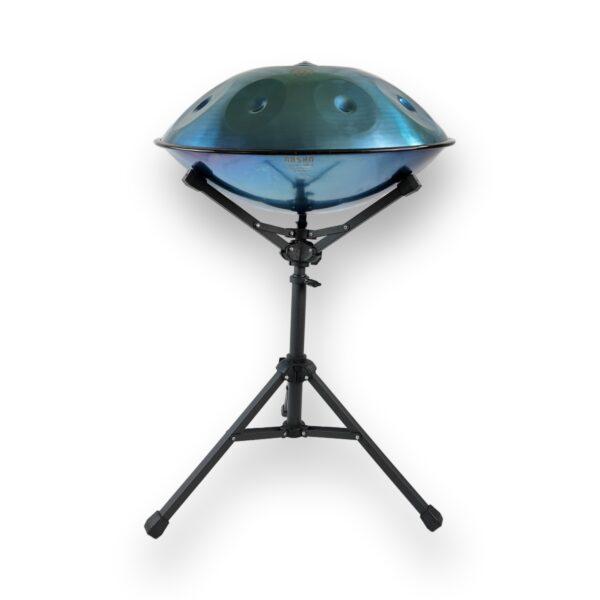
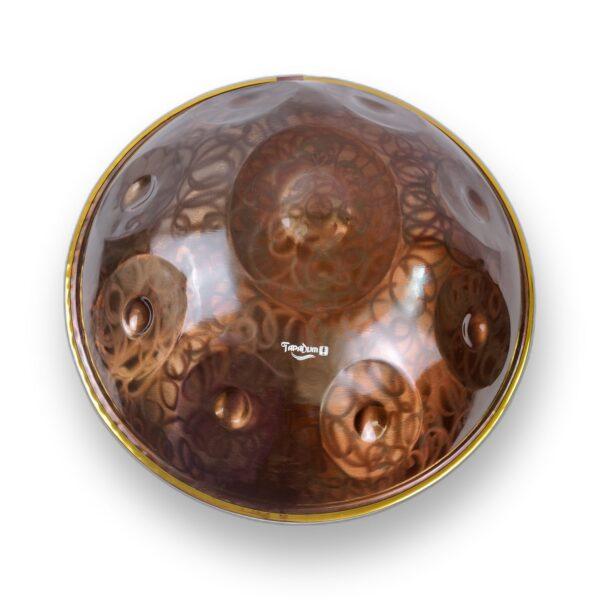
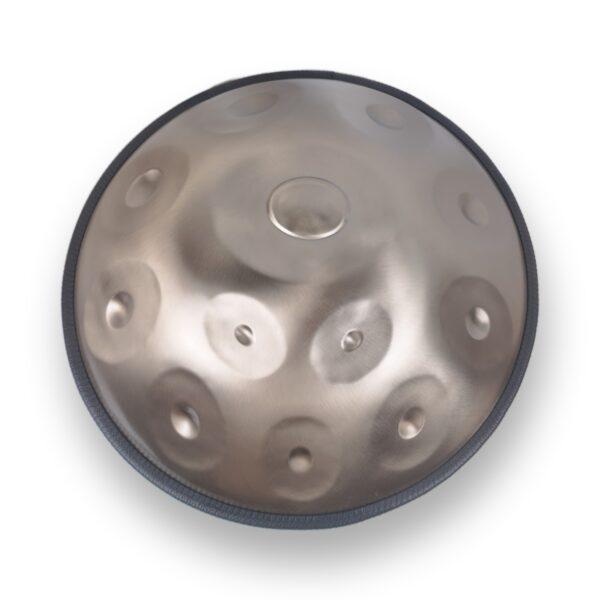
Every handpan we currently offer, from entry-level D Kurd instruments to twelve-note models, with cases and stands alongside.
-
−38%Add to cart

-
−24%Add to cart
-
−4%Add to cart
-
−23%Add to cart
-
−26%Add to cart
-
−23%Add to cart
-
−8%Add to cart
-
SaleSelect options This product has multiple variants. The options may be chosen on the product page
-
−20%Add to cart
-
−12%Add to cart
-
−37%Add to cart
-
−25%Add to cart
-
−28%Add to cart
-
−32%Add to cart
-
−32%Add to cart
-
−32%Add to cart
-
−32%Add to cart
-
−25%Add to cart
-
−36%Add to cart
-
−12%Add to cart









Tuning strings as well? Tapadum Tuner is our free online tuner for oud, baglama and other traditional instruments, with a drone, makam scales and an usul metronome, and no app to install.