
The Persian Tanboor: Sacred Lute of the Ahl-e Haqq Tradition
What you’ll learn: what makes the Persian tanboor different from every other lute in the Persian string family, why it’s played with bare fingers instead of a pick, its role as the sacred instrument of the Ahl-e Haqq (Yarsan) tradition, how 20th-century master Ostad Elahi transformed the instrument itself, and how to choose one.
Every other lute in the Persian classical family — the tar, the setar, the shourangiz — is driven by a plectrum. The tanboor stands apart: played entirely with the bare fingers, tuned to a dry, droning resonance, and carrying a devotional weight that goes beyond music. Its history reaches back to the Sassanid court, but the instrument played today owes as much to a 20th-century reformer as to that ancient lineage.
What Is a Persian Tanboor?
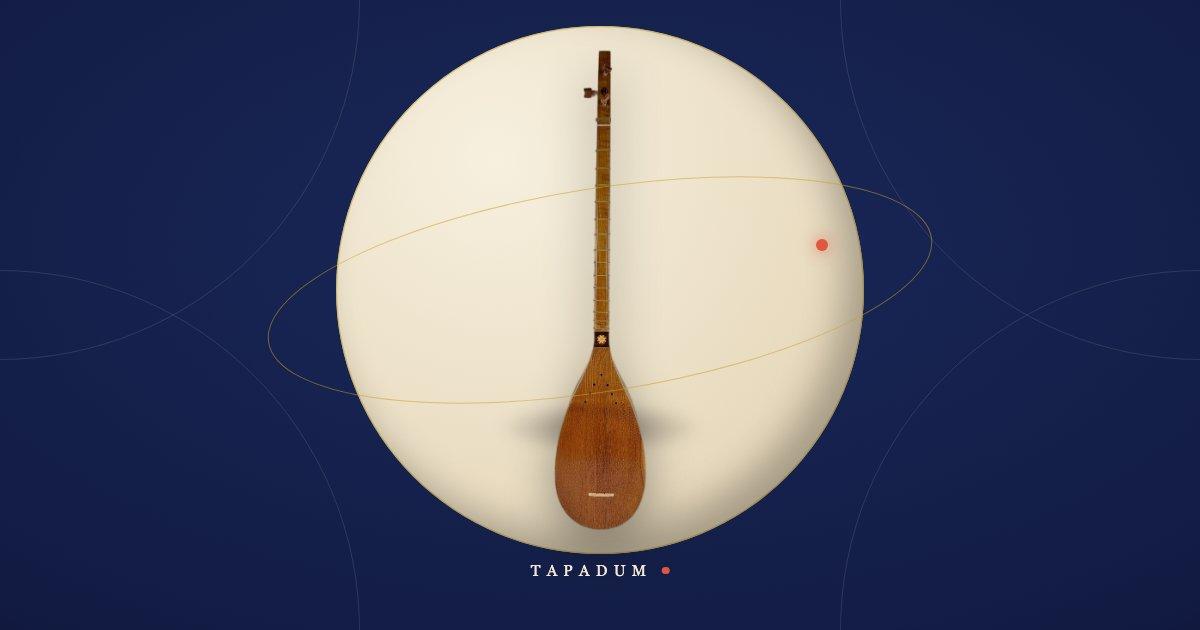
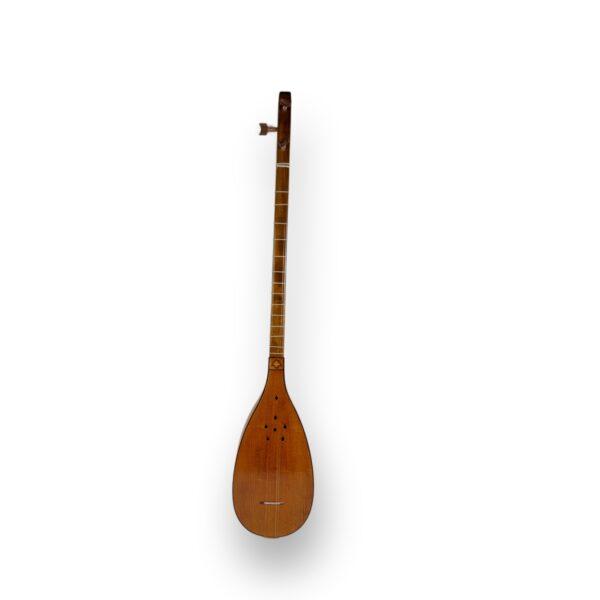
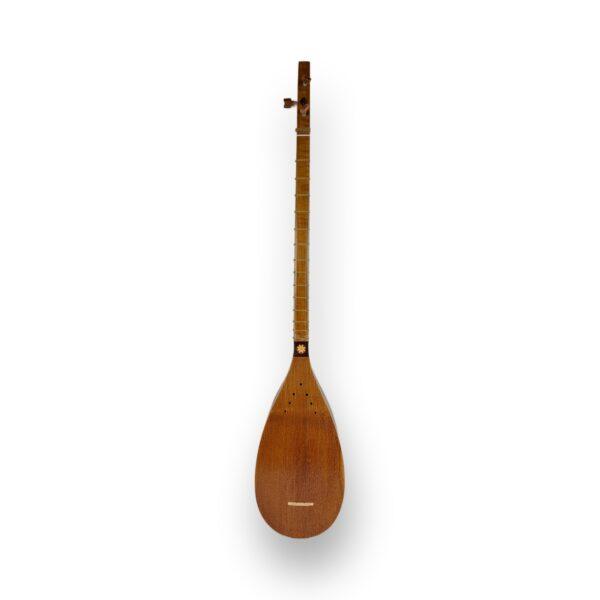
The tanboor is a long-necked lute with a pear-shaped bowl carved from aged mulberry — traditionally built from seven to ten glued ribs — closed with a matching mulberry soundboard pierced by small patterned sound-holes. A slender walnut neck carries the tuning pegs and fourteen tied gut frets, set in a semi-tempered chromatic scale. Because the frets are tied rather than fixed in place, a player can nudge each one slightly to fine-tune the microtonal intervals that Kurdish and Yarsan modes depend on — a level of tuning flexibility most fretted lutes don’t offer. A full-size tanboor stands roughly 80 cm tall and about 16 cm wide.
The Sacred Instrument of the Ahl-e Haqq
The tanboor’s lineage reaches back to the Sassanid court of the 5th and 6th centuries, but its devotional role as we know it today comes from the Ahl-e Haqq (Yarsan) order, founded in the late 14th century among Kurdish communities of Kermanshah and Lorestan in western Iran. Within this mystical tradition, the tanboor accompanies sacred hymns called zekr and ceremonial chant — not performance music in the concert-hall sense, but a devotional practice where the instrument itself is treated as sacred. For much of its history, the tanboor’s melodies and techniques were kept secret, passed only from master to student within the order, and were not shared publicly until the 20th century.
Ostad Elahi: The Reformer Who Added a String
The single most important figure in modern tanboor history is Ostad Elahi (1895–1974), a Kurdish Yarsan spiritual master widely regarded as the most celebrated Yarsan figure of the 20th century — and the tanboor he transformed isn’t just played differently today, it’s built differently. The instrument traditionally carried only two strings; Elahi added a third, doubling the main string, and paired it with a new resonance tuning (Farangi) in which the doubled strings sit a second apart from the lower string. His innovation was adopted so widely that virtually every tanboor made today carries three strings as a result.
Elahi also refined the instrument’s playing technique into the fluid, five-finger right-hand style known as shor — using all five fingers rather than the traditional two or three, to weave melody, drone, and rhythmic pulse together in one continuous motion. He drew an entire repertoire of more than a hundred pieces from the instrument, much of it still central to players today, and his own playing was known for dense, rapid ornamentation — reportedly up to twelve notes per second at its most intricate. Beginners typically start with simple drones and modal phrases before building toward full shor technique over years of practice.
Tanboor vs. Other Persian Lutes
Compared to the tar or setar, the tanboor gives up plectrum-driven brightness and rhythmic attack for something quieter and more sustained. Where a setar’s fine wire strings and tar’s louder skin-headed body are built for classical dastgah performance and virtuosic ornamentation, the tanboor’s mulberry body and finger-driven drone are built for devotional repetition — a sound meant to be sat with, not performed at an audience. That difference in purpose, more than any single technical detail, is what separates the tanboor from the rest of the Persian string family.
Choosing a Persian Tanboor
| Option | Build | Best for |
|---|---|---|
| Persian Tanboor by Mofakheri | Aged mulberry body, walnut neck, 14 tied gut frets | Players starting with tanboor technique, first devotional-lute purchase |
| Persian Tanboor by Zolghadr | Aged mulberry body and soundboard, walnut neck, 14 tied gut frets, made by master luthier Mohammad Zolghadr in Tehran | Serious students and performers wanting a master-built instrument |
Both are built to the same core specification — three strings in two courses (the Elahi standard), tied gut frets for microtonal adjustment, and the mulberry-and-walnut construction the tanboor has always used. If you’re exploring the wider Persian string tradition the tanboor belongs to, our Persian String Family guide covers how it relates to the setar, tar, santur, and kamancheh.
Frequently Asked Questions
Why is the tanboor played with fingers instead of a pick?
The tanboor’s devotional role calls for a sustained, droning texture rather than the bright attack a plectrum produces. The five-finger shor technique lets a player sound melody, drone, and rhythm together in one continuous motion, which a pick can’t easily replicate.
Who was Ostad Elahi?
Ostad Elahi (1895–1974) was a Kurdish Yarsan spiritual master and the most celebrated tanboor figure of the 20th century. He added the tanboor’s third string (it traditionally had two), introduced the Farangi tuning, and refined its five-finger shor technique — innovations so influential that virtually all tanburs made today follow his three-string design.
What is the Ahl-e Haqq tradition?
The Ahl-e Haqq (also called Yarsan) is a mystical religious order founded in the late 14th century among Kurdish communities in western Iran. The tanboor is its sacred instrument, used to accompany devotional hymns (zekr) — for much of its history, its music was kept within the order and only became publicly known in the 20th century.
Why does the tanboor use tied frets instead of fixed ones?
Tied gut frets can be nudged slightly by the player, allowing fine microtonal adjustment of individual intervals — essential for the modal subtleties of Kurdish and Yarsan music, which fixed frets can’t accommodate as precisely.
Is the tanboor related to the Turkish or Central Asian tanbur?
They share a name and a common long-necked lute ancestry — the tanbur family is traced back to instruments at the Sassanid court — but they’re distinct instruments today. The Persian tanboor is smaller, finger-played, and devotional in role, while the Ottoman Turkish tanbur is a larger classical instrument with more strings and frets, played with a plectrum or bow.
Tapadum is an ethnic music store based in Italy, specializing in handcrafted instruments from the Middle East, the Mediterranean, and the Balkans. Free EU shipping & 15-day return. Explore the full Persian Tanboor collection.