
Persian Zahme vs. Hammered Dulcimer Sticks: Choosing the Right Santur Mallet

What you’ll learn: why a Persian zahme and a hammered dulcimer stick strike the same strings completely differently, what the zahme’s finger-ring is actually for, why hammered dulcimer sticks favor a heavier pinch grip built for volume, and which one fits your santur and your repertoire.
Both tools do the same basic job — strike a santur’s strings — but a Persian zahme and a Western hammered dulcimer stick are built around two genuinely different techniques, not just two different looks. Pick up the wrong one for your style and the instrument fights you; pick up the right one and the santur’s whole character opens up. Here’s what actually separates them.
What Is a Zahme?
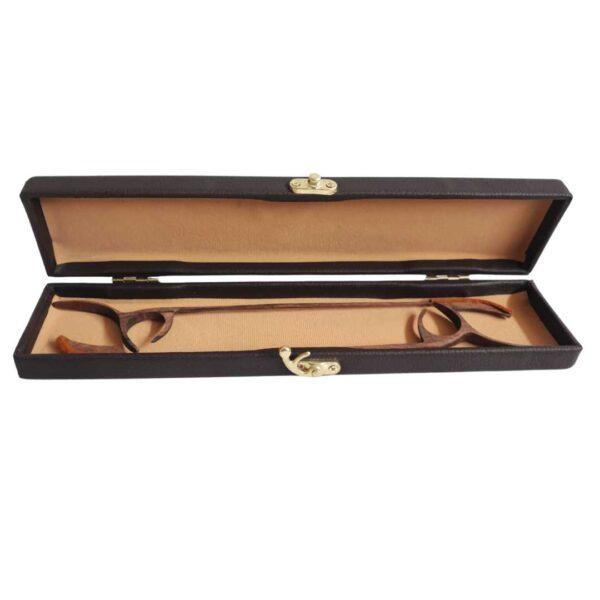
The traditional Persian mezrab — also called zahme or zakhmeh — has three named parts: the sar (the striking head), the sâghe (the shaft), and the halghe (the ring). That ring is the whole point of the design: the player’s index finger passes through it, while the thumb supports the mallet from behind and the middle finger braces it from underneath. The result is a mallet that’s locked to the hand at one point but free to pivot — which is exactly what Persian santur technique needs.
What Are Hammered Dulcimer Sticks?
Western hammered dulcimer hammers take a different shape entirely — a straight shaft ending in a small paddle or leaf-shaped head, sometimes with a decorative cut-out, but with no finger-ring. They’re held in what percussionists call a “French grip”: pinched between thumb and forefinger, or braced across thumb, index, and middle finger, the same basic hold used for timpani mallets. There’s nothing locking the stick to the hand — control comes purely from grip pressure.
The Grip: Ring vs Pinch
This is where the two techniques genuinely diverge. With the zahme’s ring, the wrist does almost all the work: a loose, controlled wrist lets the mallet rebound naturally off the string after each strike, and that rebound is what makes rapid tremolo (riz) and delicate ornamentation possible in Persian radif playing — a stiff arm flattens the bounce and kills the technique. With a pinched hammered dulcimer grip, the player strikes and actively brings the hammer back up in a controlled motion rather than relying on a natural rebound — a technique built more around consistent volume and rhythmic drive than continuous tremolo.
Neither grip is “better” in the abstract — they’re built for different playing goals, and each one struggles at the other’s specialty. A pinch grip can’t easily produce the sustained, feather-light tremolo a ring-mounted zahme achieves; a ring-mounted zahme isn’t built to survive the harder, more percussive strikes a folk or ensemble hammered dulcimer setting can demand.
Sound & Repertoire
The zahme’s light hardwood head and bare or lightly finished striking tip are tuned for the Persian classical dastgah and radif tradition — solo taqsim, vocal accompaniment, and the fast ornamental runs that define the santur’s classical voice. Hammered dulcimer sticks, shaped for Western folk and Appalachian dulcimer traditions, favor a heavier, more percussive attack suited to ensemble playing, contra dance sets, and outdoor or amplified performance where projection and rhythmic drive matter more than delicate shading.
Choosing Between Zahme and Hammered Dulcimer Sticks
| Option | Grip | Best for |
|---|---|---|
| Persian Santur Zahme (3 pairs + case) | Finger-ring (halghe), wrist-driven | Classical dastgah/radif repertoire, tremolo, authentic Persian technique |
| Traditional Zahme (premium, 3 pairs + case) | Finger-ring (halghe), wrist-driven | Same technique, heavier/premium build for regular performance use |
| Hammer Dulcimer & Santur Sticks (3 pairs) | Pinch/French grip, no ring | Folk ensemble playing, louder attack, players coming from Western hammered dulcimer |
All three are physically compatible with a santur’s strings — nothing stops you from striking santur strings with either style. The real choice is about technique: if you’re learning Persian classical repertoire, a proper zahme with its ring is worth learning correctly from the start, since the grip itself is part of the technique. If you already play Western hammered dulcimer and want a stick that transfers directly, the paddle-head sticks are the more comfortable choice.
Frequently Asked Questions
What’s the difference between a zahme and a hammered dulcimer stick?
The zahme has a ring (halghe) that the index finger passes through, letting the wrist drive a natural rebound — the basis of Persian santur tremolo technique. Hammered dulcimer sticks have no ring and are held in a pinch grip, built more for volume and rhythmic attack than continuous bounce.
Can I use hammered dulcimer sticks on a Persian santur?
Physically, yes — they’ll strike the strings fine. But you’ll lose the ring-and-wrist mechanics that Persian classical technique is built around, so fast ornamental tremolo passages will be harder to play cleanly.
How do you hold a zahme correctly?
Pass your index finger through the ring (halghe), support the mallet from behind with your thumb, and brace it from underneath with your middle finger. The grip should stay loose enough for the wrist to drive a natural rebound off the string.
Why do santur mallets need a case?
The striking tips are thin and can warp or crack if left loose in a gig bag — a dedicated stick case protects the delicate ends during transport and significantly extends how long a set lasts.
Is one style of mallet louder than the other?
Generally, hammered dulcimer sticks are built for a heavier, more percussive strike suited to ensemble and outdoor folk playing, while the traditional zahme is voiced for the more intimate, ornamented dynamics of classical Persian repertoire.


Tapadum is an ethnic music store based in Italy, specializing in handcrafted instruments from the Middle East, the Mediterranean, and the Balkans. Free EU shipping & 15-day return. New to the santur? Start with our complete Persian santur guide or learn how to tune a santur.