Santur - Hammered Dulcimer
The santur is a struck-string trapezoidal dulcimer with deep roots in Persian classical music — and a sister instrument across Greek, Turkish, Indian, European, and East Asian traditions where it appears under names such as cimbalom (Romania), tympanon (France), salterio (Italy), hackbrett (Germany), and yangqin (China). Each variant carries distinct cultural nuance, but all share the foundational technique of strings struck by a pair of light wooden mallets.
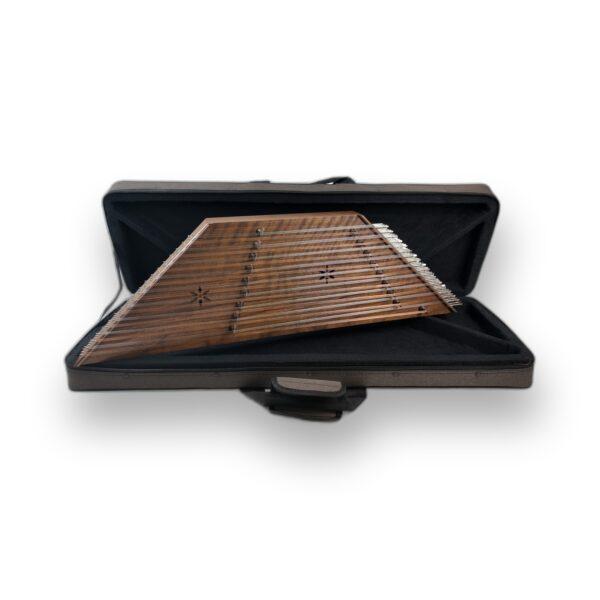
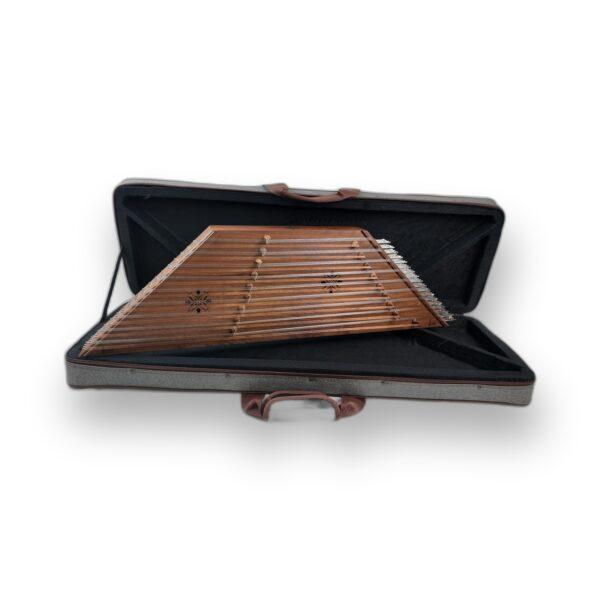
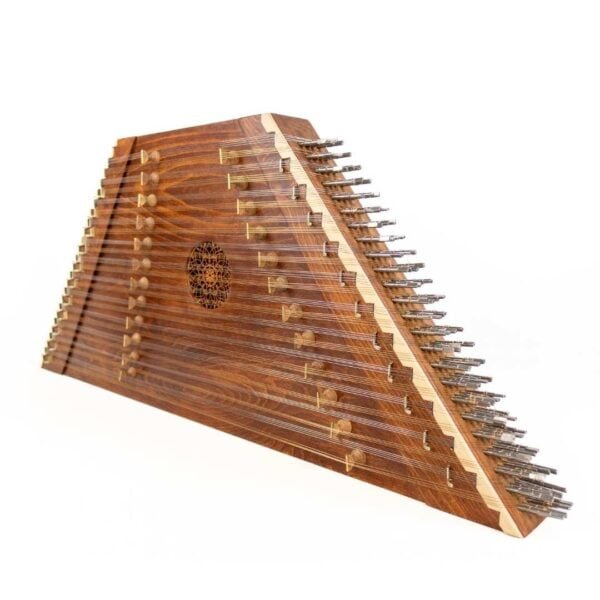
Persian santur construction uses a trapezoidal walnut or maple soundbox with a thin spruce soundboard. Strings — typically seventy-two in total, grouped in courses of four — run across two parallel sets of bridges, allowing each note to be played in two pitches by striking either side of the bridge. The mallets, called mezrab, are light wooden hammers held between the fingers, driving the rapid articulation and dynamic shading that define dastgah practice.
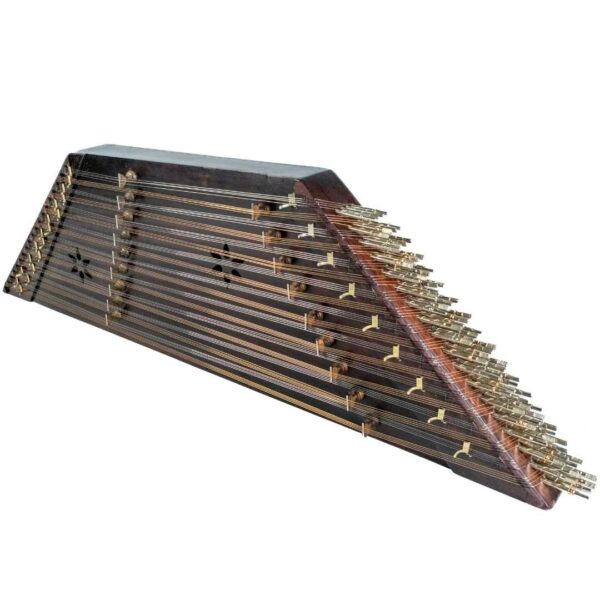
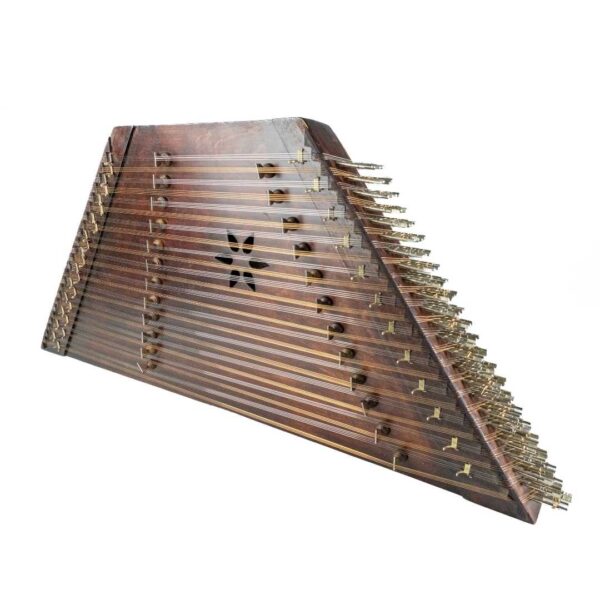
Traditional santur is a diatonic instrument — locked to a specific tuning system, with key changes requiring laborious retuning of individual strings. Tapadum carries two innovation variants that overcome this limitation. The Special Santur with Sharping Levers integrates Celtic harp–style mechanical levers, allowing each note to be shifted by a half-tone instantly — opening rapid key changes within a single piece. The Special Santur with Mandal goes further: each string carries a sliding adjustment mechanism that allows full-tone changes and microtonal positioning, with the mandal stopping at any desired pitch — supporting the full quarter-tone vocabulary of Persian dastgah practice without retuning.
The santur sits at the heart of Persian classical dastgah and avaz repertoire, alongside related traditions across Greek (santouri), Turkish, and Indian (santoor) classical music. Solo taksim improvisation, vocal accompaniment, and ensemble work all draw on the santur’s harmonic resonance and articulation range — making it a versatile partner to plucked lutes such as the qanun within the broader string instruments family.
At Tapadum, our Persian santur curation draws on multiple Tehran-tradition makers — including Behrad & Zolani, Parsa, and Alavi, alongside the Tehran workshop of Latifi and the Iranian maker Homayoun Masoudi — together with in-house builds from the Tapadum Strings & Percussion Workshop in Izmir. Each instrument passes individual quality control — tuning stability, bridge geometry, mezrab response — with our string instruments specialist Sertan Sarioglu before shipping from our Brisighella, Italy showroom.
Santur, Santoor, or Hammered Dulcimer?
The same instrument travels under several spellings, and they are not different products. Santur is the Persian form, used for the Tehran-tradition instruments on this page; santoor is the Indian spelling, carried by the wider, flatter Hindustani instrument; santouri is Greek; and hammered dulcimer is the generic English term for the whole struck-string family. What separates the santur from the qanun is not shape but touch — the santur is struck with mezrab mallets, while the qanun is plucked with plectra worn on the fingers. Our complete guide to the Persian santur covers tuning, mallet technique, and repertoire in depth, and the qanun’s history and sound is treated separately.
Santur Buying Guide — Choosing the Right Santur for Sale
Every santur for sale at Tapadum is individually inspected, so the real decision is between the three tuning architectures we stock. If you study classical Persian repertoire within a single dastgah — or want the most traditional instrument and voice — a traditional 9-bridge santur from a Tehran-tradition maker is the reference choice; the diatonic layout matches what teachers of the Persian radif expect. If you perform pieces that change key mid-set, or move between Persian, Turkish, and contemporary repertoire, the Special Santur with Sharping Levers lets you shift any note a half-tone instantly, harp-style, without touching a tuning pin. And if your practice depends on the full quarter-tone vocabulary — modulating between dastgah families or exploring microtonal composition — the Special Santur with Mandal gives each string a sliding stop that can rest at any pitch, from full tones down to microtonal increments.
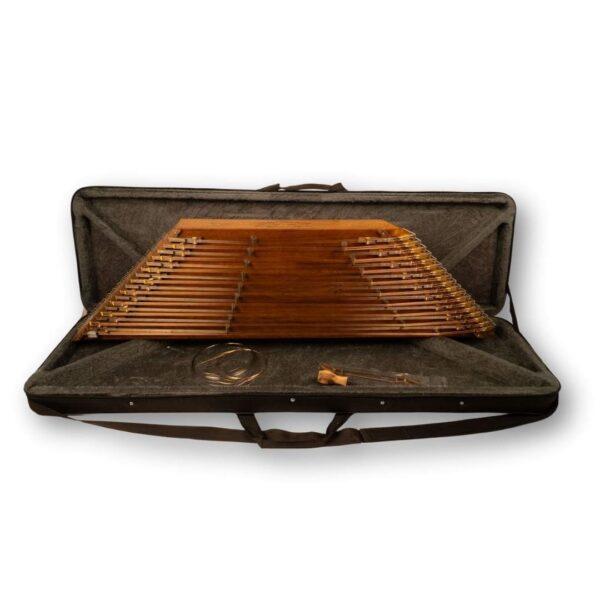
Two practical points complete the decision. First, plan the ecosystem around the instrument: spare bronze and silver string spools, mezrab/zahme mallet sets, a tuning key, and a proper stand are all in our santur accessories range — a santur is a seventy-two-string instrument, and having strings and tools at hand keeps it in voice year-round. Second, check the maker attribution on each product page: whether from Behrad & Zolani, Parsa, or the Tapadum workshop, every santur ships with its bridge geometry and tuning stability individually checked. Worldwide shipping & 15-day return apply, and our team will gladly advise which variant fits your repertoire before you order.
Where the tiers sit in the current range: the traditional side opens with the Latifi 9-bridge santur, hand-built in walnut in a Tehran workshop, and rises to the Parsa 3 Mohr — a three-seal Vizhe-grade instrument built entirely in black walnut, its nine treble courses in steel and its nine bass courses in bronze. A traditional santur starts at around €400; the lever instruments below run from roughly €800 to just under €2,000.
Sharping-Lever Santurs Developed at Tapadum
Three of the santurs on this page are our own development, built to answer the one real limitation of the traditional instrument: its fixed diatonic tuning. Each carries a row of sharping levers — mandal — that raise or lower a course by a half-step under the finger, so the key can change mid-piece without the tuning key ever coming out. The 9-bridge Special Santur with Sharping Levers is the compact one, at around €800, while two twelve-bridge builds — a twelve-bridge santur with mandal at about €900 and a second twelve-bridge build near €1,500 — add range and string count.
The Special Santur with Mobile Mandals stands apart from all of them, because its mechanism is not built around fixed stops. Each mandal travels a span of up to three half-steps and can be halted at any point along the way, not only at the semitone. That puts the intermediate pitches directly under the hand — the microtonal intervals and commas that Persian dastgah and Turkish makam rest on, reached mid-performance instead of through retuning. It is the most specialised santur we carry, and the one to choose if your repertoire lives between the notes. Its sliding tuning system was developed with Behrad & Zolani.
Frequently Asked Questions
What is a santur?
Is a santur the same as a hammered dulcimer?
What is the difference between a santur and a qanun?
How is the santur tuned?
What music styles use the santur?
What is the difference between Persian, Turkish, and Indian santur?
Which santur should I buy — traditional, sharping levers, or mandal?