
The Santur: A Complete Guide to the Persian Hammered Dulcimer (2026)
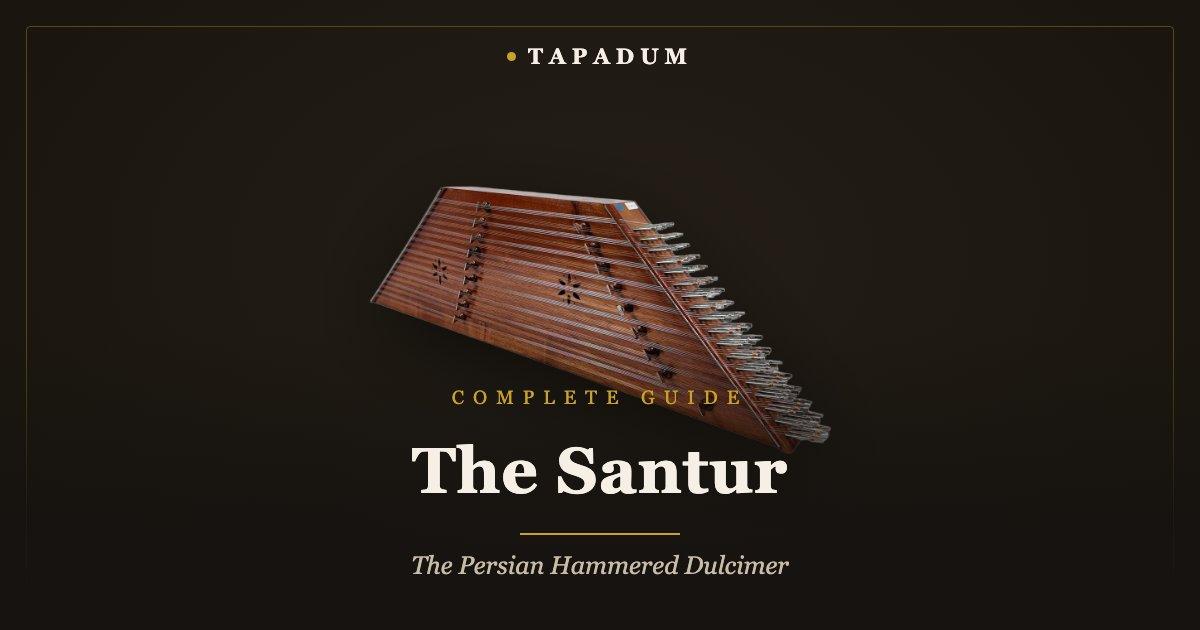
The santur is a trapezoidal, struck-string dulcimer at the heart of Persian classical music. Its 72 strings are stretched over movable bridges and played with a pair of light wooden mallets called mezrab, producing a bright, bell-like resonance that decays into a shimmering wash of overtones. Related instruments are found across Greek, Turkish, Iraqi, Indian and Central European traditions, but the Persian santur — with its two rows of nine bridges — remains the most refined member of the family. This guide covers what the santur is, where it comes from, how it is built, tuned and played, and what to look for when you buy your first one. Our traditional santurs come from Persian makers, our lever santurs are built in our own strings workshop in Izmir, and we tune and inspect each instrument before it ships worldwide.
TL;DR — The Santur at a Glance
- What it is: a Persian hammered dulcimer — a trapezoidal box with 72 strings played by striking them with two light mezrab mallets.
- Standard model: the 9-bridge (9 kharak) santur, giving a range of about three octaves.
- Two tuning families: diatonic (one scale, warm and traditional) and chromatic / mandal (sharping levers for fast key changes).
- Material: walnut is the classic soundboard and body wood; strings are brass (bass) and steel (treble).
- Best first choice: a hand-made 9-bridge diatonic santur with a hard case and a tuning key.
- Price range: in our range, roughly €400–€500 for a hand-made 9-bridge Persian santur and €700–€2,000 for a lever (mandal) santur.
What Is a Santur?
A santur is a struck-string instrument: instead of plucking or bowing, the player strikes the strings with two lightweight mallets. The body is a shallow, trapezoidal wooden box, wider at the front than the back. Strings run across the top in courses — small groups tuned to the same note — and each course passes over a small movable bridge, or kharak. On the standard Persian santur the bridges stand in two rows of nine and carry 72 strings in total, four to a note. The right-hand row carries the brass courses of the low register; the left-hand row carries the steel courses, which sound once to the right of their bridges, in the middle register, and again behind them, on the far left, in the high register — the three note regions described in a 2005 ISMIR paper on the santur. Striking a course sets all four strings ringing together, which is what gives the santur its characteristic chorus-like brilliance.
The name comes from the Persian san-tur, often traced to “a hundred strings.” In practice the modern Persian santur carries 72, but the sense of a rich, many-stringed instrument holds true. Because the bridges are movable, the same physical instrument can be tuned to many different scales — a flexibility that shapes everything about how the santur is learned and played.
Origins and History
The santur belongs to one of the oldest instrument families in the world: the box zither struck with mallets. Ancestral forms appear in Mesopotamian and ancient Persian iconography, and the instrument is closely related to a wide web of cousins — the Iraqi and Turkish santur, the Greek santouri, the Indian and Kashmiri santoor, the Chinese yangqin, and the European hammered dulcimer. Each culture adapted the number of bridges, the string material and the tuning to its own musical language; our comparison of the santur, the Indian santoor and the Western hammered dulcimer shows how far those choices go.
In Iran, the santur became a pillar of the classical radif — the codified repertoire of the Persian modal system, or dastgah. Through the twentieth century, players such as Abol Hasan Saba and Faramarz Payvar standardized technique and expanded the instrument’s role from ensemble accompaniment to solo concert performance. Today the santur is taught in conservatories across Iran and studied by musicians worldwide who are drawn to its meditative, cascading sound. For the broader background, the Santur entry on Wikipedia and the Encyclopaedia Britannica article are good starting points.
Types and Variations
Most of the choice you will face comes down to the number of bridges and whether the instrument has a mandal (sharping lever) mechanism. The table below summarizes the santurs we most often recommend.
| Type | Bridges | Tuning system | Best for |
|---|---|---|---|
| Standard 9-bridge santur | 9 treble + 9 bass | Diatonic (retuned by hand) | Beginners and Persian classical repertoire |
| Special / Mandal santur | 9 treble + 9 bass | Chromatic via sharping levers | Players who change keys quickly or play cross-genre |
| Extended / concert santur | 11+ bridges | Diatonic or chromatic | Professionals needing a wider range |
| Regional cousins (santouri, yangqin, dulcimer) | Varies | Culture-specific | Folk and world-music contexts |
For most new players, the standard 9-bridge diatonic santur is the right instrument. The mandal (sharping-lever) santur is worth the extra investment only if you already know you need rapid chromatic changes — for example, moving between Persian modes and Western keys within the same performance.
Anatomy and Materials
A well-made santur is a study in acoustic balance. The soundboard is the single most important surface: walnut is the traditional choice, prized for a warm fundamental with clear overtones, and the boards on our instruments are aged before assembly to stabilize the tone. Two rosettes (sound holes) let the box breathe and shape the resonance.
The bridges — kharak — are small wooden pieces topped with a metal or bone insert; each carries one course of strings and can be nudged left or right to fine-tune the interval between the two halves of the string. Treble courses are steel; bass courses are brass or bronze, which is why the low register sounds darker and rounder than the ringing top. Tuning pins run along one long side and hitch pins along the other.
Pro tip from our workshop: when we inspect a new santur, we look first at the soundboard grain and the seating of every bridge. A bridge that rocks even slightly will not hold its tuning, no matter how good the strings are. Even, tight-grained walnut and firmly seated bridges matter more than decoration.
How the Santur Is Played
The santur is played seated, with the instrument resting on a table or on the player’s knees, the narrow edge closest to the body. The two mezrab mallets are held lightly between the fingers so the head can bounce off the strings rather than press into them — the touch is closer to a drum stroke than a piano key. Speed and dynamics come from the wrist, and the instrument’s fast decay is used expressively: rapid tremolos sustain a note, while single strokes ring and fade.
Because the bridges of the steel row divide their courses into a usable right and left section, one steel course gives two pitches, and skilled players move fluidly across both sides of the instrument. Melodic ornamentation — the grace notes and micro-inflections central to Persian music — is produced by the exact placement and weight of each stroke.
Santur Tuning: Diatonic vs Chromatic, and How to Tune It
Tuning is the santur’s defining ritual. Because the bridges are movable and the instrument has no frets or keys, the player sets the scale directly into the strings. There are two broad approaches. Diatonic tuning sets the instrument to a single mode or scale (for example a specific Persian dastgah); it is warm, stable and traditional, but changing to a distant key means retuning by hand. Chromatic tuning, used on mandal santurs, adds small sharping levers that raise selected courses a semitone on demand, so a player can shift keys mid-performance without repositioning bridges.
Persian santurs are usually tuned to a reference pitch of A = 440 Hz (some sound-healing players prefer 432 Hz). You will need a santur tuning key and a chromatic or strobe tuner. The step sequence below is the routine we use before every instrument leaves the workshop.
Step 1 — Set your reference pitch
Choose 440 Hz (standard) or 432 Hz (sound healing) on your tuner. Tune a central steel course first; it becomes the anchor for every other note.
Step 2 — Tune the steel courses (left-hand bridges)
Working outward from the center, tune each of the nine steel courses on the left-hand row of bridges to its target note in your chosen scale. Turn the tuning key in small increments and let each string settle before moving on.
Step 3 — Tune the brass courses (right-hand bridges)
Tune the nine brass courses on the right-hand row, which form the low register. The heavier brass strings need slightly larger key movements.
Step 4 — Balance the two halves of each string
Because each bridge on the steel row divides its strings into a right-hand and a left-hand pitch, nudge the bridge a millimetre at a time until both sides ring true. This is what separates an in-tune santur from an almost-in-tune one.
Step 5 — Set your mode (dastgah)
Adjust the specific courses that carry the microtonal intervals of your chosen dastgah. On a mandal santur, engage the relevant levers instead of retuning.
Step 6 — Check octaves and fine-tune
Play octaves and fifths across the instrument, listening for beating, and make final micro-adjustments. New strings will drift for a few days, so retune often at first.
If a string keeps slipping out of tune or breaks, our guide to replacing santur strings covers fitting a new string, seating the tuning pin and checking the bridge position.
Choosing Your First Santur
If you are buying your first santur, focus on four things. Bridges: a standard 9-bridge instrument is the correct starting point — enough range for the classical repertoire without the cost and complexity of a mandal system. Wood and build: a hand-made walnut santur with a cleanly finished soundboard and firmly seated bridges will hold tune and sound better than a mass-produced one. Maker grade: Persian workshops grade their instruments by tone and finish; the Parsa 3 Mohr, for example, carries three maker’s seals, the Vizhe grade at the top of the Parsa scale. Accessories: make sure a hard case, a tuning key and a pair of mezrab are included or added, because a santur without a case is fragile in transit.
Red flag to avoid: extremely cheap “santurs” with plywood boards and glued-down bridges cannot be properly tuned and will frustrate a beginner within weeks. A slightly higher investment in a hand-built instrument pays back immediately in playability.
Browse the full range on our santur collection page, and find tuning keys, mezrab mallets and spare strings in our santur accessories.
Care and Maintenance
A santur is sensitive to humidity and temperature because its thin walnut soundboard is under constant string tension. Keep it in its hard case when not in use, away from direct sun, radiators and damp. Aim for stable room humidity of around 45–55%; sudden swings are what crack soundboards and shift bridges. Wipe the strings after playing to slow corrosion, and expect to replace strings periodically as they dull. If a bridge shifts or a string buzzes, re-seat the bridge and retune rather than forcing the pin. Treated well, a good santur lasts for decades.
The Santur in Sound Healing and Meditation
The santur’s long, overlapping decay makes it a natural voice for meditative and therapeutic music. Its cascading overtones create a continuous, gently shifting texture that many practitioners use for relaxation and sound baths, often alongside a handpan, frame drum or other sound-healing instruments. Some players in this setting tune to 432 Hz. It sits about a third of a semitone lower than 440 Hz; the special effects often claimed for it have not been shown in research, as our guide to 440 Hz and 432 Hz explains. The same qualities that suit the concert stage — resonance, richness, slow decay — translate directly into contemplative practice.
Our Santur Collection
Our santurs come from two places: Persian workshops for the traditional diatonic instrument, and our own strings workshop in Izmir for lever santurs. Every instrument is inspected and tuned in-house before dispatch.
- Professional Persian Santur — Parsa 3 Mohr & Hard Case — a three-seal Vizhe grade santur built entirely in black walnut, and our recommended traditional instrument.
- Persian Santur — Latifi 9-Bridge & Hard Case — a hand-built 9-bridge diatonic santur from the Latifi workshop; check the product page for current availability.
From our Izmir workshop, for players who change key within a piece:
- 9-Bridge Special Santur with Sharping Levers — the classical nine-bridge Persian layout with a row of levers along the bridges.
- 12-Bridge Special Santur with Sharping Levers — twelve bridges for a wider range.
- Special Santur with Sharping Levers — the higher-tier build of our twelve-bridge lever santur.
For microtonal playing, the Special Santur with Mobile Mandals carries mobile levers designed by Behrad & Zolani that can stop between the semitones. Worldwide shipping & 15-day return apply to every instrument.
Frequently Asked Questions
What is a santur?
A santur is a Persian hammered dulcimer: a trapezoidal wooden box with 72 strings that are struck with two light mallets called mezrab. On the standard model, two rows of nine bridges give a range of about three octaves.
How many strings and bridges does a santur have?
The standard Persian santur has 72 strings arranged in courses of four, carried by 9 treble bridges and 9 bass bridges — 18 movable bridges in total. Each course of four strings is tuned to one note.
Is the santur hard to learn for a beginner?
The basic striking technique is approachable, and beginners can play simple melodies within weeks. The real learning curve is tuning and the microtonal intervals of Persian music, which is why a well-built, easy-to-tune instrument matters so much for a first santur.
What is the difference between a diatonic and a mandal santur?
A diatonic santur is tuned by hand to one scale at a time and is warm and traditional. A mandal santur adds sharping levers that raise selected courses a semitone instantly, letting the player change keys mid-performance without moving the bridges.
How often should I tune my santur?
A new santur, or one with fresh strings, drifts for several days and should be retuned before each session. A settled instrument in stable humidity holds tune well but still benefits from a quick check before playing.
How much does a good santur cost?
In our range, a hand-made 9-bridge Persian santur costs roughly €400–€500, and santurs with sharping levers (mandal) run from about €700 to just under €2,000. Price reflects the maker’s grade, the quality of the walnut, the number of bridges and whether a lever system is fitted.
The santur rewards patience: once it is tuned and in your hands, few instruments match its shimmering, meditative voice. If you are ready to begin, explore our hand-built Persian santur collection, or read more about the wider family of Persian instruments and the dastgah system that shapes how they are tuned and played.
Published by Tapadum Ethnic Music Store — reviewed by our Persian instrument specialists. Worldwide shipping & 15-day return.