
Electric & Silent Oud: The Complete Guide

An electric oud is a traditional oud adapted for amplification. Instead of relying only on a hollow wooden body to project sound, it carries a pickup that converts string vibration into a signal you can send to an amp, a mixer, or an audio interface. The playing geometry — the fretless neck, the courses, the tuning — stays the same. What changes is how the sound leaves the instrument.
That single change solves two problems acoustic ouds struggle with: feedback on a loud stage, and volume in a quiet home. In our Izmir atelier we build and set up electric ouds precisely for those two situations, and the right choice depends entirely on which one you are trying to solve.
What is an electric oud?
An electric oud keeps the fretless fingerboard and doubled string courses of the acoustic instrument but adds electronics. Some models keep a full resonance chamber; others reduce or remove it. The more body a maker takes away, the less sound the instrument makes on its own — and the more it depends on the pickup.
This is why “electric oud” is not one instrument but a small family, which you can see across our electric oud collection. Choosing well means understanding where a given model sits on the scale from fully acoustic to fully silent.
The three types of electric oud
At Tapadum we group electric ouds into three categories, each built for a different need.
| Type | Body | Acoustic volume | Best for | Feedback resistance |
|---|---|---|---|---|
| Classical electric | Full resonance chamber + magnetic pickup | Full (acoustic + amplified) | Players who want one instrument for both | Moderate |
| Semi-acoustic | Reduced-depth / cutaway chamber | Medium | Stage and studio | High |
| Silent | Frame-style, no chamber | Very low | Quiet practice, recording isolation | Very high |
Classical electric oud
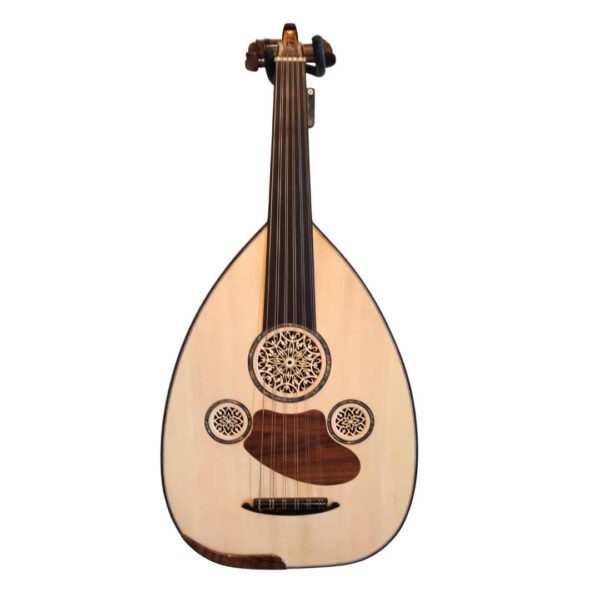
This is an acoustic oud fitted with a pickup, keeping its full body and resonance. It sounds like a normal oud unplugged and gives you amplification when you need it. It is the most versatile option, but because the body still resonates fully, it is the most prone to feedback at high stage volume.
Semi-acoustic electric oud
Often called semi-hollow or cutaway, this type reduces the depth of the body while keeping some internal resonance. The result is a warmer, more natural amplified tone than a silent oud, with far better feedback resistance than a fully acoustic instrument. Our Electric Turkish Oud, built by Ahmet Topan in Izmir, uses a semi-hollow body with a magnetic pickup and a 58.5 cm Turkish scale — a practical choice for live performance and recording.
Silent oud
A silent oud has a frame-style body with no resonance chamber, so it produces very little sound on its own and relies entirely on its pickup. It is designed for practice in apartments, late-night sessions, hotel rooms, and clean studio isolation. Our Silent Electric Oud MG-E2, hand-built by master luthier Mustafa Gezerdag in our Izmir atelier, is a solid mahogany silent body with a Fishman 301 active piezo pickup, geared guitar pegs, and Kürschner strings in the standard Turkish tuning (D–A–E–B–F#–C#, low to high).
Piezo vs magnetic pickups
The pickup is the heart of any electric oud, and there are two main kinds.
Piezo pickups sit under the bridge and read the physical vibration of the soundboard or bridge. They capture the percussive attack and detail of the oud well and are common on silent instruments. The Fishman 301 in our MG-E2 is an active piezo system powered by a 9V battery.
Magnetic pickups read the movement of the strings over a magnet, much like an electric guitar. They give a rounder, warmer amplified tone and resist feedback well, which is why we fit them to semi-acoustic models built for the stage.
Neither is “better.” Piezo favors detail and isolation; magnetic favors warmth and stage stability. The right one follows from how you plan to play.
How to choose: practice, stage, or studio
Rather than starting from specifications, start from the problem you are solving. If you are new to the instrument, our oud buying guide covers the fundamentals that apply to every oud, electric or acoustic.
If you need to practice quietly, a silent oud is the clearest answer. It lets you play at any hour without disturbing anyone, and plugs into headphones through an amp or interface. Note that the MG-E2 does not include a built-in headphone amplifier, so you will need a small interface or amp for silent monitoring.
If you play live, a semi-acoustic oud with a magnetic pickup gives you volume without the feedback that plagues a fully acoustic oud in front of monitors.
If you want one instrument for everything, a classical electric oud keeps a natural acoustic voice at home and still amplifies for smaller gigs, at the cost of some feedback resistance. If you are still deciding between traditions, our comparison of the Arabic and Turkish oud explains how tone and tuning differ.
Price tiers
Electric ouds in our collection span three broad levels.
| Level | Example | Price |
|---|---|---|
| Entry silent | Silent Electric Oud MG-E2 (Mustafa Gezerdag) | €629 |
| Mid semi-acoustic | Electric Turkish Oud / Semi-Hollow Arabic Electric | €699 |
| Professional | Electric ouds by master luthier Feramis Aktas | €1,179 |
The jump to the professional tier buys tighter build tolerances, higher-grade tonewoods, and more refined electronics — worth it for performing players, less essential for someone whose main goal is quiet practice.
Setup and care
Electric ouds need the same string care as acoustic ones, plus a little electronics housekeeping. Keep a spare 9V battery for active piezo systems, and switch the instrument off at the jack when you are not playing to preserve battery life. Quality strings such as Kürschner hold tuning better on geared pegs, and new strings still need several days of retuning as they stretch. For a full reference, see our guide to tuning a Turkish oud.
Explore our electric and silent ouds

Frequently asked questions
Can you play a silent oud without an amplifier?
Yes, but only very quietly. A silent oud has no resonance chamber, so it makes little sound on its own — that is the point. For real volume or headphone practice you connect it to an amp, mixer, or audio interface.
Is an electric oud good for beginners?
A silent or semi-acoustic oud can be excellent for a beginner who lives with others or in an apartment, because it allows quiet practice. The neck and tuning are the same as an acoustic oud, so nothing about the technique changes.
What is the difference between a silent oud and an electro-acoustic oud?
A silent oud has no resonance chamber and is nearly inaudible unplugged. An electro-acoustic (semi-acoustic) oud keeps a reduced chamber, so it still has a natural acoustic voice while resisting feedback when amplified.
Do electric ouds sound different from acoustic ouds?
Plugged in, the tone depends on the pickup. Magnetic pickups sound warmer and rounder; piezo pickups capture more attack and detail. Neither replaces the exact voice of a fine acoustic oud, but both let you perform and record where an acoustic instrument would feed back or be too quiet.