Oud Case and Gig Bag Guide: Padded or Hard Case?

What you’ll learn: the two real classes of oud case and which one your travel actually calls for, what a case protects against beyond the obvious knock, why the bowl is the measurement that decides fit, the red flags of a badly matched case, and where a case stops helping and instrument care takes over.
An oud case comes in two genuine classes, and almost every buying decision reduces to choosing between them. A padded gig bag is a fabric shell with foam inside; it is light, it goes on your back, and it handles the daily journey from home to lesson to rehearsal. A fiber hard case is a rigid shell; it is heavier and costs more, and it is what you want when the instrument travels without you watching it, or when it sits somewhere for months.
The mistake we see most often is not buying the wrong class. It is buying a case that does not fit the bowl. The oud — also written ud, and often described in English simply as the Arabic or Turkish lute — has a deep, rounded back rather than a flat one, and that depth varies noticeably between traditions and makers. A case that closes over a shallow bowl will press on a deeper one, and pressure on a rib joint over months is worse than a single knock.
The Short Answer: Two Classes, One Decision
| Padded gig bag | Fiber hard case | |
|---|---|---|
| Shell | Fabric over foam padding | Rigid moulded fiber |
| Carrying | Backpack straps and handle | Handle |
| Weight | Around a kilo | 3 kg empty |
| Protects against | Scuffs, rain, everyday knocks | Crushing, drops, being stacked under other luggage |
| Best for | Lessons, rehearsals, local gigs, cycling and public transport | Flights, couriers, tours, long-term storage |
If you carry the instrument yourself and it never leaves your hands, a gig bag is the correct answer and the hard case is money spent on weight you have to lift. If the oud is ever out of your sight — checked baggage, a courier, the back of a van with other people’s gear — the hard case is not a luxury.
What a Case Actually Protects Against
Four different things, and they call for different features.
Impact. The obvious one, and the one people over-weight. A dropped oud is rare. Padding of any real thickness handles the doorframe and the corner of a table.
Pressure. The one people under-weight, and the reason a hard case exists. A soft bag under a suitcase transmits the full load to the bowl. Ribs are thin, glued along their edges, and they do not want sustained force across the curve.
Humidity swing. A closed case slows the rate at which the surrounding air changes the wood — it buffers, it does not control. That is genuinely useful going from a cold street into a heated room, and it is not a substitute for keeping the instrument somewhere sensible. Our guide to oud care and storage covers the humidity side properly.
Dust and hardware snags. Less dramatic, but a case with a soft lining and a pocket is what stops your risha and a spare set of oud strings from rattling around against the soundboard.
The Padded Gig Bag: What You Will Use Most Days
A gig bag is the default for a reason. It weighs about a kilogram, it goes on your back and leaves both hands free, and it is shaped closely enough to the instrument that it does not turn a narrow doorway into a problem.
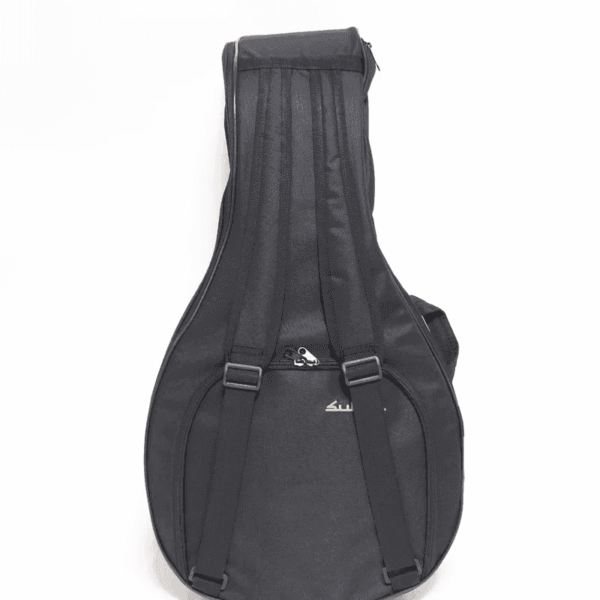
We stock two, and it is worth being clear about how they relate: they are the same class of case, not two different levels of protection. Both are padded fabric gig bags with backpack straps and a front pocket. The difference is build quality — the Oud Gig Bag Plus uses better materials and carries thicker padding than the standard High-Quality Padded Oud Case. That is the whole distinction, and it is worth roughly twenty euros if you are carrying the instrument several times a week rather than once a month.
Both are cut to take Turkish, Arabic, Iraqi and Syrian ouds, and both will take an electric or silent oud, whose slimmer body leaves room to spare. The standard bag adds a sheet-music pocket and a double-sided hook so it converts between shoulder carry and backpack.
When I pack an oud for a customer in our Brisighella showroom, the check I do on a gig bag is the zip run: I close it slowly with the instrument inside and watch whether the fabric has to stretch over the widest point of the bowl. If it does, the bag is a size too small, however well it fits everywhere else.
The Fiber Hard Case: When the Bag Is Not Enough
Our Oud Hard Case is built from moulded fiber rather than wood. Fiber matters here for a specific reason: a traditional wooden case is rigid but heavy, and weight is what makes people leave the good case at home. This one is 86 cm long overall with a bowl recess of roughly 51 × 39 × 22 cm, and it weighs 3 kg empty.
Those numbers are the ones to check against your instrument, not the price. A hard shell only protects if the oud sits in it without moving and without being compressed. Too much space and the instrument travels inside the case during a drop; too little and the lid presses on the bowl every time it closes.
The honest limitation is that 3 kg plus an oud is a two-hands, one-trip proposition. Nobody cycles to a lesson with a hard case. It earns its weight at an airport check-in desk and in a storage cupboard, and nowhere in between.
How to Check the Fit Before You Buy
Oud dimensions are not standardised, and the differences between traditions are large enough to matter. Turkish ouds generally run slightly smaller than Arabic ones, with a shorter string length and a shallower body; our comparison of the Arabic and Turkish oud goes into how far that goes. Between individual makers the spread is wider still.
Take three measurements from your own instrument before ordering:
Total length, from the bottom of the bowl to the tip of the pegbox, with the pegbox in its bent-back position. This is the measurement people forget, and the pegbox is what usually will not fit.
Bowl width at the widest point, measured across the face.
Bowl depth, from the soundboard down to the deepest point of the back. This is the number that decides whether a lid closes without pressure, and it is the one that varies most between a Turkish and an Arabic instrument.
Compare all three to the case, and leave a little room on length rather than depth. If you are still choosing the instrument itself, our complete oud guide and the beginner model comparison come first — pick the oud, then the case that fits it.
Red Flags
A guitar case sold as an oud case. A guitar has a flat back. The bowl will sit proud of the recess and the lid will press on it. This is the single most common damaging mistake.
No neck or pegbox support. In a drop, an unsupported neck takes the whole momentum of the bowl. Look for a shaped channel or a raised block under the neck.
Thin padding at the base. Cases are set down base-first hundreds of times. Padding matters most where the instrument actually lands.
A hard case that rattles. If you can hear the instrument shift when you tilt the closed case, the fit is wrong and the rigid shell is working against you rather than for you.
Storage Is Not the Same Job as Transport
A case is a transport solution that happens to be useful for storage. For anything longer than a few weeks, the case is the smaller half of the problem: where you put the case matters more than which case it is. Away from exterior walls, away from radiators and direct sun, somewhere the temperature does not swing.
Leaving an oud tuned to pitch inside a closed case for months is also a choice worth making deliberately rather than by default — the string tension is constant load on the soundboard. Our care guide covers what to do before a long rest.
One thing a case cannot do is stand the instrument up in a room where you will actually pick it up. That is a stand’s job, and an oud in a case is an oud you play less.
Which One to Buy
You go to a weekly lesson and play at home. The standard padded gig bag. It does everything you need and nothing you do not pay for.
You carry the instrument several times a week, or you cycle and use public transport. The Gig Bag Plus. Better materials and thicker padding are worth it at that frequency, and the bag is what wears out first.
You fly with the oud, ship it, or tour. The fiber hard case, without hesitation. This is the situation the class exists for.
You have one oud and it is valuable. Both. The gig bag for the journeys you make yourself, the hard case for storage and for anything you hand to someone else.
All three are in our oud accessories range. If you play more than one instrument family, we have written the same guide for saz and baglama and for percussion.
Frequently Asked Questions
Can I take an oud on a plane in a gig bag?
If it goes in the cabin, yes — a gig bag is fine because the instrument stays under your control and nothing is stacked on it. If it is going into the hold, a gig bag is not enough: checked baggage means sustained pressure from other cases, which is exactly what a soft shell cannot resist. Airline policies on instruments as cabin baggage vary, so check with the carrier before you travel rather than at the gate.
What is the difference between the two padded gig bags?
They are the same class of case. Both are padded fabric gig bags with backpack straps and a front pocket, cut for Turkish, Arabic, Iraqi and Syrian ouds. The Plus version uses higher-grade materials and thicker padding. It is a build-quality step, not a step up to a different kind of protection — if you need rigid protection, the answer is the hard case rather than a better bag.
Will an oud case fit both a Turkish and an Arabic oud?
Often, but never assume it. Turkish ouds generally run slightly smaller and shallower than Arabic ones, and the spread between individual makers is wider than the spread between traditions. Measure total length including the bent-back pegbox, bowl width across the face, and bowl depth from the soundboard to the deepest point of the back, then compare all three against the case.
Does a case protect against humidity?
It buffers, it does not control. A closed case slows how fast the surrounding air reaches the wood, which genuinely helps when you bring a cold instrument into a warm room — give it time in the closed case before opening. It does not hold a stable humidity level over weeks. For that, the room the case sits in matters more than the case.
Is a hard case worth it if I never travel?
For most players, no. If the oud only moves between rooms in your home, a padded gig bag covers it and the hard case is 3 kg you never need to lift. The exception is long-term storage of a valuable instrument, where a rigid shell protects against things being placed on top of it — a risk that has nothing to do with travel.