Santur vs Santoor vs Hammered Dulcimer: How the Persian, Indian and Western Instruments Differ
What you’ll learn: why “santur” and “santoor” are one name with two spellings, how the Persian santur, the Indian santoor and the Western hammered dulcimer differ in strings, bridges, mallets and tuning, and which of the three fits the music you want to play.
The short answer to santur vs santoor is simple: both words are spellings of the same name. In practice, though, they usually point to two different instruments. One is the Persian santur of Iran’s classical tradition. The other is the Indian santoor, which Shivkumar Sharma carried from the Sufi music of Kashmir to the Hindustani concert stage. Both belong to the family English speakers call the hammered dulcimer: a shallow box of metal strings struck with light mallets. The same family includes the Western dulcimer of European and American folk and dance music, the Greek santouri, the Hungarian cimbalom and the Chinese yangqin. The principle is shared. What separates them is detail: the number of strings, the layout of the bridges, the grip on the mallets and the tuning.
The Persian santur is the one we know from the inside. We curate santurs from Persian makers and build lever santurs in our own Izmir strings workshop, so this guide starts there. We do not stock the Indian santoor or a Western-style hammered dulcimer, and we say so plainly below. Understanding all three is still the quickest way to know which one you are really looking for.
Santur vs Santoor: One Name, Several Spellings
The name is Persian, and English has never settled on a single spelling. Britannica files the whole family under one entry, santoor. It describes a hammered dulcimer, or struck zither, found across southeastern Europe, the Middle East and South Asia, and widely believed to have originated in Persia. The same entry gives a range of about 72 to more than 100 strings, depending on the region and the tradition.
The spelling alone therefore tells you little. The Indian instrument is almost always written santoor. The Persian one appears as santur, santour and santoor too; our own string listings use “Persian santoor” as an alternative name. When you meet the word, look at what is described. A 72-string instrument with two rows of nine bridges is a Persian santur, whatever it is called.
Hammered dulcimer is the English family name. The Smithsonian traces “dulcimer” to the Latin and Greek dulce and melos, “sweet tune”. It also points out that the plucked Appalachian, or mountain, dulcimer shares the name but differs in form, sound and playing technique. When this guide says hammered dulcimer, it means the struck instrument.
The Three Instruments at a Glance
| Persian santur | Indian santoor | Western hammered dulcimer | |
|---|---|---|---|
| Home tradition | Persian classical music (radif, dastgah) | Sufi music of Kashmir; Hindustani classical music since the mid-20th century | European and North American folk and dance music |
| Strings | 72, in 18 courses of four | About 90 to 100 or more | Varies with size; a common layout has 12 treble and 11 bass courses |
| Bridges | 18 small movable bridges (kharak), nine per row, one per course | Many more individual bridges: 31 on the instrument Shivkumar Sharma played | Two long bridges, treble and bass, each carrying many courses |
| Range | About three octaves on a nine-bridge santur | About three octaves on the Sharma-style instrument | Usually two to three octaves, diatonic |
| Mallets | Feather-light wooden mezrab with a finger ring | Two light wooden mallets held between the index and middle fingers | Thin-handled hammers with wooden heads, sometimes leather- or felt-covered |
| Tuning approach | Set by hand for each dastgah, microtones included | String layout and tuning reworked for raga-based music | A fixed pattern of fifths across the treble bridge, giving several keys |
The Persian Santur
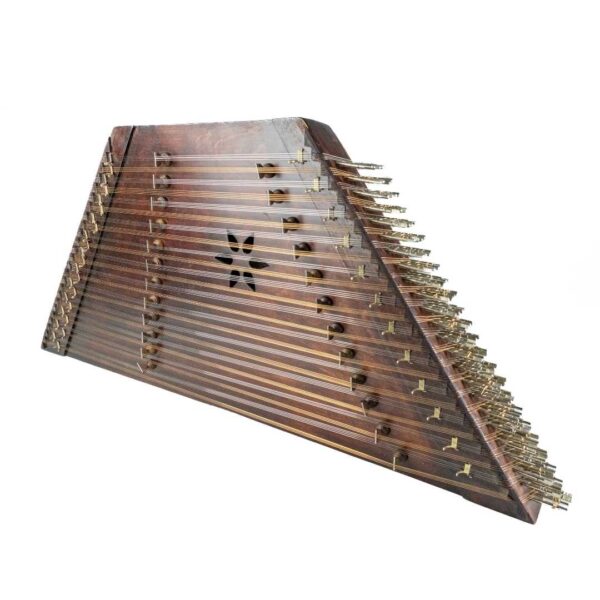
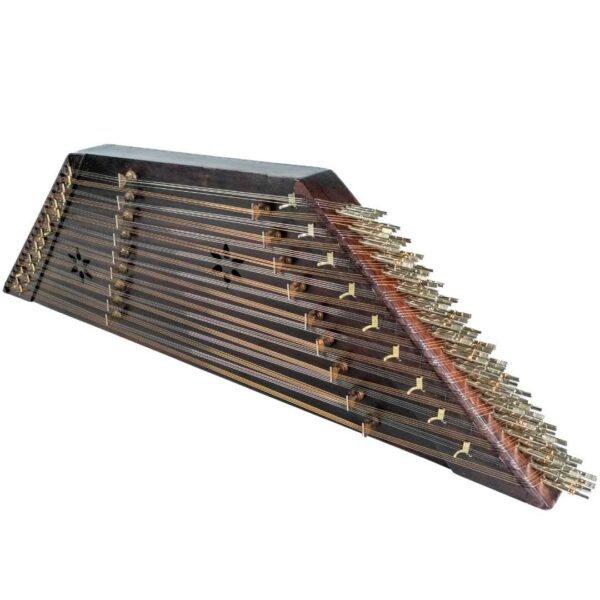
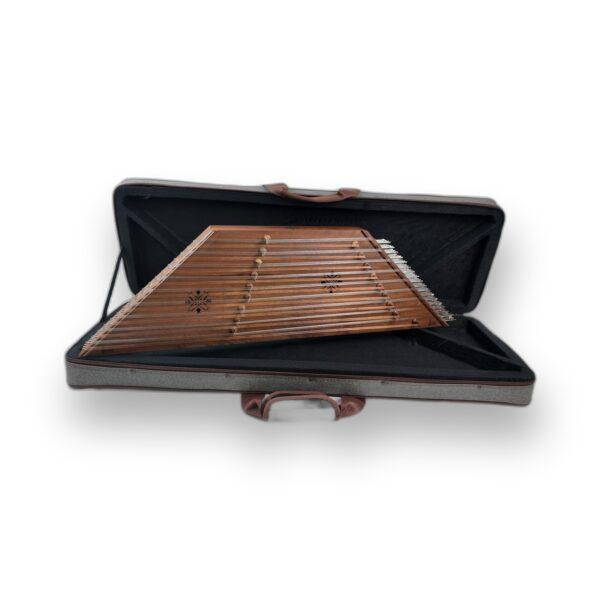
The Persian santur is a trapezoidal box, usually of walnut, carrying 72 strings in 18 courses of four. Each course rests on its own small movable bridge, or kharak, and the bridges stand in two rows of nine. The bass courses are brass or bronze; the upper courses are steel. Peyman Heydarian and Joshua Reiss studied the instrument in a paper for the 2005 International Conference on Music Information Retrieval. They describe three note regions on the santur. Brass notes sit on the right and steel notes in the centre. The same steel courses sound again behind their bridges, on the left. That third region is why a nine-bridge santur covers about three octaves; the authors give an eleven-bridge santur a range from C3 to F6.
The mallets, called mezrab or zahme, are light and wooden, with tips left bare or lightly finished. The index finger passes through a small ring on each one, and the wrist does the work, letting the mallet bounce off the string. That rebound produces the santur’s fast tremolo and ornamented runs. We compare it with Western sticks in our guide to zahme and hammered dulcimer sticks.
Because every course has its own bridge, the player sets the scale directly into the instrument, including the microtonal intervals of the Persian modes. Moving to a distant mode means retuning by hand. This is why the santur sits so naturally in the radif, the classical repertoire organised by the dastgah system. It also shares much with its neighbours in the Persian string family.
On the Parsa 3 Mohr santur we carry from the Parsa workshop, the soundboard, the frame and all 18 bridges are cut from black walnut. It is selected by our strings specialist Sertan Sarioglu and inspected at our Brisighella showroom before it ships. Our complete guide to the Persian santur covers its history, anatomy and care in depth.
The Indian Santoor
In South Asia the santoor belongs first to Kashmir. According to Britannica, it was traditionally played in Sufi music there, usually in a small ensemble with drums and other stringed instruments. Britannica describes the Kashmiri santoor as a dulcimer with some 100 strings. It was well known in the region’s Sufi music but foreign to the Hindustani tradition — until Shivkumar Sharma (1938–2022).
Sharma’s father, the vocalist and tabla player Uma Dutt Sharma, introduced him to the instrument as a teenager. In 1955 Sharma gave his first major public performance of Hindustani music on the santoor. Britannica records that traditionalists objected. A percussive, fixed-pitch instrument, they argued, could not follow the pitch bends of Hindustani music. Sharma answered by widening the instrument’s range, changing the arrangement and tuning of its strings, and reworking his technique towards a more sustained sound. By the late 20th century the santoor was firmly part of the Hindustani tradition.
The result feels like a different instrument in the hands. Jameela Siddiqi, writing for the Darbar Arts Culture and Heritage Trust, notes that the santoor Sharma played has 31 bridges and more than 90 strings. It covers three octaves. It also moved from a wooden block in front of the musician onto the player’s lap. Its two light wooden mallets are held between the index and middle fingers.
We do not stock the Indian santoor. If raga music drew you to the instrument, look for an Indian santoor and a teacher from that tradition. A Persian santur has a different bridge layout and a different grip, so it will not give you the same instrument.
The Western Hammered Dulcimer
The Western hammered dulcimer solves the same problem with fewer, longer bridges. In the Smithsonian’s account of the instrument, the treble courses cross a treble bridge that divides their vibrating length in a 2:3 ratio. Each course therefore gives two notes a perfect fifth apart, the higher one on the left. A second bridge near the right side carries the bass courses, which pass low through gaps in the treble bridge. One string can be struck in more places without making the instrument larger. Dulcimers built this way began to appear in Europe in the 16th century.
In the United States the dulcimer was a common domestic and concert instrument in the 18th and 19th centuries. In the North it was nicknamed the “lumberjack’s piano”; in German it is the Hackbrett, the “chopping board”. A common layout has 12 treble and 11 bass courses, tuned so that scales in D, G and C fall under the hands. That suits the dance tunes the instrument is known for. Most dulcimers are diatonic, with a range of two to three octaves. The Hungarian cimbalom, developed around the end of the 19th century, is the large concert exception, with a damper mechanism and four chromatic octaves.
Dulcimer hammers come in many forms. The Smithsonian describes thin handles with knobs at one end. The heads are usually wood, sometimes covered with leather or felt. Players hold them between the thumb and forefinger, or between the forefinger and the middle finger.
What Actually Changes When You Play Them
The note map
On the santur and the santoor, every course has its own bridge, and the player builds the scale into the instrument. On the Western dulcimer, two long bridges fix the layout in a pattern of fifths. The geography under the hands is different, so patterns learned on one do not transfer one-to-one to another.
The grip
The Persian mezrab is ringed on the index finger and driven from the wrist. The Indian santoor’s mallets sit between the index and middle fingers. Western hammers are pinched or balanced between two fingers. Each grip belongs to its own technique, and none of them is a detail you can swap later without relearning.
The music
The Persian santur lives in the dastgah and radif. The Indian santoor lives in raga and Hindustani form. The Western dulcimer lives in dance tunes, folk songs and band playing. Choosing the instrument usually means choosing the music first.
Which One Should You Choose?
- Persian classical music: start with a standard nine-bridge diatonic santur. The Persian santur collection shows what we currently have. Our guide to replacing santur strings explains the upkeep you can expect.
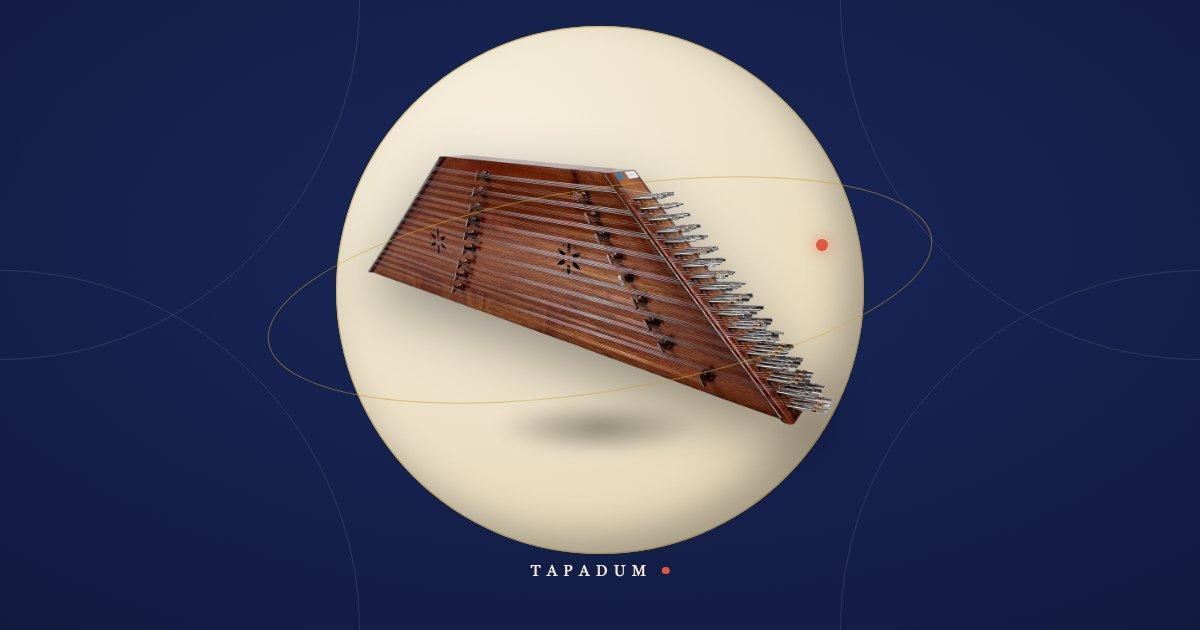
- Several keys or styles in one set: a lever santur keeps the Persian layout but adds a row of mandal levers. Each lever raises its course by a half-step at a touch. We build them in our Izmir strings workshop in nine-bridge and twelve-bridge versions. You can hear the levers change the scale on Tapadum’s YouTube channel.
- Hindustani raga music: you need the Indian santoor, which we do not carry.
- Western folk and dance music: a Western hammered dulcimer is the instrument for that repertoire. We do not build or stock one, but our set of hammer dulcimer and santur sticks is made for both instruments.
Frequently Asked Questions
Is a santoor the same as a santur?
The words are two spellings of the same Persian-derived name, but they usually describe two instruments. The Persian santur has 72 strings on 18 small bridges and plays Persian classical music. The Indian santoor, as Shivkumar Sharma played it, has 31 bridges and more than 90 strings. It rests on the lap and plays Hindustani raga music.
Is the santur a hammered dulcimer?
Yes. The santur belongs to the hammered dulcimer, or struck zither, family, which is why it is often called the Persian hammered dulcimer. It differs from the Western dulcimer in layout. Each santur course has its own movable bridge. The Western instrument uses two long bridges and splits its treble strings into notes a fifth apart.
How many strings does a santur have?
A standard Persian santur has 72 strings in 18 courses of four, carried on two rows of nine bridges. The Indian santoor usually has more, about 90 to 100 or more. Across the whole family, Britannica gives a range of about 72 to more than 100 strings.
Is a hammered dulcimer the same as an Appalachian dulcimer?
No. The hammered dulcimer has one string or course for each note and is struck with hammers. The Appalachian, or mountain, dulcimer is plucked, and its player shortens the strings on a fretted fingerboard to change pitch. The two share a name but differ in form, sound, history and technique.
Can I use hammered dulcimer sticks on a Persian santur?
Physically, yes: they strike the strings without harm. Persian technique, however, is built on the ringed mezrab and its wrist-driven rebound. Fast tremolo passages are harder to play cleanly with a pinched stick. For Persian classical repertoire, learn on a proper mezrab from the start.
Three instruments, one family, three ways of thinking about strings and bridges. If the Persian santur is the one for you, start with our complete santur guide, then browse the santur collection.